The Atomic Bomb and the Dawn of the Nuclear Age
Chain Reaction Physics
The Atom's Energy Debt
At the heart of every atom, protons and neutrons are bound together in the nucleus by the strong nuclear force. If you were to weigh a nucleus and then weigh all of its individual protons and neutrons separately, you'd find something odd. The whole nucleus weighs less than the sum of its parts.
This missing mass is called the 'mass defect'. It's not truly gone; it was converted into energy when the nucleus formed. This is the nuclear binding energy, the energy that holds the nucleus together. The relationship between this missing mass and the energy it represents is described by one of the most famous equations in physics.
Think of it like an energy debt. To break a nucleus apart into its constituent protons and neutrons, you'd have to 'repay' this binding energy. Conversely, when light nuclei fuse or heavy nuclei split, they can rearrange into more stable configurations with a larger mass defect. This difference in mass is released as energy.
Different elements have different binding energies per nucleon (a proton or neutron). Iron-56 sits at the peak of this stability curve. Elements lighter than iron can release energy by fusing together, while elements heavier than iron can release energy by splitting apart.
Fission and the Chain Reaction
Nuclear fission is the process of splitting a heavy atomic nucleus, such as uranium, into two or more smaller nuclei. This process doesn't happen spontaneously for most elements. It needs a trigger, usually a stray neutron.
When a neutron with the right amount of energy strikes a fissile nucleus like uranium-235, the nucleus absorbs it. This makes the nucleus highly unstable, causing it to wobble and then split violently. The split results in two smaller nuclei (fission fragments), a burst of gamma radiation, and, crucially, two or three new neutrons. These newly released neutrons can then go on to strike other uranium-235 nuclei, creating a self-sustaining chain reaction.
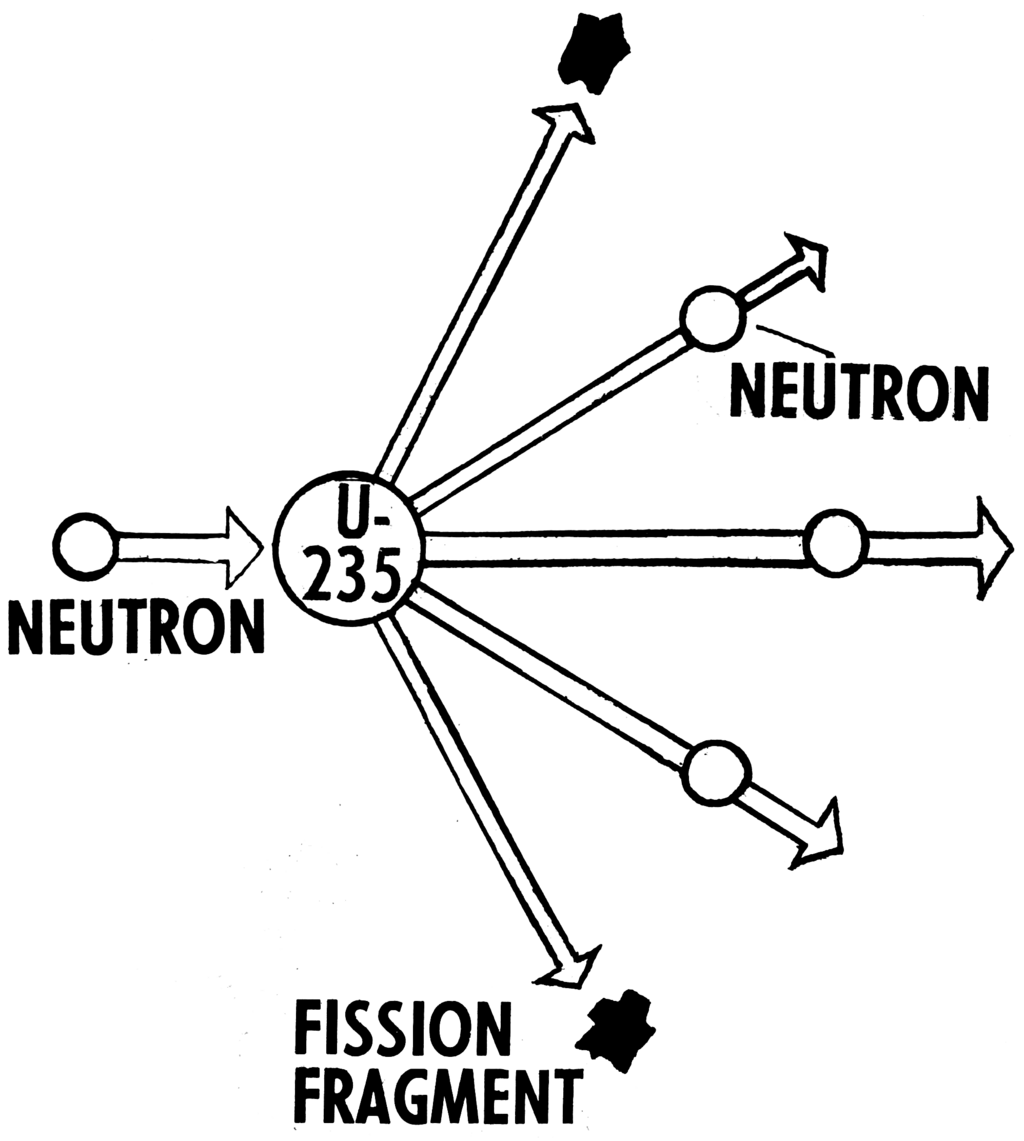
The key to a chain reaction is that each fission event must produce, on average, at least one more neutron that goes on to cause another fission event.
Not all heavy isotopes are good for this. The most common isotope of uranium, U-238, makes up over 99% of natural uranium. When it absorbs a neutron, it typically doesn't fission. Instead, it transmutes into plutonium-239 after a couple of beta decays. Uranium-235, however, fissions readily when struck by a neutron. This is why uranium must be 'enriched'—the concentration of U-235 must be increased—to be useful in a weapon or most reactors.
Plutonium-239 is another excellent fissile material. It's not found in nature but is created inside nuclear reactors from U-238. It has the advantage of releasing more neutrons per fission event than U-235, making a chain reaction easier to sustain.
Achieving Criticality
A lump of fissile material won't necessarily explode. For a chain reaction to become self-sustaining, the rate of neutron production from fission must equal or exceed the rate of neutron loss. Neutrons can be lost by escaping from the surface of the material or by being absorbed by non-fissile impurities. When production balances loss, the mass is said to be 'critical'.
Critical mass is the minimum amount of fissile material needed to achieve a self-sustaining chain reaction. Several factors influence this value:
| Factor | Effect on Critical Mass |
|---|---|
| Geometry | A sphere has the smallest surface-area-to-volume ratio, minimising neutron leakage. The critical mass is lowest for a sphere. |
| Density | Compressing the material increases the probability that a neutron will hit a nucleus before escaping. Higher density means a lower critical mass. |
| Purity | Impurities can absorb neutrons without causing fission, 'poisoning' the reaction. Higher purity of U-235 or Pu-239 leads to a lower critical mass. |
| Reflector | Surrounding the fissile material with a dense material called a tamper (or reflector) can bounce escaping neutrons back into the core, improving neutron economy and lowering the critical mass. |
Tamper
noun
A dense material (like uranium-238 or tungsten) placed around fissile material. It reflects neutrons back into the core and its inertia helps hold the core together for a fraction of a second longer, allowing more fission events to occur.
In a nuclear weapon, the goal is not just to be critical, but 'supercritical'. This is a state where neutron production far exceeds neutron loss, causing the number of fission events to multiply exponentially in a fraction of a second. This runaway chain reaction releases a tremendous amount of energy before the device blows itself apart.
To achieve this, weapons use conventional explosives to rapidly assemble a subcritical mass into a supercritical one. This can be done by either slamming two subcritical pieces together (a 'gun-type' device) or by crushing a subcritical sphere into a much denser state (an 'implosion' device).
What is the 'mass defect' of an atomic nucleus?
According to the text, which element sits at the peak of the binding energy per nucleon curve, representing a highly stable nucleus?
Understanding the physics of a chain reaction reveals how manipulating the properties of matter at the atomic level can unleash extraordinary power.