The Art of Acting and the Science of Math
Introduction to Acting Techniques
The Actor's Toolkit
Acting is more than just pretending. It’s a craft, built on techniques developed over centuries. For a long time, stage acting was grand and presentational, with actors delivering lines to the audience in a stylized way. But in the late 19th and early 20th centuries, a shift began toward realism. The goal was no longer just to recite lines beautifully, but to create believable, living characters on stage.
This movement was spearheaded by Russian actor and director Konstantin Stanislavski. He developed a systematic approach to help actors create truthful performances. His work became the foundation for most of the acting techniques used today.
The Stanislavski System
Stanislavski wanted to move beyond external gestures and find an internal source for acting. He asked actors to answer a fundamental question: "What would I do if I were in this character's situation?" This is the famous "magic if."
Instead of faking an emotion, the actor finds a personal truth to connect with the character's experience. This involves analyzing the script's "given circumstances"—the who, what, where, when, and why of the scene. From there, the actor identifies the character's objective, or what they are trying to achieve.
By focusing on the character's objective and asking "what if," the actor's actions become purposeful and their emotions emerge naturally from those actions.
Stanislavski’s ideas were revolutionary and spread to America, where they were taught and interpreted by a new generation of teachers. This led to several distinct, yet related, acting techniques.
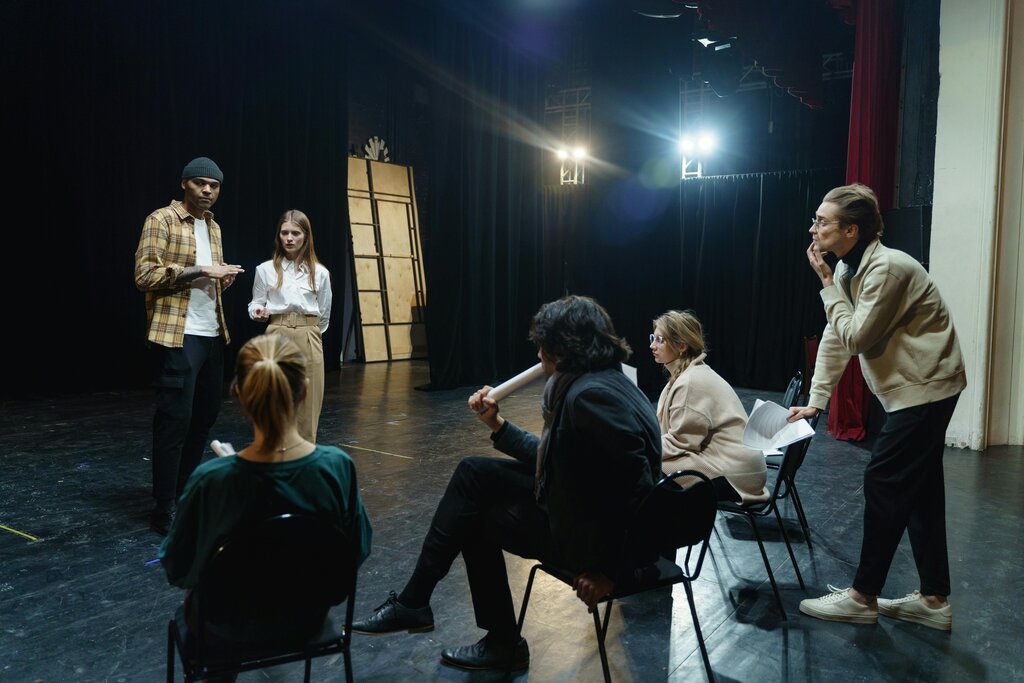
Branches of the Method
Stanislavski's work was so influential that it's often just called "The Method." However, his students emphasized different parts of his system, creating their own schools of thought.
Stella Adler famously broke with other teachers over the concept of emotional recall. She believed that dredging up painful past memories to fuel a performance was unhealthy and limiting.
Adler championed the power of imagination. She taught that actors could create the necessary emotional depth by thoroughly researching the script's world and using their imagination to build the character's reality. For Adler, the text was the primary source, and the actor’s job was to bring its circumstances to life through creative and intellectual work, not personal trauma.
Another prominent teacher, Sanford Meisner, took a different path. He believed the key to truthful acting was not in memory or imagination, but in the present moment. His technique is designed to get actors out of their heads and connect authentically with their scene partners.
repetition
noun
A foundational Meisner exercise where two actors repeat a phrase back and forth, allowing their responses to be influenced purely by their partner's behavior, not intellect or pre-planned emotion.
The goal of the Meisner technique is to achieve what he called "living truthfully under imaginary circumstances." The focus is less on internal work and more on external reaction. By listening and responding spontaneously, the actor's performance becomes organic and alive.
A Practical Approach
Later, playwright David Mamet and actor William H. Macy developed a technique called Practical Aesthetics. Born out of a series of workshops, this method offers a straightforward, action-based approach to acting. It strips away the focus on an actor's personal feelings entirely.
Practical Aesthetics argues that an actor's job is simple: figure out what the character wants in a scene and then go after it. The work is broken down into a four-step script analysis.
| Step | The Question Actors Ask |
|---|---|
| 1. The Literal | What is literally happening in the scene? |
| 2. The Want | What does my character want the other character to do? |
| 3. The Essential Action | What is my character doing to get what they want? (Expressed as an active verb, like 'to persuade a friend.') |
| 4. The 'As If' | What is this scene like for me personally? (This connects the actor's will to the character's action.) |
This technique provides actors with a clear, repeatable process. The focus is on playing a physical action, not an emotion. The theory is that if you commit to the action, the necessary emotions will follow as a byproduct.
Ready to see what you've learned about these foundational acting methods?
Konstantin Stanislavski's 'magic if' asks an actor to consider which fundamental question?
Which acting teacher emphasized the power of imagination and script analysis over drawing from an actor's personal, emotional memories?
These techniques—from Stanislavski's internal truth to Meisner's moment-to-moment reality—provide a roadmap for actors. They are tools, not rigid rules, designed to help performers build believable and compelling characters.