The Art and Science of Locksmithing
Cylinder Mechanics and Physics
The Physics of the Shear Line
You already know the basic principle of a pin-tumbler lock: align the breaks between key pins and driver pins along a single plane, the shear line. With a standard lock, this is a relatively straightforward mechanical challenge. But in high-security cylinders, the game changes. It becomes a battle of microns.
The security of a cylinder is directly proportional to its manufacturing tolerances. We're not talking about millimeters; we're talking about precision down to a few ten-thousandths of an inch. When a driver pin is pushed up by a key pin, it must clear the shear line perfectly. If it's too low, the core won't turn. If it's too high, the key pin crosses the shear line, also preventing rotation.
This precision is what makes a high-quality lock feel 'smooth'. But it also creates the very vulnerabilities that lock picking exploits. The slight imperfections and the natural binding order of the pins are what a picker feels for. In a high-security lock, these tolerances are so tight that the feedback is minimized, forcing a picker to work with near-imperceptible cues.
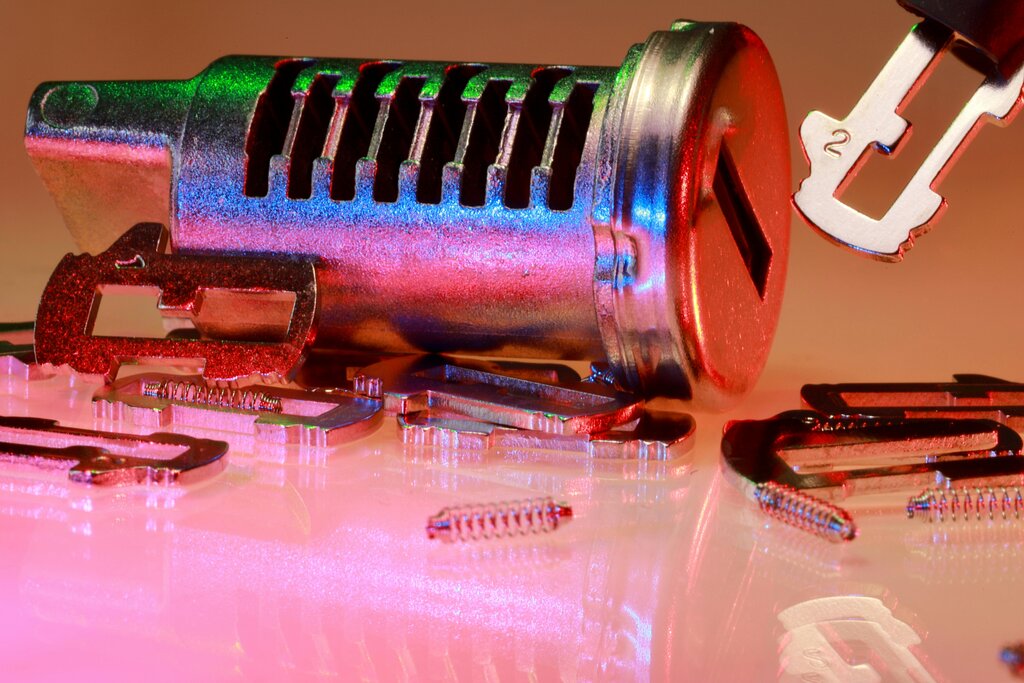
Deception Through Geometry
Standard driver pins are simple cylinders. They provide clean, predictable feedback when manipulated. High-security locks replace them with pins designed to lie. These 'security pins' use specific shapes to trick a lock picker by mimicking the feeling of a successfully set pin.
When a picker applies tension to the core and begins lifting the pins, they're listening and feeling for a subtle 'click' as the top of the key pin reaches the shear line. Security pins are designed to provide misleading clicks and physical feedback. The three most common types are spool, serrated, and mushroom pins.
- Spool pins have a narrow waist. As the spool pin is lifted, its wider top edge passes the shear line, but the tension on the core immediately causes the narrow waist to get caught on the edge. To lift the pin further, the picker must slightly release tension, which causes the core to rotate backward. This is a dead giveaway that a security pin is in play. It feels like progress is being lost.
- Serrated pins have multiple small grooves along their sides. As a picker lifts a serrated pin, each groove catches the shear line, creating a series of clicks. This makes it extremely difficult to distinguish the true 'set' click from the false ones.
- Mushroom pins have a flared bottom that gets caught below the shear line, forcing the pin to tilt. This binding feels very similar to a spool pin and can also induce counter-rotation.
This whole process creates what's known as a 'false set'—a state where the core has turned slightly, making the picker believe the lock is nearly open when, in reality, they've only engaged a security feature.
Strategic Defenses
Beyond the pins themselves, high-security locks employ other physical defenses to prevent manipulation. Two of the most important are the keyway's geometry and the materials used in the cylinder's construction.
A is one where the internal ridges, or 'wards', extend past the central axis of the keyhole. This creates a winding, snake-like path instead of a straight shot to the pins. From a physics standpoint, this design severely limits the leverage and angle of any tool inserted into the lock. It's difficult to maneuver a pick and a tension wrench simultaneously in such a cramped and contorted space, making it harder to apply precise, isolated force to each pin.
Finally, brute force is always an option for attackers. To counter drilling, manufacturers embed hardened steel components within the cylinder. These can be pins, discs, or ball bearings placed at strategic points in front of the shear line or protecting the mounting screws.
When a drill bit encounters this hardened steel, it can't get a purchase and will often skate off or simply dull and burn out. This forces an attacker to use specialized—and much slower—carbide or diamond-tipped bits, dramatically increasing the time and noise required for a destructive entry.
Understanding these physical principles—precision tolerance, deceptive geometry, and material reinforcement—is the key to moving beyond simply fixing locks to truly engineering security.
What is the primary effect of very tight manufacturing tolerances in a high-security lock from a lock picker's perspective?
While picking a lock, you feel the core suddenly rotate backward slightly as you lift a pin. This phenomenon, known as counter-rotation, is a tell-tale sign of which type of security pin?