The Architecture of Combat
Striking Dynamics
Where Power Comes From
Every powerful strike, whether a boxer's hook or a karateka's reverse punch, begins from the ground up. This transfer of energy is called the kinetic chain—a sequence of movements starting with your feet pushing against the floor, traveling up through your legs, hips, and torso, and finally being unleashed through a limb. Think of it like cracking a whip. The handle moves just a little, but that energy multiplies as it races to the tip, creating a sharp crack.
Different striking arts are essentially different architectural blueprints for channeling this energy. They don't invent new physics; they just optimize the kinetic chain for different goals. A style's stance, footwork, and core philosophy all dictate how that whip-crack of power is generated and delivered.
Rotation vs. Commitment
Western boxing is a masterclass in rotational power. A boxer's stance is mobile, designed for quick entries and exits. Power for a punch like a right cross starts with the back foot pivoting. This drives the hip to rotate explosively, which then whips the torso and shoulder forward, propelling the fist towards its target. The power is sharp, fast, and snaps back, allowing the boxer to quickly return to a defensive posture.
Muay Thai takes a different approach. Known as the "Art of Eight Limbs," it uses fists, elbows, knees, and shins. Generating power for a roundhouse kick, for example, isn't just about rotation; it's about total body commitment. A Muay Thai fighter throws their entire body weight into the strike, turning their hip over completely and swinging their leg like a baseball bat. There is little concern for snapping the leg back quickly. The goal is to transfer as much mass as possible into the target.
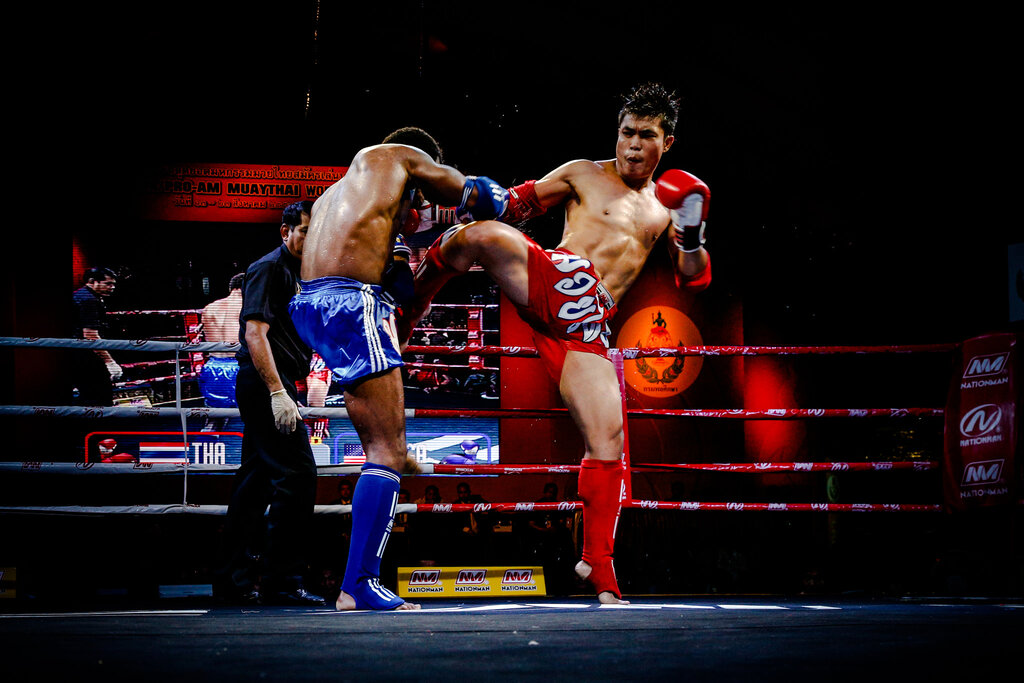
This creates a fundamental trade-off. The boxer's snapping punch is faster and allows for a quicker defensive recovery. The Muay Thai kick is slower to launch and leaves the fighter more exposed if it misses, but it delivers devastating power upon impact. One system prioritizes speed and volume, the other, singular, crushing force.
The Karate Compromise
Karate strikes a balance between these two extremes. Its power generation relies on both hip rotation and linear drive, but with a unique emphasis on kime, or focus. The idea is to concentrate all the body's energy into the instant of impact, followed by a rapid retraction. This creates a powerful, penetrating strike without the full-body commitment of a Muay Thai kick.
This philosophy is deeply tied to Karate's strategic foundation: controlling distance. The concept of (engaging distance) is paramount. A karateka aims to stay just outside the opponent's reach, dart in to deliver a decisive blow, and then immediately retreat to safety. This tactical approach has historical roots in , the predecessor to modern Karate. As a civilian self-defense system on an island that had banned weapons, its techniques were developed for life-or-death encounters, often against armed opponents. The goal was to end the fight with a single, disabling strike, not to engage in a prolonged exchange.
This leads to another trade-off. Karate's deep, stable stances, like the horse stance (kiba-dachi), are excellent platforms for generating immense power for a single technique. However, they sacrifice the fluid mobility of a boxer's footwork. The structure is built for decisive, in-and-out attacks rather than continuous, close-range pressure.
The typical Karate and Taekwondo snap-like kick is based heavily on rapid knee extension, while Muay Thai uses a technique that places greater emphasise on COM [Center of Mass] movements to develop high impact forces.
The Eight Limbs Advantage
The 'Eight Limbs' philosophy fundamentally alters the architecture of a fight. While boxing operates at punching range and traditional karate excels at long range, Muay Thai thrives in the gaps. The introduction of elbows and knees as primary weapons makes close-range combat incredibly dangerous.
This is best seen in the (clinch). Rather than breaking away when fighters get close, a Muay Thai practitioner will seek to control the opponent's head and posture. From this position, they can deliver powerful knees to the body and head or create space for devastating elbow strikes. The clinch neutralizes a boxer's primary weapons and forces a karateka out of their preferred fighting distance.
Each system is a highly specialized solution to the problem of combat. Their architectural differences aren't flaws; they are intentional trade-offs designed to maximize effectiveness within their own strategic framework.
Time to test your understanding of these different striking architectures.
What is the term for the sequence of movements that transfers energy from the ground up through the body to be unleashed in a strike?
Which striking art's philosophy is best described as prioritizing speed, volume of strikes, and a quick return to a defensive posture?
Understanding these mechanical and strategic differences is key to appreciating why fighters move the way they do. It’s not just about throwing a punch or a kick; it’s about the entire system built around that single movement.