The AI-Ready Manager
Understanding AI in Management
What Is AI Anyway?
Artificial Intelligence, or AI, is about creating systems that can perform tasks that normally require human intelligence. This includes things like learning from experience, understanding language, recognizing patterns, and making decisions. Think of it less like a robot from a movie and more like a smart assistant that can analyze huge amounts of information and automate repetitive tasks.
Artificial Intelligence
noun
A field of computer science dedicated to creating machines and software that can reason, learn, and act autonomously.
At its core, AI allows machines to learn from data and improve over time without being explicitly programmed for every single task. This capability is what makes it so powerful for businesses.
Types of AI
AI isn't a single thing; it exists on a spectrum of capability. The most common way to categorize AI is by its level of intelligence, from systems that are highly specialized to those that could, in theory, match human intellect.
| Type | Description | Example |
|---|---|---|
| Artificial Narrow Intelligence (ANI) | Specializes in one specific task. This is the only type of AI we have successfully created so far. | A chatbot for customer service, a spam filter for your email, or a recommendation engine on a shopping website. |
| Artificial General Intelligence (AGI) | Has the ability to understand, learn, and apply knowledge across a wide range of tasks at a human level. | A hypothetical AI that could write a novel, compose music, and debate philosophy with the same proficiency as a person. |
| Artificial Superintelligence (ASI) | An intellect that is much smarter than the best human brains in practically every field. | A theoretical AI that could solve major world problems like disease and climate change in ways we can't currently imagine. |
For now, all the AI you interact with in a business context is Narrow AI. It's designed for a specific purpose, like managing inventory or analyzing sales data. It's also helpful to see where AI fits within related fields like Machine Learning and Deep Learning.
How AI Changes Business Operations
AI is fundamentally changing how businesses operate by introducing new levels of efficiency and insight. It can automate routine, time-consuming tasks, freeing up employees to focus on more strategic work. For example, AI can handle data entry, schedule meetings, or even provide initial drafts of reports.
Beyond automation, AI excels at analyzing vast datasets to uncover patterns and trends that would be impossible for a human to spot. This leads to more informed decision-making, from forecasting market demand to identifying potential risks in a project. By processing information faster and more accurately, AI helps make operations smoother and more responsive.
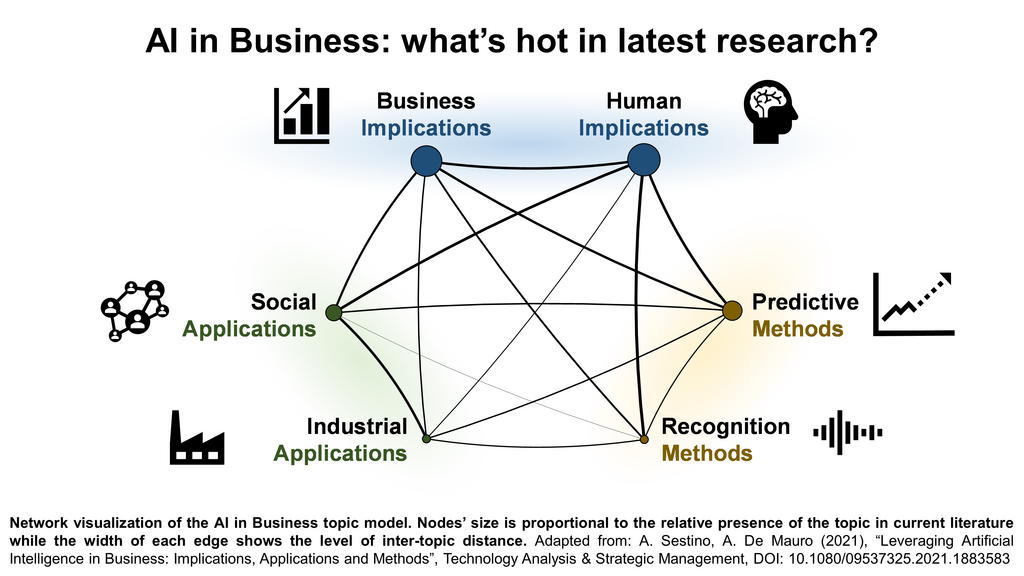
As a manager, integrating AI can transform how you lead your team. Instead of spending hours compiling performance metrics, you can use an AI tool to generate a dashboard in seconds. This gives you more time for coaching, strategy, and creative problem-solving.
The main benefit of AI in management is augmentation, not replacement. It equips leaders with better tools to make smarter decisions and lead more effectively.
Navigating the Challenges
Adopting AI isn't without its hurdles. One of the biggest challenges is the initial investment. Developing or implementing AI solutions can require significant resources, both in terms of money and time. There's also the technical complexity; integrating new AI systems with existing company software can be a major project.
Another challenge is the skills gap. Your team may not have the expertise needed to work with AI tools effectively. This means you'll need to invest in training and development to get everyone up to speed. Finally, there can be resistance from employees who may be worried about AI replacing their jobs. As a manager, it’s crucial to communicate clearly about how AI will be used to support the team, not supplant it.
Understanding these potential benefits and challenges is the first step for any manager looking to bring AI into their workflow. It sets the foundation for a thoughtful and strategic approach to this powerful technology.
Which statement best defines the core concept of Artificial Intelligence (AI)?
The type of AI currently used in business contexts, which is designed for a specific purpose like analyzing sales data, is known as...