The AI-First Enterprise
Introduction to AI-First Enterprises
What Is an AI-First Company?
An AI-First enterprise doesn't just use artificial intelligence as a tool; it places AI at the very core of its strategy and operations. Think of it less like a company that has an IT department and more like a business where machine intelligence drives every major function, from product development to customer service.
In these organizations, AI is not an afterthought or a feature added to an existing product. Instead, the business is built from the ground up to leverage AI's ability to learn, predict, and automate. The goal is to create systems that improve on their own, scaling faster and more effectively than human teams ever could.
Rather than treating AI as a technology initiative, these principles guide leaders in approaching AI adoption as a comprehensive organizational transformation that requires strategic vision, systematic execution, and sustained commitment to achieve meaningful business impact.
Data-Driven vs. AI-First
Many companies today are data-driven. They collect vast amounts of data, analyze it to find trends, and create reports that help managers make better decisions. This is a powerful, human-centric model where data informs human judgment. A sales director might look at a dashboard of quarterly performance and decide to shift focus to a new region.
An AI-First company takes this a step further. Data is not just for reports; it's the fuel for automated systems that make decisions in real time. Instead of a human analyzing sales data, an AI model might automatically adjust marketing spend across thousands of ads, optimize supply chain logistics, and personalize the user's experience—all without direct human intervention for each decision.
| Characteristic | Data-Driven | AI-First |
|---|---|---|
| Primary Goal | Inform human decisions | Automate and augment decisions |
| Data's Role | Input for analysis and reports | Fuel for predictive models |
| Decision Speed | As fast as humans can analyze | Real-time, continuous |
| Workflow | Humans analyze data, then act | AI models analyze, act, and learn |
| Scalability | Limited by human capacity | Nearly limitless, scales with data |
Redefining Business Operations
The shift to an AI-First model fundamentally changes how a business operates. Efficiency is no longer just about optimizing existing workflows; it's about creating new, automated ones that were previously impossible. AI can handle complex logistical challenges, manage inventory, and even respond to customer support queries, freeing up human employees to focus on creative and strategic tasks.
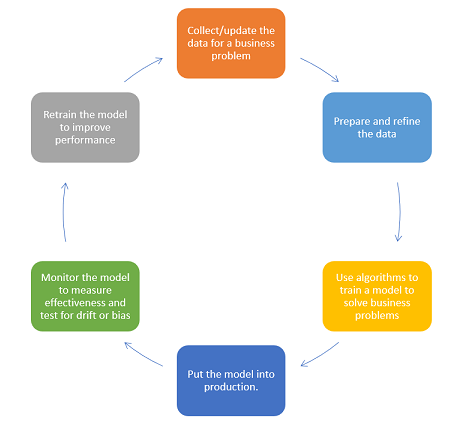
Decision-making also becomes faster and more predictive. Companies can anticipate customer needs before they arise or identify potential market shifts before they become trends. For example, Netflix doesn't just recommend movies based on what you've watched; its AI models influence which shows get produced in the first place, based on predictive analysis of audience preferences.
Amazon uses AI to optimize the routes of its delivery trucks in real time, accounting for traffic, weather, and delivery density. This is a classic AI-First strategy: turning a complex operational problem into an automated, self-optimizing system.
For these reasons, transitioning to an AI-First model is becoming a necessity. In a competitive market, the ability to operate with greater speed, intelligence, and scalability provides a decisive advantage. Companies that stick to older models risk being outpaced by competitors who have fully embraced AI at their core.
Ready to check your understanding of these core concepts?
What is the primary characteristic of an AI-First enterprise?
How does a 'data-driven' company primarily use data compared to an 'AI-First' company?
Building a company around artificial intelligence is no longer a futuristic concept; it's a strategic imperative for businesses aiming to lead in their industries.