The Adult Film Industry in Los Angeles
Origins and Early Development
Hollywood's Shadow Industry
In the early 20th century, Los Angeles was a city buzzing with explosive growth. People flocked to Southern California, drawn by the sunshine and the promise of the burgeoning motion picture industry. While major studios were building the “Dream Factory” that would captivate the world, a different kind of filmmaking was quietly taking root in its shadow.
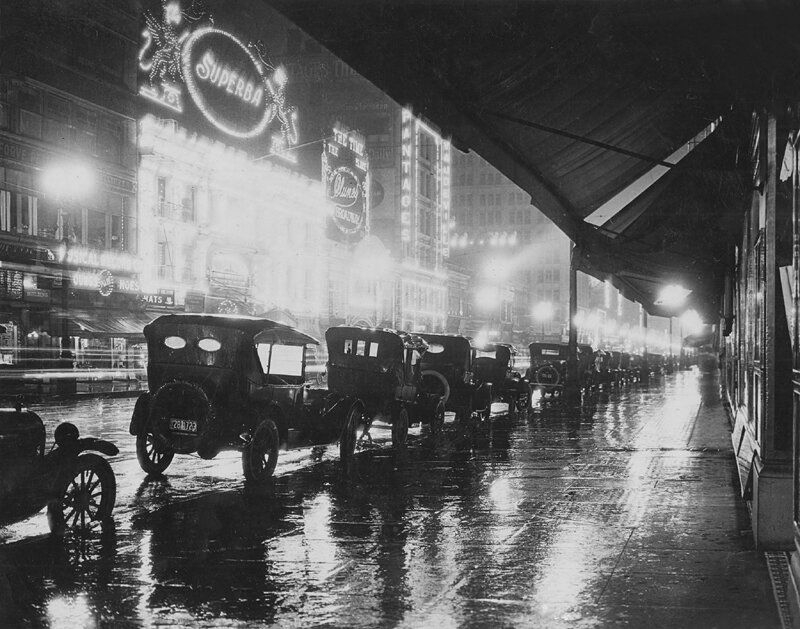
The early decades of the 20th century saw a massive population boom in Los Angeles and the surrounding areas in the Golden Age of Hollywood.
This parallel industry operated far from the glamorous movie palaces. Its products were known as “stag films” or “smokers.” These were short, silent, black-and-white films, typically running about 10 minutes. Lacking sound and plot, they were simple, direct, and intended for an exclusively male audience. They were never shown in public theaters. Instead, they were screened in private settings like fraternity houses, men's clubs, and brothels.
Pioneers and Theaters
The producers of these early films were not studio moguls. They were independent operators, often working with shoestring budgets and borrowed equipment. They took advantage of the filmmaking infrastructure that Hollywood provided—skilled camera operators, film processing labs, and a pool of aspiring actors willing to work outside the mainstream system. An entire underground network existed to produce and distribute these movies across the country.
As demand grew, so did the need for viewing spaces. The first adult theaters began to appear, though they were a far cry from today's establishments. Often operating under the guise of “art houses” or private screening rooms, these venues were small, discreet, and constantly at risk of being shut down by the authorities. They were concentrated in areas on the fringe of respectable society, catering to a clientele that sought anonymity.
Censorship and the Law
Publicly, early 20th-century society was staunchly conservative. The mainstream film industry itself was under immense pressure to be wholesome, leading to the creation of the Motion Picture Production Code, or Hays Code, in the 1930s. This code enforced strict moral guidelines on what could be shown in Hollywood films.
Naturally, the adult film industry operated in direct violation of these prevailing attitudes. From the very beginning, it was a constant cat-and-mouse game with law enforcement. The legal landscape was treacherous. Producers, distributors, and even projectionists faced arrest and prosecution under state and federal obscenity laws. These laws were often vaguely worded, giving authorities wide latitude to crack down on anything they deemed morally offensive.
A conviction could mean hefty fines and prison time. The legal risk was a constant feature of the business, forcing it to remain decentralized and secretive.
Despite the legal risks and societal disapproval, the industry survived and grew. Los Angeles, with its unique concentration of film talent and equipment, provided the perfect, if paradoxical, environment for this underground industry to develop. The seeds sown in these early, clandestine years would set the stage for the massive changes that were to come decades later.
What were the typical characteristics of the 'stag films' produced in early 20th century Los Angeles?
Where were early 'stag films' typically screened?