The Accountability Mechanism in Advanced Self Leadership
Socio-Cognitive Regulation Foundations
Agency and Environment
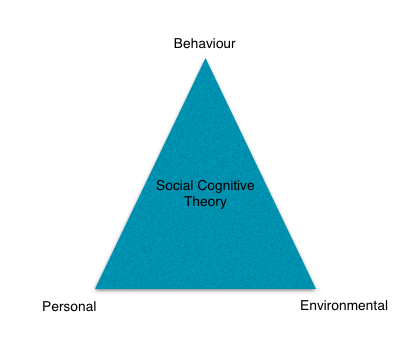
In professional self-leadership, we often focus on internal drive and personal discipline. Yet, individual action doesn't happen in a vacuum. Albert Bandura's Social-Cognitive Theory (SCT) offers a more dynamic model: Triadic Reciprocal Determinism. It posits that our actions are the result of a continuous interaction between three factors: personal cognitive factors (P), behavior (B), and the external environment (E).
This isn't a simple cause-and-effect chain. Each factor influences and is influenced by the others. A challenging work environment (E) might impact your self-belief (P), which in turn affects your performance (B). Conversely, improving a specific work habit (B) can boost your confidence (P), leading you to seek out more supportive environments (E). This is the 'agentic perspective': you are simultaneously a product of and a producer of your social systems. You have agency—the power to act intentionally.
Strategic Accountability
Human agency operates in several forms. We can exercise it directly through our own actions. However, in complex professional settings, we often rely on proxy agency—influencing others to act on our behalf to achieve a desired outcome. This isn't about delegation out of weakness; it's a strategic use of our environment to extend our own capabilities.
An accountability partner functions as a sophisticated form of proxy agency. By engaging a partner, you are intentionally manipulating an environmental factor (E) to regulate your own behavior (B) and reinforce your cognitive commitments (P). The partner isn't there to force compliance. Instead, they become a living part of your self-regulatory system, providing feedback, structure, and social incentive that might be difficult to generate internally, especially under pressure.
This strategic use of an external person makes accountability a powerful tool for high performers, not a crutch. It's a recognition that willpower is a finite resource and that intelligent system design—including social systems—is key to sustained success.
Self-Efficacy and Collective Performance
The success of an accountability partnership hinges on self-efficacy, or one's belief in their ability to succeed. High self-efficacy is a strong predictor of goal attainment. Individuals with a robust belief in their capabilities are more likely to seek out challenges, persevere through setbacks, and interpret feedback from an accountability partner constructively rather than defensively.
Self-efficacy is a functional self-awareness in which students reflect on their personal efficacy, thoughts, actions, the meaning of their pursuits, and make corrective adjustments if necessary (Bandura, 2006).
This principle scales from the individual to the group. Collective agency is a group’s shared belief in its power to organize and execute actions to produce given levels of attainment. In an organization, a culture of mutual accountability can elevate collective agency, leading to improved performance.
When teams hold each other responsible not as a form of policing but as a shared commitment to a common goal, they create a powerful feedback loop. Successes build collective efficacy, which in turn encourages more ambitious behaviors, reinforcing the high-performing environment. This demonstrates how individual self-regulatory strategies, when adopted culturally, can produce significant organizational outcomes.
These cognitive underpinnings are what fuel motivation and resilience. By understanding that our environment is not a fixed reality but a variable we can influence, we unlock new strategies for self-leadership. Accountability becomes a deliberate choice to build a more effective personal system.
According to Albert Bandura's theory of Triadic Reciprocal Determinism, what are the three factors that continuously interact to determine human action?
A software development team shares a strong belief that they can collectively overcome a major technical challenge. This shared belief is an example of:
Ultimately, integrating external accountability is an advanced form of self-regulation, leveraging social structures to enhance personal agency in the pursuit of complex goals.