TFF Operations in Downstream Bioprocessing
System Setup
Assembling the System
The first step in any Tangential Flow Filtration (TFF) run is physically setting up the hardware. This begins with installing the membrane cassette into its holder. Think of the cassette as the engine of the system; its correct installation is critical for performance.
Start by placing the cassette, along with its gaskets, into the holder. The gaskets ensure a tight seal between the cassette and the manifold, preventing leaks. Once positioned, the holder is compressed. This must be done evenly to a specific torque value recommended by the manufacturer. Uneven pressure or incorrect torque can lead to leaks or, worse, damage the cassette. It's like tightening the lug nuts on a car tire; you follow a specific pattern and torque to ensure a secure, even fit. All ports for the feed, retentate, and permeate streams must be perfectly aligned before you tighten anything.
With the hardware assembled, the next stage is preparing the membrane itself for use. This critical phase ensures the system is clean, functional, and ready for your product.
Preparing the Membrane
New TFF cassettes are shipped in a storage solution, typically containing glycerin or sodium hydroxide, to keep the membrane stable and prevent microbial growth. This solution must be completely flushed out before use.
The process begins with an air flush at low pressure to force out the bulk of the storage agent. Following this, the system is flushed with purified water or a buffer solution. The goal is to remove all traces of the storage agent and fully wet the membrane. Different membrane materials, such as (PES) or regenerated cellulose, have different wetting requirements. PES membranes are naturally hydrophilic and wet out quickly, while others may require a more extensive flushing protocol, sometimes including a pre-rinse with a solvent like ethanol if recommended by the manufacturer.
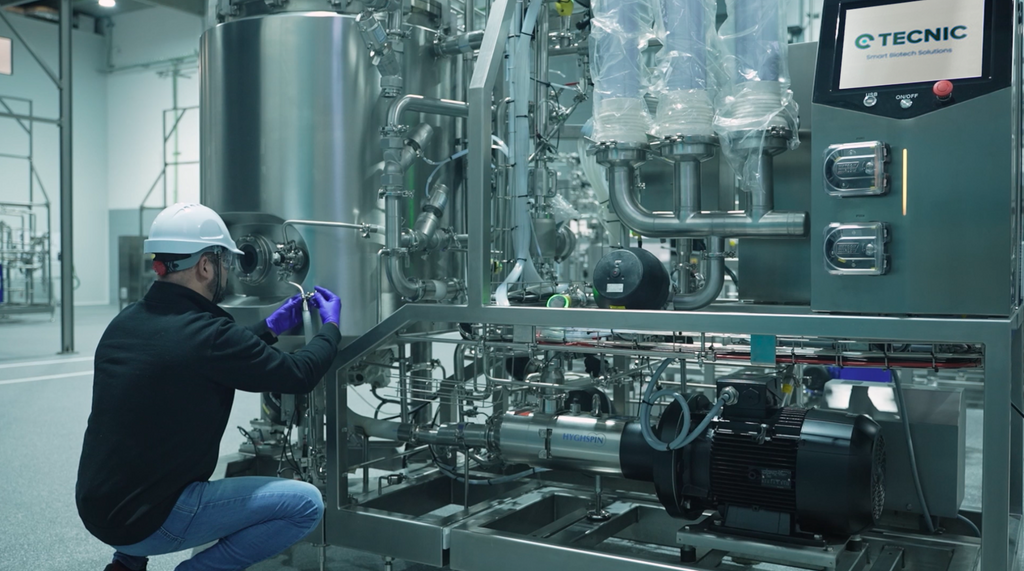
During the flush, you should visually inspect all connections for leaks. A properly assembled system should be completely sealed. Any drips or pressure drops are signs of a problem that needs to be addressed before proceeding. The flush is typically run until the conductivity of the permeate (the fluid that passes through the membrane) matches the conductivity of the water or buffer being fed into the system. This confirms that the storage solution is gone.
Verifying System Integrity
Once the system is flushed and leak-free, you must verify its integrity. This isn't just about checking for leaks; it's about confirming the membrane is performing as expected. The primary measurement here is the (NWP).
The NWP is a calculation that corrects the water flux rate for temperature, as water's viscosity changes with temperature. It provides a consistent baseline for the membrane's hydraulic performance. You'll measure the permeate flow rate at a set transmembrane pressure (TMP) and temperature, then apply a temperature correction factor.
The calculated NWP value should fall within the manufacturer's specified range for a new membrane. A value outside this range could indicate an issue with the setup, the membrane itself, or an incomplete flush. This pre-use integrity test confirms that the system is not only assembled correctly but is also performing to specification, ready for the introduction of your valuable product stream.
A successful TFF process relies on a correctly assembled, thoroughly flushed, and properly verified system. Skipping these setup steps can lead to process failure, product loss, and significant downtime.
With the setup and verification complete, the TFF system is now primed and ready for the actual filtration process.
What is the primary purpose of compressing the TFF cassette holder to a specific torque value?
A new TFF cassette must be flushed before use to remove the ______.