Textile Life Cycle Analysis
Introduction to Life Cycle Analysis
The Full Story of a Product
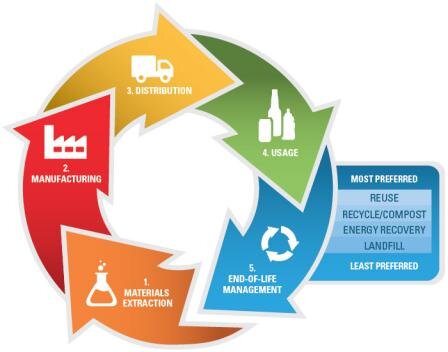
Every product has a life story. Think about a simple cotton t-shirt. Its life began as a seed in a field, which required water, soil, and energy to grow. The cotton was harvested, processed, spun into yarn, woven into fabric, dyed, and sewn into the shirt you wear. After it was made, it was packaged, shipped to a store, and eventually purchased. Its life continues with you, through every wash and wear, until it's finally discarded, recycled, or repurposed.
This entire journey, from raw material to final disposal, is its life cycle. Life Cycle Analysis, or LCA, is a method for looking at this entire story to understand its environmental impact. It’s a way to measure a product’s footprint from cradle to grave.
LCA helps us avoid solving one problem while accidentally creating another. By looking at the whole system, we can spot unintended consequences.
The idea isn't new. It began to take shape in the 1960s and 70s, spurred by concerns over limited resources and growing energy consumption. Companies started looking for a more systematic way to evaluate their products. Over time, these methods were refined and standardized, leading to the comprehensive framework we use today.
The Four Phases of an LCA
To ensure consistency and credibility, LCAs follow a structured, four-phase process. This framework is laid out in the International Organization for Standardization's ISO 14040 and 14044 standards, which provide the global benchmark for conducting an LCA.
1. Goal and Scope Definition This first phase is the blueprint for the entire study. Here, you define what you're studying and why. What is the exact product or system being analyzed? What is the purpose of the analysis—to compare two products, or to find environmental hotspots in a single product's life cycle?
You also set the boundaries of the study. Will it cover the full cradle-to-grave cycle, or just a portion, like cradle-to-gate (from raw materials to the factory exit)? Clear goals and a well-defined scope are critical for a meaningful analysis.
2. Life Cycle Inventory (LCI) This is the data-gathering phase. It involves meticulously cataloging every single input and output within the boundaries set in phase one. Inputs include all the raw materials, energy, and water used. Outputs include all the emissions to air, water, and soil, as well as waste and co-products.
Think of it as environmental accounting. For our t-shirt, this would mean quantifying the fertilizers used to grow the cotton, the electricity used to power the sewing machines, the fuel for transportation, and the wastewater from dyeing, among many other things.
3. Life Cycle Impact Assessment (LCIA) With the inventory data collected, this phase translates those raw numbers into potential environmental impacts. A long list of inputs and outputs—like kilograms of carbon dioxide or cubic meters of wastewater—is difficult to understand on its own. The LCIA groups and converts this data into a smaller number of recognizable environmental issues.
For example, emissions of CO₂, methane, and other greenhouse gases are converted into a single indicator for climate change potential (often expressed as kg CO₂ equivalent). Other common impact categories include ozone depletion, smog formation, acidification, and water use.
Carbon accounting requirements include baseline, or counterfactual specification, and full life cycle analysis (LCA) within a specified process boundary.
4. Interpretation The final phase is about making sense of it all. Here, you analyze the results from the inventory and impact assessment to draw conclusions and make recommendations that are consistent with the initial goal. This phase identifies the most significant environmental impacts—the so-called "hotspots" in the product's life cycle. It also assesses how sensitive the results are to the data and assumptions used.
The interpretation is where the real value of an LCA comes to light. The findings help designers, engineers, and policymakers make more informed decisions to reduce a product's environmental footprint.
An Iterative Process
While these four phases are presented in order, the LCA process is often iterative. The findings from the interpretation phase might reveal data gaps or a need to refine the scope, sending you back to an earlier phase. This cyclical nature ensures the final analysis is robust, thorough, and truly useful.
Understanding these fundamentals is the first step toward applying this powerful tool to create more sustainable products and systems.
What is the primary purpose of a Life Cycle Analysis (LCA)?
Which phase of an LCA is considered the 'blueprint' for the entire study, where its purpose and boundaries are defined?