Textile Engineering and Material Science
Fiber Polymer Architecture
The Molecular Blueprint
At its core, a fiber is simply a collection of very long molecules called polymers, all tangled up together. Think of a single polymer chain like a long string of paper clips. The number of paper clips in that string is called the degree of polymerization (DP). A fiber with a high DP has extremely long polymer chains, which generally translates to greater strength. Just as a long chain is harder to pull apart than a short one, long polymer chains can entangle and align more effectively, distributing stress and resisting breakage.
Order vs. Chaos
Polymer chains within a fiber can arrange themselves in two basic ways. In some areas, the chains line up in a neat, orderly, parallel fashion. These are called crystalline regions. In other areas, the chains are jumbled together in a disordered, random tangle. These are amorphous regions.
Imagine a box of uncooked spaghetti—that's a crystalline region. Now, picture a plate of cooked spaghetti—that's an amorphous region. Nearly all fibers contain a mix of both. The ratio of crystalline to amorphous regions is a huge factor in a fiber's personality. High leads to stiffness, strength, and resistance to chemicals and moisture. Amorphous regions, on the other hand, provide flexibility, elasticity, and absorbency. They create voids that allow water and dye molecules to enter the fiber.
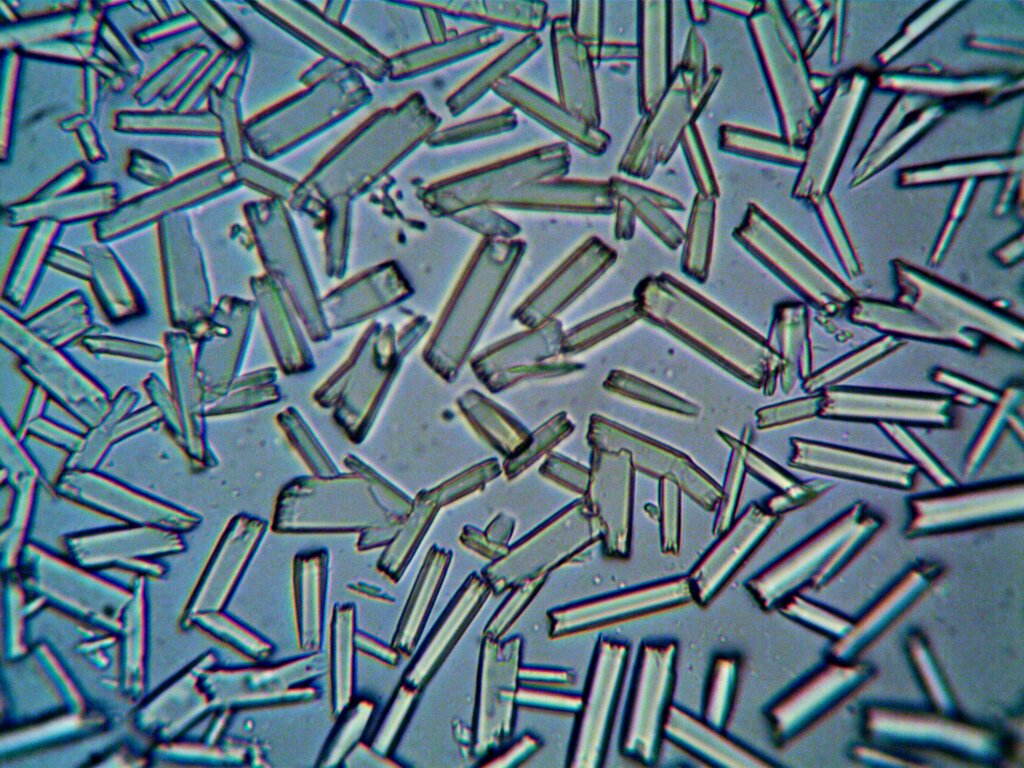
The forces holding these chains together are key. In cellulosic fibers like cotton, the polymer chains are made of glucose units. These chains are held together by a vast network of relatively weak attractions called hydrogen bonds..
While any single hydrogen bond is weak, there are millions of them in a cotton fiber. Collectively, they act like molecular Velcro, locking the cellulose chains into highly crystalline structures. This is what gives cotton its strength and crisp feel. However, these bonds can be broken by water, which is why cotton absorbs moisture so well but also weakens when wet.
Protein fibers, like wool, use a different strategy. Their polymer chains are made of amino acids and are crumpled into a coiled or folded shape. Instead of many weak hydrogen bonds, they are held together by fewer, but much stronger, chemical bonds called cross-links, often in the form of disulfide bonds between sulfur-containing amino acids.
These strong cross-links act like hinges, connecting the coiled chains. When you stretch wool, you're uncoiling the chains, but the cross-links pull them back into place once the tension is released. This gives wool its natural elasticity and wrinkle resistance. Because the chains are held apart by these cross-links, wool has a largely amorphous structure, which is why it's so good at trapping air and providing insulation.
Synthetic Structures
Synthetic polymers introduce another level of control over architecture. They are broadly classified into two types: thermoplastic and thermoset.
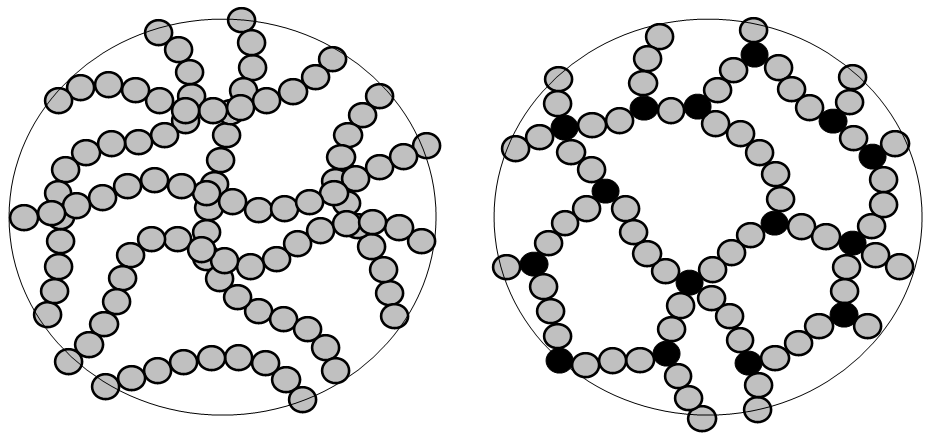
polymers consist of long, individual chains with no cross-links between them. They are held together by weaker intermolecular forces. When heated, these forces weaken, and the chains can slide past one another, allowing the material to soften and melt. This process is reversible, which means thermoplastics like polyester and nylon can be melted down and reformed, making them recyclable. During fiber manufacturing, this property is used to stretch, or "draw," the fibers, aligning the polymer chains and increasing their crystallinity and strength.
Thermoset polymers, in contrast, form strong, permanent covalent cross-links between their chains when cured with heat or a catalyst. Once these links are formed, they create a single, massive molecule in a rigid 3D network. The material cannot be melted or reshaped. While less common in apparel, thermosetting resins are used to create high-performance composite fibers like aramids (e.g., Kevlar), where absolute strength and heat resistance are critical.
Ultimately, the architecture of a fiber at the molecular level—the length of its chains, its crystalline/amorphous balance, and the nature of its bonds—determines its macro-level performance. A highly crystalline, hydrogen-bonded fiber like cotton is strong but inelastic. A cross-linked, amorphous fiber like wool is elastic and insulating. And a drawn, thermoplastic fiber like polyester can be engineered for specific levels of strength and durability.
Ready to test your knowledge of fiber structures?
What does a high Degree of Polymerization (DP) in a fiber generally indicate?
A fiber that is stiff, strong, and resistant to moisture would be expected to have a high degree of __________.
Understanding these microscopic details is the key to predicting how a fiber will behave in the real world.