Texas Hold 'em Strategy and Mechanics
Position and Flow
Position is Power
In Texas Hold 'em, your two hole cards are only a small part of the story. Where you sit at the table in relation to the dealer is often more important. This is your position, and it dictates the entire flow of the hand. Acting after your opponents gives you a massive informational advantage. You get to see them bet, check, or raise before you have to make a decision.
Position is your most powerful weapon in Texas Hold’em – players in late position win approximately 60% more hands than those in early position
The flow of action in every betting round is determined by a circular white disc known as the button or dealer button. It moves one seat to the left after each hand, ensuring everyone experiences every position.

The action always starts to the left of the button. The two players immediately to the left are forced to make bets before they even see their cards. These are the blinds. The player directly to the left posts the small blind, and the next player posts the big blind. These forced bets create the initial pot, giving everyone something to fight for.
Early, Middle, and Late
Your position is categorized based on when you act in a betting round. The seats are generally grouped into three categories: Early Position, Middle Position, and Late Position.
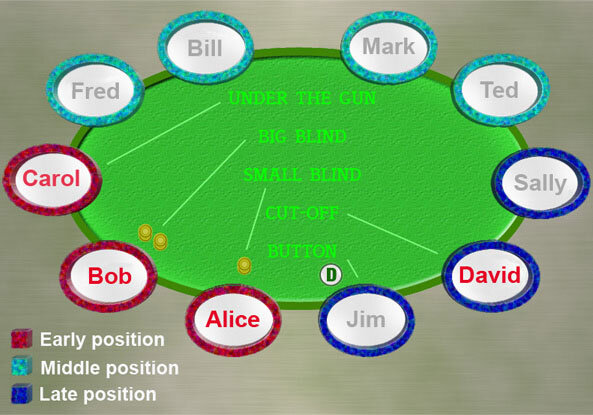
Early Position (EP): These are the first few players to act after the big blind, including the player known as "under the gun". Acting first is a huge disadvantage. You have no information about what the seven or eight players behind you will do. Because of this, you should only play a very narrow and strong range of starting hands from here.
Middle Position (MP): You're in a slightly better spot. A few players have acted before you, but several more are still to act behind you. You can start to play a slightly wider range of hands than from early position, but you still need to be cautious.
Late Position (LP): This is where the power lies. These positions, including the "cutoff" and the button itself, act last. You get to see everyone else's actions before making your own. This information allows you to play a much wider range of hands, bluff more effectively, and control the size of the pot.
| Position Category | Example Seats (10-Player Table) | Hand Selection Strategy |
|---|---|---|
| Early Position | Under the Gun (UTG), UTG+1, UTG+2 | Very Tight: Only premium pairs and top-tier Broadway cards. |
| Middle Position | MP1, MP2, Hijack | Tight: Add medium pairs, suited connectors, and strong aces. |
| Late Position | Cutoff (CO), Button (BTN) | Wide: Play many speculative hands, bluff, and apply pressure. |
The Four Streets of Betting
A hand of Texas Hold 'em unfolds over a maximum of four betting rounds, known as "streets." Your positional advantage applies to every single one.
- Pre-Flop: The first betting round begins after every player receives their two hole cards. The player to the left of the big blind (under the gun) acts first. Action proceeds clockwise.
- The Flop: After the pre-flop betting is complete, three community cards are dealt face-up in the middle of the table. The first active player to the left of the button starts the second betting round.
- The Turn: A fourth community card is dealt. Another round of betting occurs, following the same rules as the flop.
- The River: The fifth and final community card is dealt. The last betting round takes place. If more than one player remains, a showdown occurs where the best five-card hand wins the pot.
In every post-flop round (flop, turn, and river), the player in the small blind, or the first active player to their left, is always first to act. The player on the button is always last. This unchanging order is why the button is the most profitable and powerful seat in poker. You consistently gain the maximum amount of information before you commit a single chip to the pot.
Let's check your understanding of these core concepts.
Why is late position (like the button) considered the most powerful in Texas Hold 'em?
Which of these positions is considered an "Early Position"?
Mastering position is not just about memorizing seat names. It's about fundamentally changing how you think about your hand. A marginal hand like a pair of sevens is unplayable from early position but can become a powerful weapon on the button. Your cards don't change, but their value does based on where you sit.