Terraform Fundamentals
Introduction to Infrastructure as Code
Managing Infrastructure with Code
In the past, setting up servers, networks, and databases was a manual job. An IT professional would log into a machine, click through menus, and run commands one by one. This process was slow, prone to human error, and difficult to repeat perfectly every time. If you needed ten identical servers, you had to perform the same tedious steps ten times, hoping you didn't forget anything.
Modern cloud computing demands a better way. We need to deploy complex systems quickly and reliably. This is where Infrastructure as Code, or IaC, comes in.
Infrastructure as Code (IaC) is the process of managing and provisioning infrastructure—including servers, network devices, and firewalls—through machine-readable configuration files rather than manual hardware configuration.
Think of it like a recipe for your infrastructure. Instead of manually grabbing ingredients and mixing them, you write down the exact steps. This recipe can be saved, shared, and used again and again to produce the exact same result. The "recipe" is a set of configuration files, and the "kitchen" is an IaC tool that reads your files and builds the infrastructure for you.
The Benefits of IaC
Adopting IaC brings several major advantages. First is consistency. When infrastructure is defined in code, every environment you create from that code will be identical. This eliminates the problem of "configuration drift," where small, undocumented manual changes cause staging and production environments to diverge over time.
Second is repeatability. Need to spin up a temporary testing environment? Just run the script. Need to deploy to a new region for disaster recovery? Run the same script. The process is reliable and predictable, every single time.
Finally, there's automation. IaC tools automate the provisioning process, which is dramatically faster than manual setup. This speed allows development teams to move faster, deploying new features and applications without waiting for infrastructure to be built.
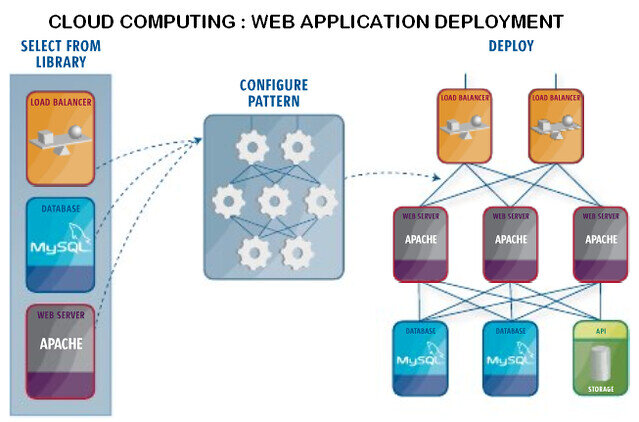
By automating infrastructure deployments, IaC eliminates the bottlenecks associated with manual processes, enabling teams to deploy software more frequently and with greater confidence.
Choosing a Tool
Several tools exist to help you implement IaC. Some are specific to a single cloud provider, while others are cloud-agnostic, meaning they can work with multiple providers. The right choice depends on your specific needs.
| Tool | Type | Key Feature |
|---|---|---|
| AWS CloudFormation | Cloud-Specific | Deeply integrated with Amazon Web Services (AWS) |
| Azure Resource Manager | Cloud-Specific | The native IaC tool for Microsoft Azure |
| Google Cloud Deployment Manager | Cloud-Specific | Manages Google Cloud Platform (GCP) resources |
| Terraform | Cloud-Agnostic | Works with AWS, Azure, GCP, and many others |
| Pulumi | Cloud-Agnostic | Lets you use general-purpose programming languages (like Python or TypeScript) |
While cloud-specific tools offer tight integration, cloud-agnostic tools like Terraform provide flexibility. This is especially useful for organizations that use multiple cloud providers or want to avoid being locked into a single vendor.
Terraform is an Infrastructure as Code (IaC) tool that allows engineers to define and provision data center infrastructure using a declarative configuration language.
Terraform uses its own human-readable language to describe the desired state of your infrastructure. You simply declare what you want, like "I need one server and one database," and Terraform figures out how to create, modify, or destroy the necessary resources to match your declaration. This approach simplifies the management of even very complex systems.
Now that you have a grasp of what IaC is and why it's so important, it's time to test your knowledge.
What is the primary concept behind Infrastructure as Code (IaC)?
Which problem, caused by small, undocumented manual changes over time, is directly solved by the consistency benefit of IaC?
Next, we'll dive into the specifics of using Terraform to build and manage your own infrastructure.