Terminal Velocity Explained
Forces and Motion
The Resistance to Change
Objects don't just start, stop, or change direction on their own. Something has to make them do it. That something is called a force. You can think of a force as a simple push or a pull.
Isaac Newton figured out some fundamental rules about how forces and motion work. His first law of motion is often called the law of inertia. It states that an object will keep doing whatever it's doing unless a force acts on it.
An object at rest stays at rest, and an object in motion stays in motion with the same speed and in the same direction unless acted upon by an unbalanced force.
Imagine a hockey puck gliding across a perfectly smooth sheet of ice. If you ignore the tiny bit of friction, it will keep sliding in a straight line at a constant speed forever. It won't stop until it hits the wall or is stopped by a hockey stick, both of which apply a force. The same puck on a rough patch of concrete will stop quickly because of the force of friction.
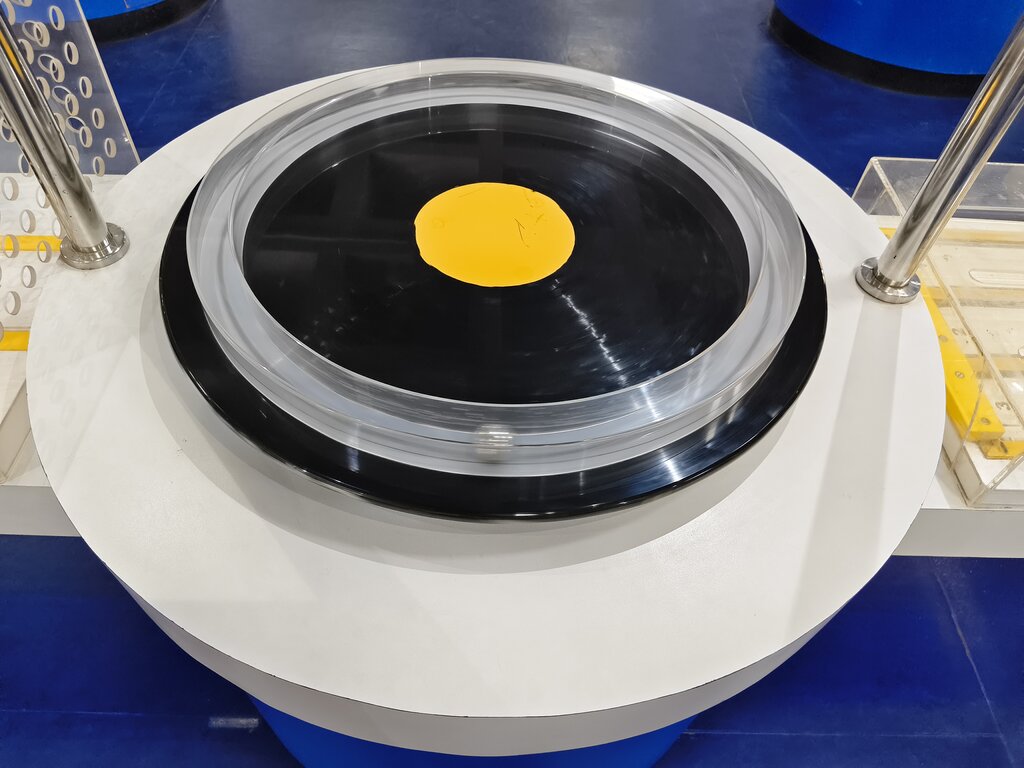
This tendency of an object to resist changes in its state of motion is called inertia. The more massive an object is, the more inertia it has. It’s much harder to get a train moving from a standstill than it is to push a bicycle.
How Force Creates Motion
So, a force can change an object's motion. But how much does it change? Newton's second law gives us the answer and connects force, mass, and acceleration in a neat little package.
Mass
noun
The amount of matter or "stuff" in an object. It's a measure of an object's inertia.
Acceleration is any change in velocity, which means speeding up, slowing down, or changing direction. The relationship is simple: the acceleration of an object is directly proportional to the net force acting on it and inversely proportional to its mass.
In plain English, if you push something, it accelerates. If you push it twice as hard, it accelerates twice as much. If you apply the same push to an object with twice the mass, it will accelerate only half as much. This is why it's easier to get an empty shopping cart up to speed than a full one.
Mass vs. Weight
People often use the terms "mass" and "weight" interchangeably, but in physics, they are very different concepts. As we just covered, mass is the amount of matter in an object. It's measured in kilograms (kg) and it's the same everywhere.
Weight, on the other hand, is a force. Specifically, it's the force of gravity pulling on an object's mass. Since weight is a force, it's calculated using Newton's second law.
Here, is weight, is mass, and is the acceleration due to gravity. On Earth, is about . If you were on the Moon, your mass would be the same, but the Moon's gravity is much weaker. Your weight would be only about one-sixth of what it is on Earth.
An astronaut's mass doesn't change in space, but they become "weightless" because they are in a state of freefall around the Earth, where the pull of gravity isn't felt as weight.
Action and Reaction
Newton's third law of motion is probably the most famous: for every action, there is an equal and opposite reaction. This means that forces always come in pairs. When you push on a wall, the wall pushes back on you with the exact same amount of force.
You might wonder, if the forces are equal and opposite, how does anything ever move? The key is that the forces act on different objects. When a rocket expels hot gas downwards (the action), the gas pushes the rocket upwards (the reaction). The force on the gas and the force on the rocket are a pair. The rocket moves because the force is acting on it.
The same principle applies when you swim. You push the water backward with your hands (action), and the water pushes you forward (reaction). Every interaction involves this two-way push or pull.
Balanced vs. Unbalanced
The concept of a net force is crucial. Often, multiple forces act on an object at once. The net force is the overall force after all the individual forces are combined.
When the forces acting on an object cancel each other out, we say they are balanced. The net force is zero, and the object's motion doesn't change. It either stays at rest or continues to move at a constant velocity, just like Newton's first law says. A book resting on a table is an example. Gravity pulls it down, and the table pushes it up with an equal force. The forces are balanced.
When the forces don't cancel out, they are unbalanced. This results in a non-zero net force, which causes the object to accelerate according to Newton's second law. If you and a friend push on a box from opposite sides with equal force, it won't move. But if your friend pushes harder, the forces become unbalanced, and the box will start to move in the direction of the stronger push.
According to Newton's First Law of Motion (the law of inertia), an object in motion will do what if no external forces act on it?
An astronaut travels from Earth to the Moon. Which of the following statements is true about their mass and weight?
These fundamental laws govern the motion of everything from planets in orbit to cars on the road. Understanding them is the first step to analyzing any kind of movement.