Tensor Algebra Essentials
Introduction to Tensors
Beyond Scalars and Vectors
In physics and math, we often start with simple concepts. A scalar is just a single number, like temperature (25°C) or mass (10 kg). A vector is a step up, representing a quantity with both magnitude and direction, like velocity (10 m/s north). We usually write a vector as a list of numbers called components.
Matrices take this a step further. They are grids of numbers, useful for things like describing transformations or systems of equations. You might think this is the end of the line, but there's a broader concept that includes all of these: the tensor.
A tensor is a mathematical object that generalizes scalars, vectors, and matrices to higher dimensions. It's a way of organizing information that can describe more complex relationships in space.
Think of it like this: A scalar is a point. A vector is a line (a list of points). A matrix is a plane (a grid of points). A tensor can be a cube or even a higher-dimensional structure of points.
Understanding Rank
The most important property of a tensor is its rank, also called its order. The rank tells you how many indices you need to identify a specific component within the tensor. This is easier to understand with examples.
| Rank | Name | Indices Needed | Example |
|---|---|---|---|
| 0 | Scalar | 0 | Temperature (T) |
| 1 | Vector | 1 (e.g., ) | Velocity () |
| 2 | Matrix | 2 (e.g., ) | Stress in a material |
| 3+ | Tensor | 3+ (e.g., ) | Piezoelectric tensor |
A rank-0 tensor is a scalar. It has no indices because it's just one number. A rank-1 tensor is a vector. You need one index to pick out a component, like the x-component () from the vector . A rank-2 tensor is a matrix. You need two indices, one for the row and one for the column, to find a specific element ( is the element in the second row, third column).
A tensor of rank 3 or higher is a multi-dimensional array of numbers. For a rank-3 tensor, you'd need three indices () to specify a single value, like locating a number in a cube of numbers.
Staying Constant
The true power of tensors is that they represent physical quantities that are independent of the coordinate system you use to measure them. This is a crucial idea. The laws of physics shouldn't change just because you decided to tilt your head or use a different set of axes.
Imagine a velocity vector. It's an arrow pointing in a specific direction with a certain length. If you rotate your coordinate system, the components of the vector (the x, y, and z values) will change. But the arrow itself—the actual physical velocity—hasn't changed at all. The tensor is the arrow, not just its numerical components in one particular coordinate system.
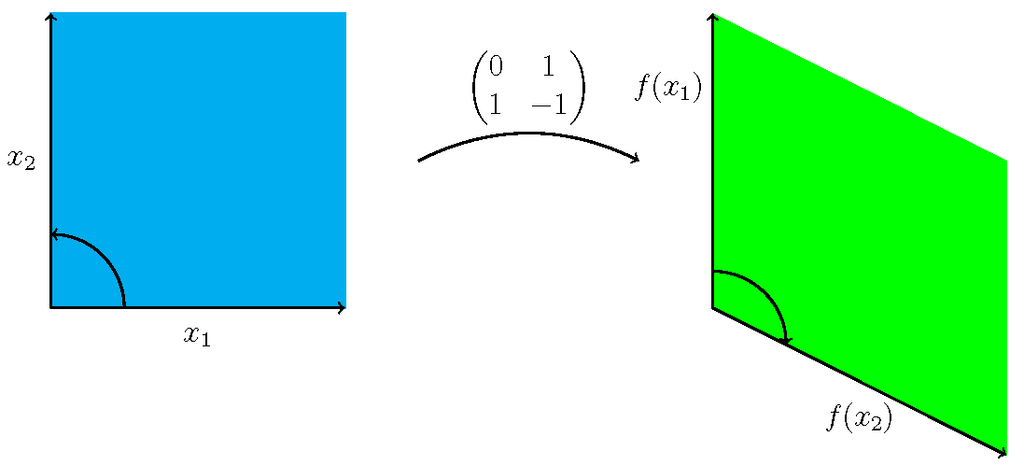
Tensors provide a mathematical framework to handle this. The rules for how tensor components transform from one coordinate system to another are precisely defined, ensuring the underlying physical quantity remains consistent.
Covariant and Contravariant
To manage these transformations, tensors use two types of indices: covariant and contravariant. This distinction explains how the components of a tensor change when the coordinate system (the basis vectors) changes.
- Contravariant components are shown with a superscript (e.g., ). They transform in the opposite way to the basis vectors.
- Covariant components are shown with a subscript (e.g., ). They transform in the same way as the basis vectors.
Why does this matter? In a simple Cartesian grid with perpendicular axes of equal length, the distinction isn't very important. But in curved spaces (like in general relativity) or with skewed coordinate systems, it's essential for keeping the physics consistent.
This might seem complicated, but the core idea is simple: tensors are a robust way to describe physical reality, no matter how we choose to look at it. They provide the language needed for many advanced fields of science and engineering.