Ten Foundational Physics Concepts
Newtonian Mechanics
Describing Motion
Before we can understand why things move, we need a clear way to describe how they move. This is the job of kinematics. It’s the language we use to talk about motion, focusing on concepts like position, velocity, and acceleration without getting into the forces that cause them.
Imagine you're driving a car. Your position is simply where you are at any given moment. Your velocity is your speed in a specific direction—say, 60 miles per hour heading north. If you press the gas, hit the brakes, or turn the wheel, your velocity changes. Any change in velocity is called acceleration.
Acceleration isn't just speeding up. Slowing down is a type of acceleration (deceleration), and so is changing direction, even if your speed stays constant.
For motion along a straight line with constant acceleration, a few key equations let us predict the future. They connect initial velocity (), final velocity (), acceleration (), time (), and displacement ().
What about more complex movements, like a ball thrown through the air? This is motion in two dimensions. The trick is to break the problem down. We treat the horizontal motion and the vertical motion as two separate, independent problems. Gravity only affects the vertical motion, while the horizontal motion (ignoring air resistance) remains constant.
Why Things Move
Kinematics tells us how objects move, but dynamics tells us why. The answer almost always involves forces. Isaac Newton laid down three fundamental laws that form the bedrock of classical mechanics.
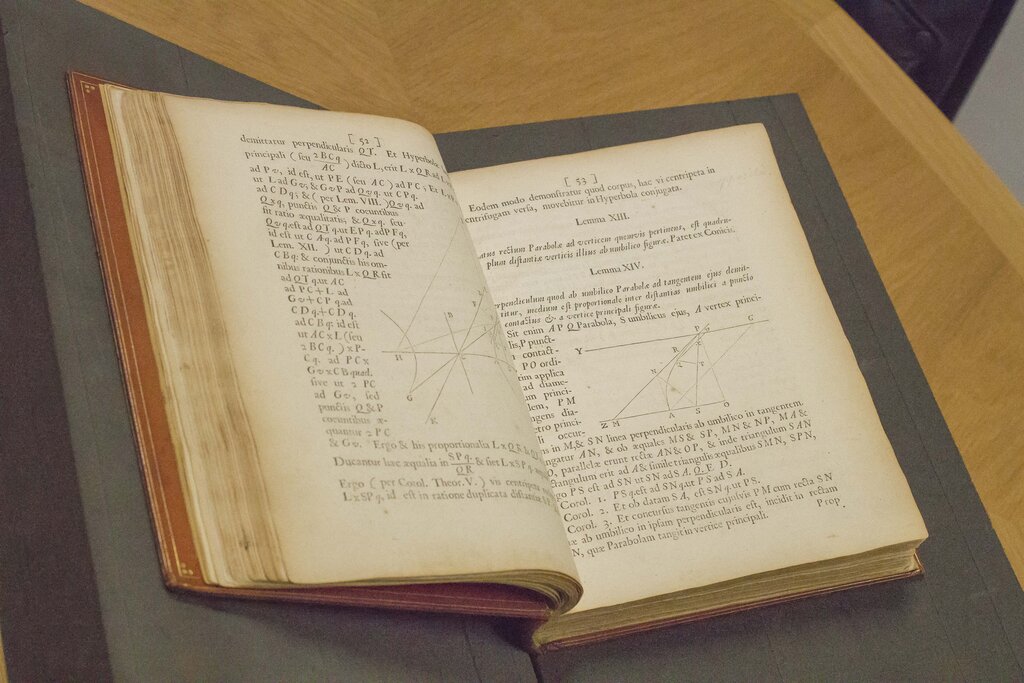
Inertia
noun
The property of matter by which it continues in its existing state of rest or uniform motion in a straight line, unless that state is changed by an external force.
Newton's First Law is the law of inertia. It states that an object at rest will stay at rest, and an object in motion will stay in motion with the same speed and in the same direction unless acted upon by an unbalanced force. It’s our natural tendency to resist changes in our state of motion.
Newton's Second Law is the most famous of the three. It gives us a way to calculate the effect of a force. The acceleration of an object is directly proportional to the net force acting on it and inversely proportional to its mass.
In simpler terms: push something, and it accelerates. Push it harder, and it accelerates more. If it’s more massive, it will accelerate less for the same push.
Newton's Third Law is often summarized as "for every action, there is an equal and opposite reaction." This means that forces always come in pairs. When you push on a wall, the wall pushes back on you with the exact same force. A rocket expels gas downwards (action), and the gas pushes the rocket upwards (reaction).
Energy and Momentum
Force and acceleration are not the only way to look at motion. We can also analyze a system using the concepts of energy and momentum. These are often called 'conserved quantities,' which makes them incredibly powerful tools.
Work is done when a force causes an object to move a certain distance. It's a transfer of energy. The rate at which work is done is called power.
Energy itself comes in many forms, but in mechanics, we often focus on two: kinetic energy (the energy of motion) and potential energy (stored energy, often due to height).
Momentum is another crucial concept, often described as 'mass in motion.' It's the product of an object's mass and its velocity. Like energy, the total momentum of a closed system is conserved. This principle of conservation of momentum is why a cannon recoils when it fires a cannonball. The forward momentum of the cannonball is perfectly balanced by the backward momentum of the cannon.
In any collision, from billiard balls striking each other to galaxies merging, the total momentum before the collision is equal to the total momentum after.
Going in Circles
What about objects that don't move in a straight line? Consider a ball being swung on a string. The ball is in circular motion. Its speed might be constant, but its velocity is always changing because its direction is always changing. And as we know, a change in velocity means there must be acceleration.
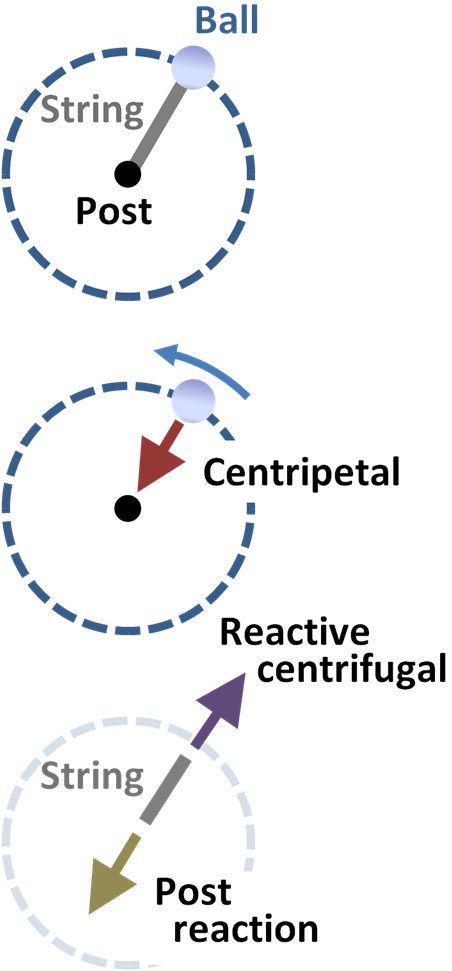
This acceleration, directed toward the center of the circle, is called centripetal acceleration. According to Newton's Second Law, if there's an acceleration, there must be a net force causing it. This inward-pointing force is the centripetal force. For the ball on a string, the tension in the string provides the centripetal force. For a planet orbiting the sun, gravity provides it. Without this constant inward force, the object would fly off in a straight line, following its inertia.
These principles, from the flight of a ball to the orbit of a planet, all fall under the umbrella of Newtonian mechanics. They provide a remarkably accurate description of the world we experience every day.
Which of Newton's Laws explains why you feel pushed back into your seat when a car suddenly accelerates forward?
A projectile is launched into the air. Ignoring air resistance, which of the following statements is true about its motion?