Temporary Geosynchronous Motion Explained
Orbital Mechanics Fundamentals
The Rules of Cosmic Motion
To understand why a satellite stays in orbit, we first need to look at the ground rules for how things move. Isaac Newton laid these out centuries ago, and they're still the foundation of mechanics. They might seem simple, but they govern everything from a thrown baseball to a planet's path.
1. The Law of Inertia: An object stays in motion with the same speed and in the same direction unless acted upon by an unbalanced force.
2. The Law of Acceleration: The acceleration of an object is directly proportional to the net force acting on it and inversely proportional to its mass ().
3. The Law of Action-Reaction: For every action, there is an equal and opposite reaction.
In short: things keep doing what they're doing unless pushed, a push causes a change in motion, and every push gets a push back. These laws explain how forces create movement. The next question is, what force keeps a satellite from flying off into space?
The Universal Pull
That force is gravity. Newton realized that the same force pulling an apple to the ground is what holds the Moon in its orbit around the Earth. He called it the law of universal gravitation. It states that every object with mass in the universe pulls on every other object with mass.
The strength of this pull depends on two things: how much mass the objects have and how far apart they are. The more massive the objects, the stronger the pull. The farther apart they are, the weaker the pull becomes. Newton captured this relationship in a single elegant equation.
Let's break that down:
- is the gravitational force.
- and are the masses of the two objects.
- is the distance between the centers of the objects.
- is the gravitational constant, a tiny number that scales the force correctly.
The in the denominator is crucial. It's an inverse-square law, meaning if you double the distance between two objects, the gravitational force between them drops to one-quarter of its original strength. This rapid weakening with distance is key to how orbits work.
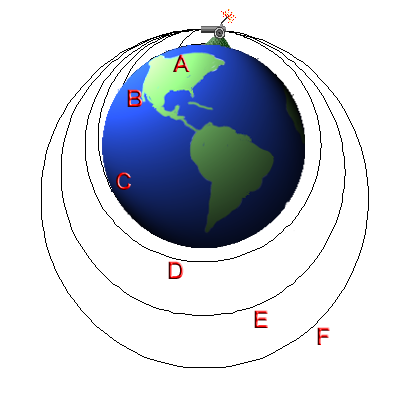
Imagine a cannon on a very tall mountain. A little gunpowder, and the cannonball lands a short distance away. More gunpowder, and it lands farther. With enough sideways speed, the cannonball travels so far that the Earth's surface curves away underneath it at the same rate it falls. It never lands. It's now in orbit, constantly falling but never getting closer to the ground.
Kepler's Cosmic Choreography
Before Newton explained why planets move the way they do, an astronomer named Johannes Kepler figured out how they move. By meticulously analyzing astronomical data, he discovered three fundamental laws of planetary motion.
First Law: The Law of Ellipses. The orbit of every planet is an ellipse with the Sun at one of the two foci.
For centuries, people assumed orbits were perfect circles. Kepler showed they are actually ellipses, which are essentially stretched or flattened circles. A circle has one center point, but an ellipse has two special points inside called foci (singular: focus). For any planetary orbit, the Sun sits at one of these foci. This means a planet is not always the same distance from the Sun.
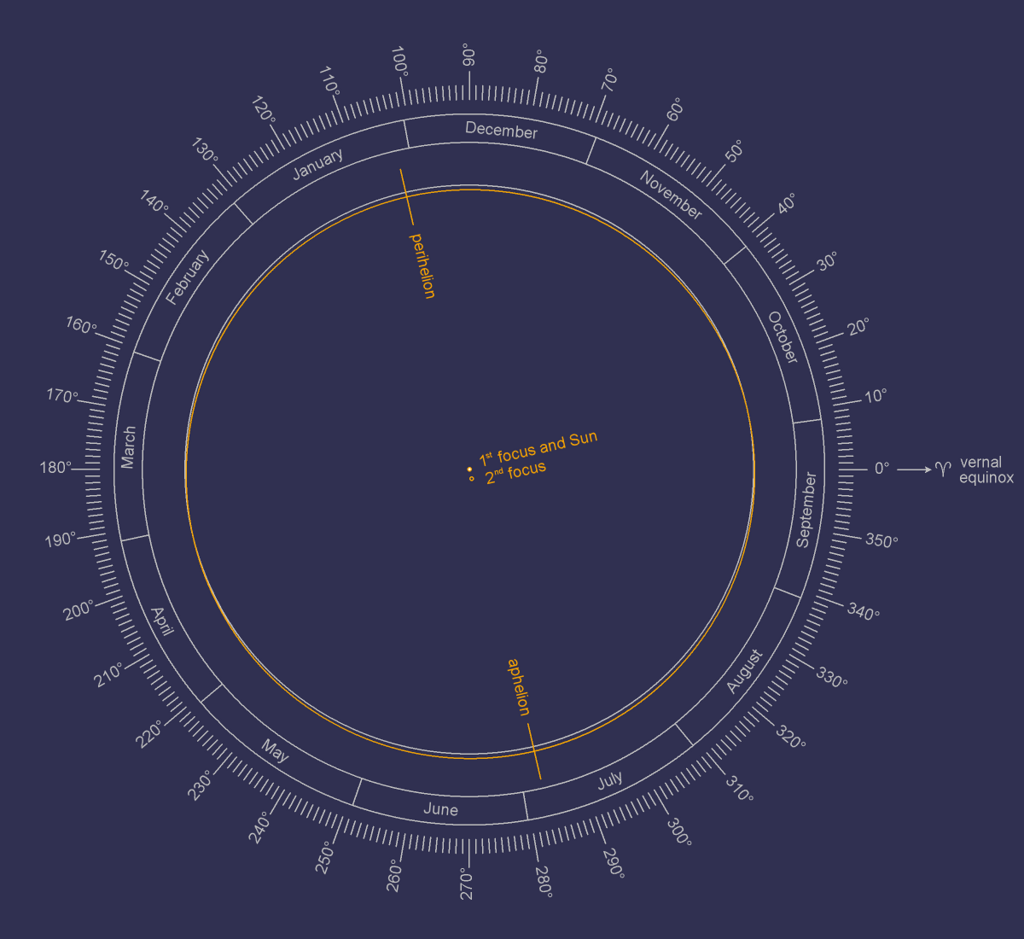
Second Law: The Law of Equal Areas. A line joining a planet and the Sun sweeps out equal areas during equal intervals of time.
This sounds a bit abstract, but it has a very simple consequence: planets move faster when they are closer to the Sun and slower when they are farther away. To sweep out the same amount of area in a short, wide triangle (when the planet is close to the Sun), the planet must travel a longer path along its orbit. To cover the same area in a long, skinny triangle (when it's far away), it travels a shorter path. This is a direct result of the conservation of angular momentum.
Third Law: The Law of Harmonies. The square of the orbital period of a planet is directly proportional to the cube of the semi-major axis of its orbit.
Kepler's third law relates how long a planet takes to complete one orbit (its period, ) to the average distance from the Sun (its semi-major axis, ).
This means that planets farther away from the Sun don't just have a longer path to travel, they also move more slowly. The result is a dramatic increase in orbital period with distance. For example, Mars is about 1.5 times farther from the Sun than Earth, and its year is almost twice as long as ours. Jupiter, about 5 times farther out, has a year that's almost 12 Earth years long.
These foundational principles from Newton and Kepler are the building blocks of orbital mechanics. They describe a universe governed by predictable, mathematical laws, allowing us to plot the course of satellites, probes, and planets with incredible accuracy.
According to Kepler's First Law of Planetary Motion, what is the shape of a planet's orbit?
Imagine two asteroids in space. If the distance between their centers is doubled, what happens to the gravitational force between them?