Temporal Shifts in Nineteenth Century Fiction
Industrialization and Linear Time
From Sun to Steam
Before the Industrial Revolution, time was fluid. For most people in agrarian societies, the day was governed by the sun and the year by the seasons. Time was cyclical, a repeating pattern of planting, growing, and harvesting. It was organic, tied to natural rhythms rather than the precise ticking of a clock.
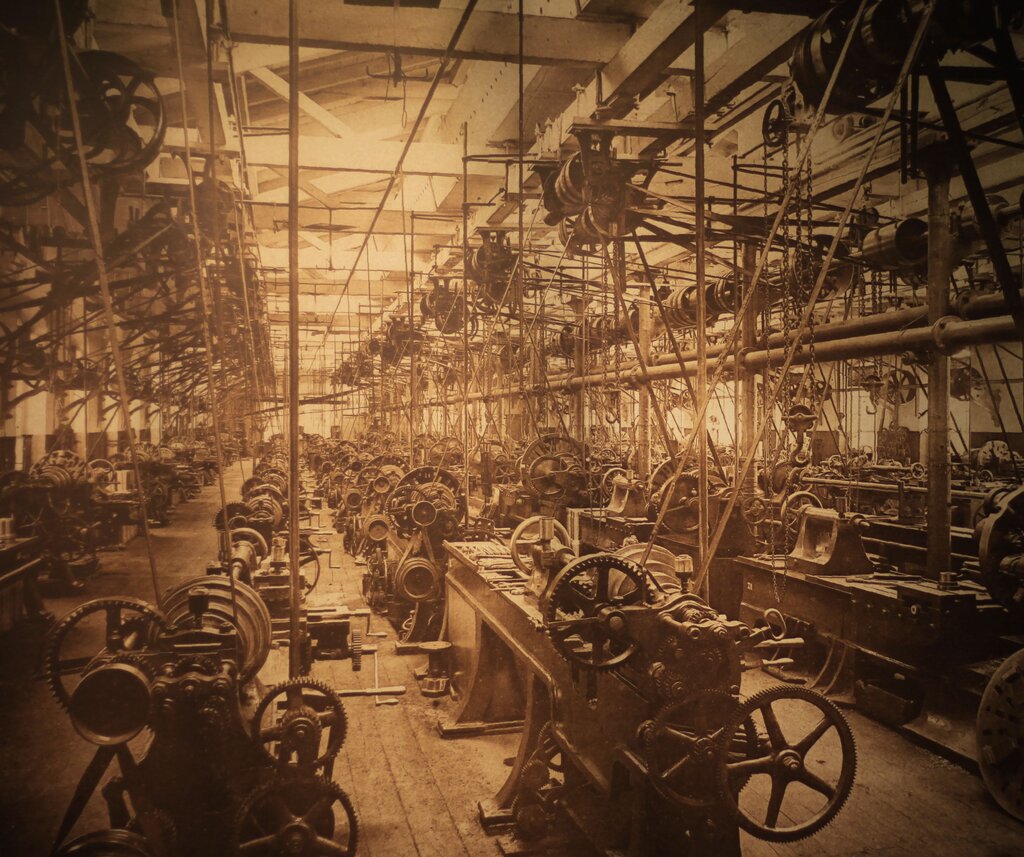
Factories shattered this relationship with time. The steam engine didn't care about sunrise; the power loom didn't pause for seasons. Life was reorganized around the factory whistle, which sliced the day into rigid, identical blocks of work. This new, mechanical time was linear and relentless. Every minute was a unit of production, a measurable quantity that could be optimized for efficiency. This shift from a circular, natural flow to a straight, artificial line changed not just how people worked, but how they perceived reality itself.
The Railway's Clock
Nowhere was the need for standardized time more urgent than on the railways. In the mid-19th century, a train journey from London to Bristol meant passing through dozens of towns, each with its own local time based on high noon. A schedule was a logistical nightmare. A train might leave London at 10:00 AM, but what time was it really just 50 miles down the track?
To solve this chaos, British railway companies began adopting a single, standardized time: London time, distributed daily by telegraph from the Royal Observatory at Greenwich. This was the birth of , a system that overrode local sun-dials and church bells. By 1880, what began as a commercial convenience became the legal standard for the entire country. The railway didn't just conquer distance; it conquered time, imposing a unified, linear grid across the entire nation. This act of standardizing time was a crucial step in conceiving of time as a universal, measurable dimension, much like space.
The single biggest catalyst for the creation of time zones was the invention and proliferation of the steam train.
Time's Arrow
This new linear consciousness was reinforced by groundbreaking scientific ideas. The recently formulated laws of introduced the concept of entropy—the idea that in a closed system, disorder always increases. This gave time a direction. Unlike the endlessly repeating cycles of Newtonian mechanics, the universe according to thermodynamics was a one-way street. It had a beginning and was moving towards an inevitable end, a state of maximum entropy or "heat death."
This scientific principle, dubbed the "" by astronomer Arthur Eddington, provided a physical basis for the Victorians' intuitive sense of progress. History was no longer seen as a series of repeating cycles, but as a linear progression from a primitive past toward a more advanced future. This idea of time as a forward-moving vector, a kind of track laid out through the universe, created the necessary mental framework for imagining travel along it. If time is a dimension you can measure and standardize, why couldn't you move through it, just as a train moves along a track?
The factory whistle, the railway schedule, and the laws of thermodynamics all worked together to create a new temporal landscape. This landscape—rigid, linear, and universal—provided the very ground on which narrative time travel could be built. The idea of moving through time became plausible precisely when time itself was reimagined as a standardized, forward-marching dimension.
Before the Industrial Revolution, how was time primarily perceived in agrarian societies?
What was the main reason British railway companies adopted a single, standardized time?