Telomeres The Secrets of Cellular Aging
Introduction to Telomeres
The Protective Caps of Chromosomes
Our genetic information is stored in chromosomes, which are long strands of DNA. To keep this vital information safe, the ends of our chromosomes have special protective structures.
If you think of your chromosomes – which carry your genetic material – as shoelaces, telomeres are the little protective tips at the end.
These tips are called telomeres. They are repeating segments of DNA that don't code for any proteins. Their main job is to maintain the integrity of our chromosomes. They prevent the ends from fraying or deteriorating, and they stop chromosomes from accidentally fusing with each other, which would be catastrophic for a cell.
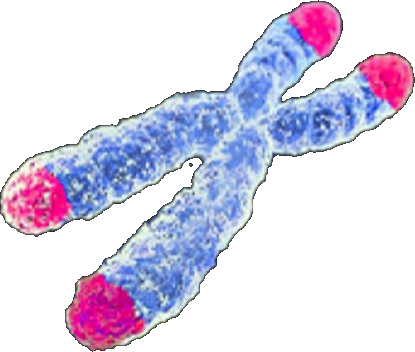
Built for Protection
Telomeres are made of a short sequence of DNA repeated over and over again. In humans and other vertebrates, this sequence is TTAGGG. This six-nucleotide sequence can be repeated hundreds or even thousands of times.
This repetitive structure is rich in the nucleotide guanine (G). A key feature of telomeres is that one of the two DNA strands extends beyond the other, creating a single-stranded overhang. This overhang doesn't just dangle; it folds back and tucks into the double-stranded part of the telomere, forming a protective cap called a T-loop. This loop structure effectively hides the end of the chromosome, further protecting it from being recognized as damaged DNA by the cell's repair machinery.
A Little Shorter Each Time
Every time a cell divides, it must first copy all of its DNA. This process, called DNA replication, is incredibly accurate but has a peculiar quirk when it comes to the ends of linear chromosomes. The machinery that copies DNA cannot replicate the very tip of one of the strands, known as the lagging strand.
DNA replication requires a small piece of RNA called a primer to get started. On the lagging strand, these primers are placed at various points. While most of the DNA can be copied seamlessly, the final primer at the very end of the chromosome poses a problem. Once this primer is removed, there's no way for the DNA polymerase enzyme to fill in the resulting gap. It needs a pre-existing strand to build upon, and there isn't one at the end.
This issue is called the end-replication problem. It means that with each round of cell division, a small piece of the chromosome's end is not copied and is subsequently lost.
This is precisely why telomeres are so important. The DNA that is lost is from the repetitive, non-coding telomere region. This acts as a buffer, protecting the essential genes further down the chromosome from being eroded away. For a while, the cell can afford to lose a bit of its telomeres with each division without any harm to its genetic blueprint.
This shortening process is a natural consequence of how our cells copy their DNA. It sets a limit on the number of times most of our cells can divide, a topic we'll explore more later.