Telecom Upgrade Propensity Modeling with PySpark ML
Introduction to Machine Learning
Learning from Data
Machine learning is a way of teaching computers to find patterns. Instead of writing explicit instructions for every possible scenario, we give the computer data and let it figure out the rules on its own. It's like showing a child a hundred pictures of cats to teach them what a cat looks like, rather than trying to describe a cat with a long list of rules about fur, whiskers, and tails.
For a business, this means you can analyze customer behavior to predict future actions. For instance, by looking at past customer data, a machine learning model can learn the signs that indicate a customer is likely to upgrade their phone soon. This is the core idea behind a propensity model.
Two Main Styles of Learning
Machine learning is generally split into two main approaches: supervised and unsupervised learning. The difference comes down to whether the data you're using has the "answers" included.
Supervised learning is like studying with flashcards. Each card has a question (the data) and the correct answer (the label). The goal is to learn the relationship between the questions and answers so you can correctly answer new questions you've never seen before. In our telecom example, the data would be customer information (like contract length, current phone age, data usage) and the label would be whether they upgraded their phone in the past.
Unsupervised learning is like being given a box of jumbled photos of animals and being asked to sort them into groups. You don't know the names of the animals, but you can group them based on similarities like fur, feathers, or scales. You find the hidden patterns yourself, without any pre-labeled answers.
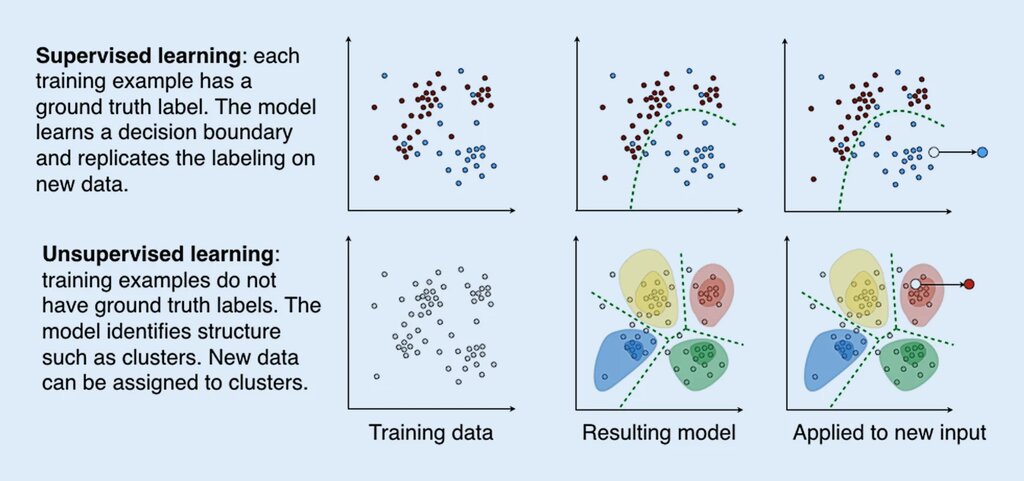
Supervised learning problems are typically either for classification or regression.
- Classification predicts a category. "Will this customer upgrade?" is a classification problem because the answer is either "yes" or "no."
- Regression predicts a continuous number. "How much will this customer spend in the next year?" is a regression problem because the answer could be any value, like $50.25 or $120.00.
Unsupervised learning is often used for clustering, which involves grouping similar data points together. A telecom company might use clustering to discover different segments of customers, like "heavy data users," "frequent international callers," or "budget-conscious users," without knowing these groups existed beforehand.
Common Algorithms
There are many machine learning algorithms, each with its own strengths. Here are a few foundational ones you'll often encounter.
Decision Trees are intuitive algorithms that make predictions by following a flowchart of simple yes/no questions. Because they mimic human decision-making, they are easy to understand and are a great starting point for tasks like predicting customer behavior.
Logistic Regression is a go-to for classification problems. Despite its name, it's not used for regression. It calculates the probability of a certain outcome, like the probability a customer will upgrade. If the probability is over 50%, the model predicts "yes," otherwise "no."
K-Means Clustering is a popular unsupervised algorithm. You tell it how many clusters () you want to find in your data, and it groups the data points into distinct segments based on their similarity.
Preparing Your Data
There's a famous saying in machine learning: "garbage in, garbage out." Even the most advanced algorithm will fail if it's fed poor-quality data. That's why data preprocessing is a critical first step in any project.
Preprocessing is the act of cleaning and organizing your raw data to make it suitable for a machine learning model. It involves several tasks.
Key Data Preprocessing Steps:
- Handling Missing Values: Decide whether to remove data with missing entries or fill them in using a logical substitute, like the average value.
- Removing Duplicates: Eliminate identical records that could bias the model.
- Handling Categorical Data: Convert non-numeric data (like a phone's color) into a numeric format that algorithms can understand.
- Feature Scaling: Standardize the range of your numeric data. For example, ensuring that a customer's age (e.g., 25-65) and their monthly data usage in gigabytes (e.g., 1-100) are on a similar scale so one doesn't unfairly dominate the other.
Clean, well-prepared data is the foundation of a reliable and accurate machine learning model. Taking the time to get this step right will save you a lot of trouble later.