Tech Product Go-to-Market Strategy
Ideation
Coming Up With the Big Idea
Every new product starts as a simple thought. The process of generating and shaping these thoughts into something real is called ideation. It's the first, most creative step in building something new. The goal isn't to find one perfect idea right away. Instead, it's about generating a flood of possibilities and then carefully filtering them down to the few that are truly promising.
Think of it like panning for gold. You start with a lot of dirt and rock, then sift through it all to find the valuable nuggets. In ideation, the initial brainstorming is gathering the raw material.
Feature ideation is a process through which product teams brainstorm ideas for new features to introduce to their product.
Brainstorming Beyond the Buzzwords
Brainstorming is more than just getting a team in a room with a whiteboard. To get truly innovative ideas, you need structure. Unstructured sessions often let the loudest voices dominate and can lead to groupthink. A few simple techniques can help generate a wider and more creative range of ideas.
Ideation
noun
The creative process of generating, developing, and communicating new ideas.
One effective method is brainwriting. Instead of saying ideas out loud, everyone writes them down silently for a few minutes. Then, you pass your list to the person next to you, who reads your ideas and adds their own. This continues for a few rounds. This technique ensures everyone contributes, not just the most extroverted team members.
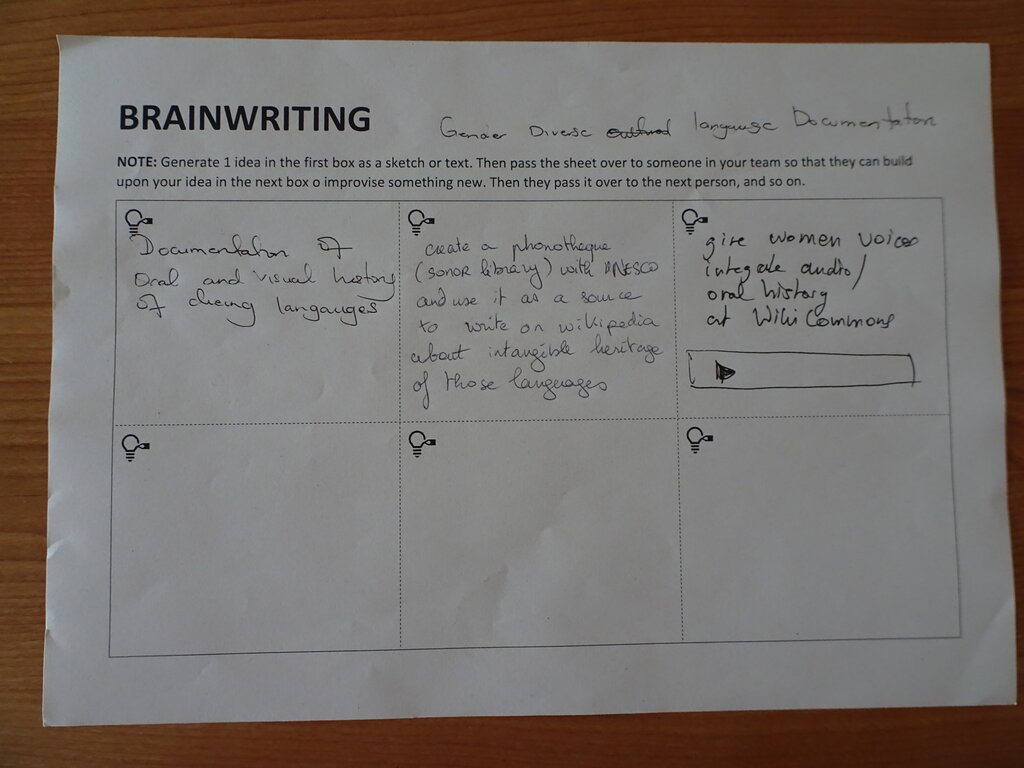
Another powerful tool is the SCAMPER method. It's a checklist of questions that forces you to look at an existing product or idea from different angles.
| Letter | Action | Question to Ask |
|---|---|---|
| S | Substitute | What parts of this product could be swapped for something else? |
| C | Combine | Can we merge this with another product or idea? |
| A | Adapt | How could we adapt this for a different context or user? |
| M | Modify | What can we magnify, minimize, or change about this? |
| P | Put to another use | Can we use this product in a new way or for a different purpose? |
| E | Eliminate | What features or parts can we remove? |
| R | Reverse | How could we rearrange or reverse the process? |
Using a framework like SCAMPER helps break creative blocks and pushes thinking beyond the obvious improvements.
Finding Problems Worth Solving
A clever idea isn't enough. It needs to solve a real problem for a real person. This is where market research comes in, but not the kind with huge surveys and focus groups. At the ideation stage, research is about finding and understanding customer needs and frustrations.

Look for clues in places like:
- Customer Support Tickets: What are people constantly complaining about or asking for?
- Online Reviews: What do customers love and hate about your competitors' products?
- Direct Observation: Watch how people perform tasks related to your area of interest. Where do they get stuck? What workarounds have they invented?
When you talk to potential customers, avoid pitching your idea. Instead, ask about their experiences. Good questions sound like, "Tell me about the last time you tried to..." or "What's the hardest part about...?" This uncovers the pain points that your product could solve.
From Idea to Contender
Once you have a long list of ideas grounded in real user needs, it's time to filter them. Two key questions help separate the contenders from the wishful thinking: Is it feasible, and does it fit our strategy?
Feasibility is a quick check on whether an idea is even possible. Can we build this with our current technology and skills? Do we have the resources (time, money, people) to make it happen? This isn't a detailed technical plan, just a high-level reality check. An idea to build a teleporter is cool, but not feasible today.
Strategic alignment ensures you're working on ideas that actually help the company achieve its goals. Does this idea support our company's mission? Does it strengthen our brand? Will it help us reach a market we want to enter? An idea might be brilliant and feasible, but if it takes the company in a completely random direction, it's probably not the right one to pursue now.
By the end of this process, you won't have a finished product plan. You'll have a small, curated list of strong, viable concepts that are worth exploring further.
Time to check your understanding of the core concepts of ideation.
What is the primary goal of the initial phase of ideation?
A product team wants to ensure that introverted members have an equal chance to contribute their ideas. Which structured technique would be most effective?
This structured approach turns a vague notion of "coming up with ideas" into a reliable engine for innovation.