Teaching Your Child to Read
Phonemic Awareness
Hearing the Sounds in Words
Before children learn to read letters on a page, they first need to learn how to hear the sounds in the words we speak. This skill is called phonemic awareness. It has nothing to do with sight and everything to do with listening. It's the ability to tune into the individual sounds that make up spoken language.
Think of a word like a chord played on a piano. You might hear it as one sound, but it's actually made of several individual notes. Phonemic awareness is like developing the ear to hear each of those separate notes. This is the very first step toward understanding how our language is built.
phoneme
noun
The smallest unit of sound in a spoken word. For example, the word 'cat' has three phonemes: /k/, /æ/, and /t/.
Identifying and Separating Sounds
One of the first skills in phonemic awareness is simply identifying the sounds within a word. Can a child hear the first sound in the word 'sun'? Can they hear the last sound in 'mat'? This isn't about knowing the letter 's' or 't', but about recognizing the /s/ and /t/ sounds.
A simple game is to ask, "What's the very first sound you hear in the word pig?" The correct answer isn't the letter P, but the sound /p/.
Once a child can identify sounds, the next step is segmenting. This means breaking a word down into all its separate phonemes. It's like taking a toy apart to see how it's made. The word 'dog' isn't one single sound, but a sequence of three: /d/, /o/, /g/.
Blending and Rhyming
Blending is the opposite of segmenting. Instead of taking a word apart, we're putting sounds together to create a word. If you give a child the sounds /b/, /a/, /t/, can they blend them together to say the word 'bat'? This skill is crucial for sounding out words later on in their reading journey.
Phonemic awareness helps students blend sounds together to form words, isolate the beginning, middle, or end sounds in a word, identify which words have the same beginning or ending sounds, identify how many syllables a word has, or manipulate phonemes to form new words.
Rhyming is another key part of phonemic awareness. When children play with rhyming words like 'cat', 'hat', and 'sat', they are learning to pay attention to the sound structure of language. They notice that the end of each word sounds the same. This helps them recognize patterns in words, which is a foundational skill for both reading and spelling.
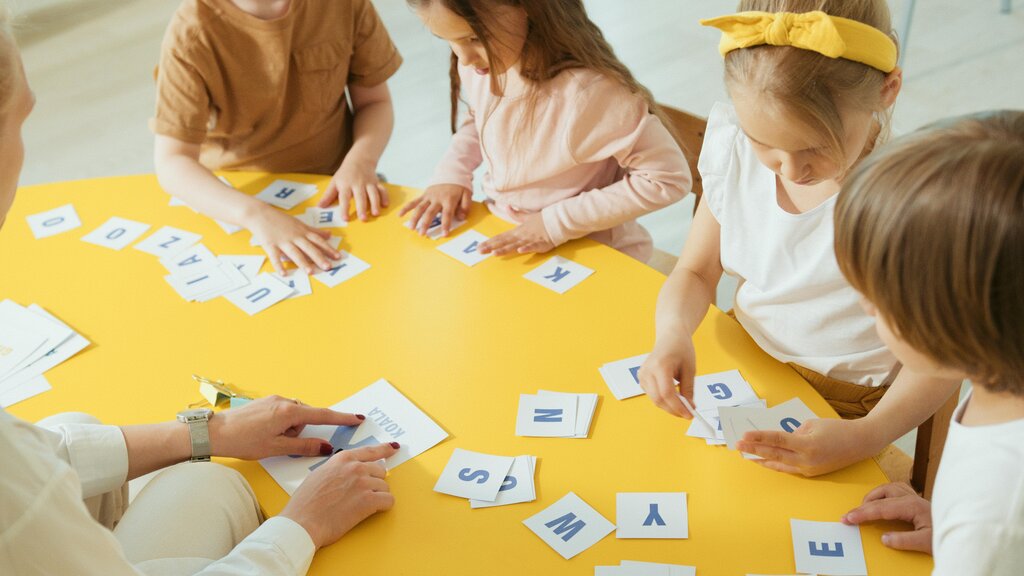
Practicing these skills doesn't require workbooks or special tools. It can be done through simple games, songs, and conversation throughout the day.
| Word | Rhymes with... |
|---|---|
| Fan | Pan, Can, Man |
| Top | Mop, Hop, Pop |
| Bug | Rug, Hug, Mug |
| Pen | Hen, Ten, Den |
Let's check your understanding of these auditory skills.
Phonemic awareness is primarily a(n) _______ skill.
When a child says the sounds /f/, /i/, /sh/ to break down the word 'fish', what skill are they demonstrating?
Mastering these listening skills gives children a huge advantage before they ever see a letter. They learn that words are not just single chunks of sound but are made of smaller, movable parts. This understanding is the bedrock upon which all other reading skills are built.