Teaching English to Young Learners
Child Language Acquisition
The Blueprint for Language
A child's journey from silence to speaking full sentences often feels like magic. With no formal lessons or grammar books, they master a complex system of sounds, words, and rules. This process isn't random; it follows a predictable pattern, driven by innate abilities and their environment. Understanding this natural blueprint is key for anyone teaching language to young learners.
From Gurgles to Grammar
Language development unfolds in observable stages. It starts with simple sounds and gradually builds toward complex sentences. While every child's timeline is unique, they generally follow the same path.
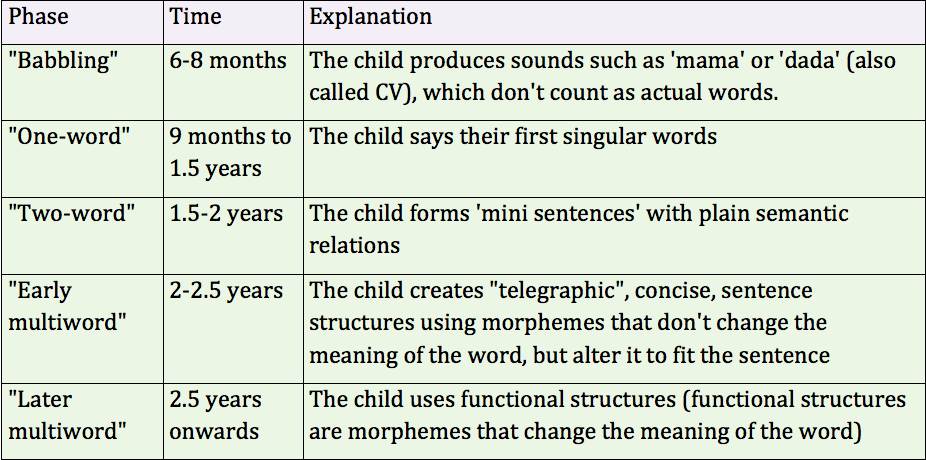
These stages show a clear progression. First, a child masters the sounds of their language (babbling). Then, they connect those sounds to meaning (one-word stage). Next, they learn to combine words into simple relationships (two-word stage), and finally, they begin to weave those words into increasingly complex sentences.
The Learning Window
Timing plays a crucial role in language acquisition. The Critical Period Hypothesis suggests there is an optimal window, from early infancy to puberty, during which the brain is uniquely primed to learn a language. During these years, children's brains are incredibly plastic, allowing them to absorb linguistic rules and sounds with remarkable ease.
Think of it like learning to swim. An adult can certainly learn, but a child often picks it up more naturally and fearlessly. The same principle applies to language. Learning a first or second language during this critical period is more efficient and often leads to a higher level of fluency. This doesn't mean learning is impossible later, but the process may require more conscious effort.
For educators, the critical period highlights the immense opportunity of early education. A young learner's brain is not just ready for language; it is actively seeking it out.
Cracking the Code
So how do children decipher the rules of grammar without being taught? They use clever cognitive strategies to pull themselves up by their own linguistic bootstraps. One of these is semantic bootstrapping.
Children first learn the meaning of some key words. They figure out that words like "ball" and "cup" are objects (nouns) and words like "eat" and "run" are actions (verbs). They then use this understanding of meaning to make educated guesses about sentence structure. If a child hears "The cat is sleeping," they know "cat" is a thing and "sleeping" is an action. They intuitively map this onto a basic grammatical rule: things do actions. This gives them a foothold for understanding who is doing what.
Bootstrapping
verb
In linguistics, the process of using existing knowledge (like word meaning or sentence structure) to figure out new information about language.
This process also works in reverse. A child can use the structure of a sentence to figure out a new word's meaning. This is called syntactic bootstrapping. Imagine a child knows the word "dog" but has never heard the word "glorping." If you point to a dog that's jumping and say, "Look! The dog is glorping!" the child can use the sentence structure to make a good guess.
They recognize the familiar frame, "The (noun) is (verb)-ing." Since they already know "dog" is the noun, they can infer that "glorping" must be the action the dog is performing. They have used the syntax, or grammar, as a clue to unlock the meaning of a new word.
Together, semantic and syntactic bootstrapping form a powerful learning cycle. Children use meaning to understand grammar, and they use grammar to understand meaning. This allows them to rapidly expand both their vocabulary and their ability to form sentences.
Children do not learn languages through formal instruction but rather absorb them naturally by listening and engaging with the linguistic environment around them.
By understanding these core principles, educators can create learning environments that align with a child's natural instincts. Lessons that provide rich context, model clear sentence structures, and allow for exploration are most effective because they tap into the very processes children use to learn their first language.
Which of the following best describes the typical sequence of language development in a child?
The 'Critical Period Hypothesis' in language acquisition suggests that:
These foundational concepts explain the remarkable journey every child takes to learn language.