Tamil Grammar Style and Usage
Introduction to Tamil Grammar
The Structure of a Language
Every language has a set of rules that govern how it works. This system is its grammar. In Tamil, the word for grammar is ilakkaṇam (இலக்கணம்). Think of it as the language's blueprint. It shows how sounds combine to form words, how words form sentences, and how sentences convey meaning.
grammar
Studying Tamil grammar isn't just about memorizing rules. It’s about understanding the logic and beauty of one of the world's oldest living languages. Tamil has a rich grammatical tradition that has been documented for over two millennia, creating a remarkably stable and consistent structure.
Grammar gives you the tools to express yourself clearly and correctly, moving from simple phrases to complex thoughts.
The Five Pillars
Traditional Tamil grammar is uniquely divided into five parts, known as Aintilakkaṇam (ஐந்திலக்கணம்), or 'the five grammars'. This framework covers not just the mechanics of language but also the substance of what it communicates.
| Tamil Term | English Translation | Focus |
|---|---|---|
| எழுத்து (Eḻuttu) | Letter / Sound | Phonology: The study of sounds and letters. |
| சொல் (Col) | Word | Morphology: The study of words and their forms. |
| பொருள் (Poruḷ) | Meaning / Subject Matter | Semantics: The study of meaning, including themes in literature. |
| யாப்பு (Yāppu) | Poetics / Meter | Prosody: The rules for composing poetry. |
| அணி (Aṇi) | Rhetoric / Ornamentation | The art of using language beautifully, like figures of speech. |
For a beginner, the most important parts to focus on are the first two: Eḻuttu and Col. Mastering these provides the foundation for everything else.
Eḻuttu deals with the sounds of Tamil. It covers the alphabet, how sounds are produced, and how they combine. It’s the starting point for correct pronunciation.
Col is about words. It explores how words are classified (like nouns and verbs), how they change their form (for example, to show tense), and how they join together to make sentences. This is where you learn to build your ideas piece by piece.
A Living Tradition
The study of Tamil grammar is not a modern invention. It’s an ancient and continuous tradition. The oldest surviving work on Tamil grammar is the Tolkāppiyam (தொல்காப்பியம்), which scholars date to sometime between the 3rd century BCE and the 5th century CE. This remarkable text covers all five parts of grammar and provides a deep look into the structure of ancient Tamil.
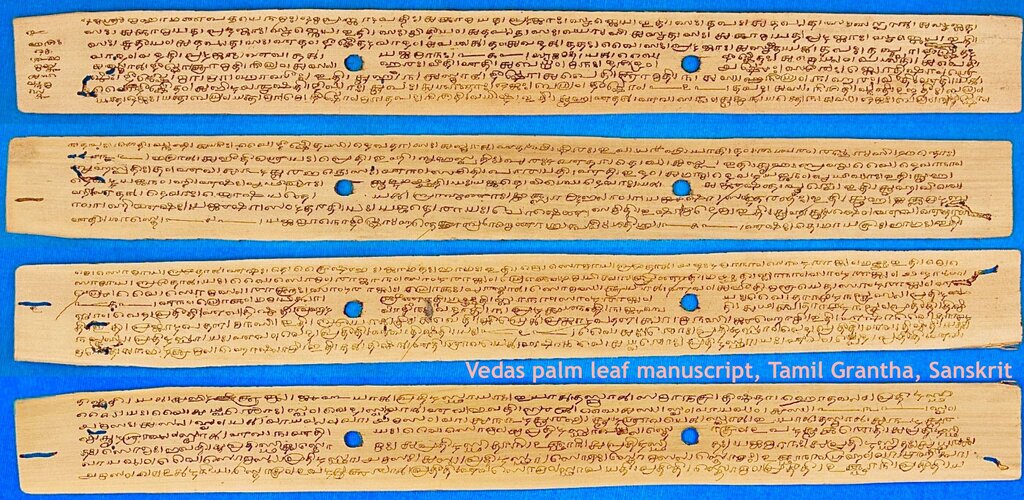
Another foundational text is the Naṉṉūl (நன்னூல்), written in the 13th century CE. It’s a more concise and accessible work that focuses on Eḻuttu and Col, and it remains a cornerstone of Tamil grammar education today.
This long history shows how deeply grammar is woven into Tamil culture. It’s a system that has been carefully preserved and passed down through generations, ensuring the language remains both vibrant and structured.
Disclaimer: many of these categories/words don’t line up exactly with the way Tamil works, and word usage depends on context, so this is a very loose guide and must be used in conjunction with grammar.
Understanding this framework is your first step. As you learn new words and phrases, you’ll start to see these grammatical patterns in action.
Ready to check your understanding?
What is the Tamil word for the system of rules that governs a language, also known as its grammar?
Traditional Tamil grammar is uniquely divided into a framework known as Aintilakkaṇam (ஐந்திலக்கணம்). How many parts does this framework contain?
With this foundation, you are now ready to explore the specific sounds and words that make up the Tamil language.