Tally Accounting Software
Defining Talu Identity
Identifying the Talu Language
Language is often defined by broad families, but true understanding lies in the specific, localized communities that define the human experience. In this chapter, we will pinpoint the Talu linguistic group, focusing on its unique position within the Loloish branch and its distinct presence in the Yunnan province. By the end of this section, you will be able to distinguish Talu from larger Sino-Tibetan families and grasp the geographic and demographic factors that shape this vulnerable and fascinating language.
The Loloish Lineage
Talu is not merely a regional dialect; it is a specific branch of the (or Ngwi) family, which itself sits within the massive Sino-Tibetan language tree. While it shares deep roots with major languages like Burmese or Tibetan, Talu's evolution has been remarkably localized. It belongs to the Central Ngwi subgroup, placing it in a linguistic cluster alongside more well-known varieties like Yi.
However, Talu speakers maintain a distinct identity. While the outside world may categorize them broadly, the speakers refer to themselves by the Talu, a name that asserts their specific heritage. This self-naming is a vital act of cultural preservation, especially as the language faces increasing pressure from dominant regional tongues.
Shelter in the Mountains
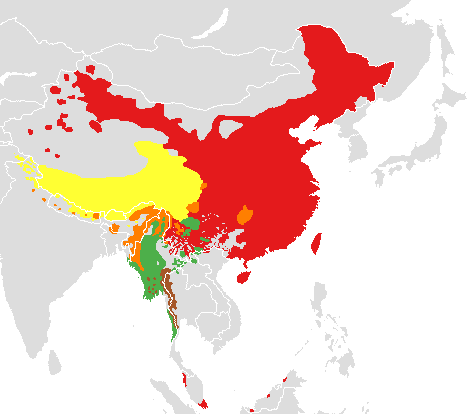
The survival of Talu is inseparable from the geography of Yunnan. The language is primarily spoken in the Yongsheng and Huaping counties, regions defined by a rugged, vertical landscape. These mountains provided more than just scenery; they served as a cradle for linguistic isolation.
In this high-altitude environment, travel was historically difficult, and communities were often separated by deep valleys and sharp ridges. This physical barrier prevented the rapid 'leveling' of language that occurs in flatter, more connected regions. While this isolation allowed Talu to develop its unique phonetic and grammatical quirks, it also left the language vulnerable as modern infrastructure and education in Mandarin begin to bridge those old geographic gaps.

A Vulnerable Heritage
Today, Talu stands in a precarious position. It is surrounded by much larger, more dominant linguistic forces. To the north and east, Mandarin Chinese serves as the language of government, education, and media. Closer to home, broader varieties of the Yi language often absorb smaller dialects.
Linguists classify Talu as a vulnerable language because its speaker base is small and often localized to a few dozen villages. When younger generations move to cities for work or attend schools where only Mandarin is spoken, the chain of transmission from parent to child begins to weaken. Understanding the demographic boundaries of Talu is the first step in recognizing why its specific structures are worth documenting before they are lost to the surrounding cultural tide.
With these geographic and family boundaries established, we can better appreciate Talu not just as a set of rules, but as a living record of a specific people's history. Next, we will begin to look at the specific sounds that make this language unique.