Taiwan Mandarin for Beginners
Mandarin Phonetics
Meet the Sounds of Mandarin
Before diving into Chinese characters, you need to learn how Mandarin sounds. In Taiwan, the primary tool for this is a phonetic system called Zhuyin Fuhao (注音符號), often nicknamed Bopomofo.
Think of it as an alphabet for Mandarin. Instead of representing letters like A, B, C, its 37 symbols represent the basic sounds—the consonants and vowels—that make up every word. The name "Bopomofo" comes from the first four symbols of the system: ㄅ (bo), ㄆ (po), ㄇ (mo), and ㄈ (fo).
Learning Zhuyin first builds a strong foundation for pronunciation, helping you speak clearly and understand others more easily.
The Building Blocks
The 37 symbols are divided into three groups: initials (consonants), medials (a special type of vowel), and finals (the remaining vowels and vowel-nasal combinations). Let's start with the initials, which are the consonants that begin a syllable.
| Symbol | Sound | Pinyin Equivalent |
|---|---|---|
| ㄅ | boat (unaspirated) | b |
| ㄆ | pot (aspirated) | p |
| ㄇ | mom | m |
| ㄈ | fun | f |
| ㄉ | dad (unaspirated) | d |
| ㄊ | top (aspirated) | t |
| ㄋ | no | n |
| ㄌ | leg | l |
| ㄍ | go (unaspirated) | g |
| ㄎ | car (aspirated) | k |
| ㄏ | ha | h |
| ㄐ | jeep | j |
| ㄑ | cheap | q |
| ㄒ | she | x |
| ㄓ | judge (retroflex) | zh |
| ㄔ | church (retroflex) | ch |
| ㄕ | shirt (retroflex) | sh |
| ㄖ | measure | r |
| ㄗ | cats | z |
| ㄘ | hats (aspirated) | c |
| ㄙ | sun | s |
Next are the finals. These are the vowel sounds that follow the initial. Three of them—ㄧ, ㄨ, and ㄩ—are special and can also act as "medials," meaning they bridge an initial and another final.
| Symbol | Sound | Pinyin Equivalent |
|---|---|---|
| ㄧ | see | i / yi |
| ㄨ | food | u / wu |
| ㄩ | (French tu) | ü / yu |
| ㄚ | father | a |
| ㄛ | song (in British English) | o |
| ㄜ | teacher | e |
| ㄝ | yes | ê |
| ㄞ | eye | ai |
| ㄟ | eight | ei |
| ㄠ | loud | ao |
| ㄡ | oh | ou |
| ㄢ | yawn | an |
| ㄣ | bend | en |
| ㄤ | song | ang |
| ㄥ | (nasalized "en") | eng |
| ㄦ | err | er |
Adding the Music Tones
Mandarin is a tonal language. The same syllable pronounced with a different pitch contour can have a completely different meaning. Think of it as adding melody to your words. There are four main tones and a fifth, neutral tone.
Let's use the syllable ma as an example to see how tones work.
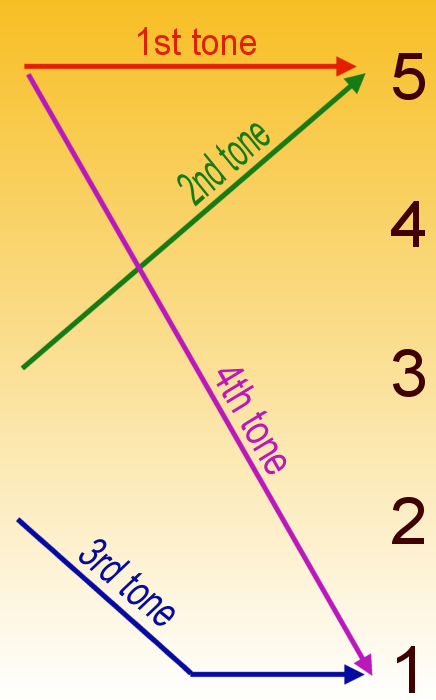
- First Tone ( ˉ ): A high, level pitch. For example, ㄇㄚ (mā) can mean "mother" (媽).
- Second Tone ( ˊ ): A rising pitch, like you're asking a question. For example, ㄇㄚˊ (má) can mean "hemp" (麻).
- Third Tone ( ˇ ): A falling and then rising pitch. It's the lowest and longest tone. For example, ㄇㄚˇ (mǎ) means "horse" (馬).
- Fourth Tone ( ˋ ): A sharp, falling pitch, like a command. For example, ㄇㄚˋ (mà) means "to scold" (罵).
- Neutral Tone (no mark): A light, short, and unstressed sound. For example, the "ma" in ㄇㄚㄇㄚ (māma) is often neutral.
Putting It All Together
Every Mandarin syllable is formed by combining these parts, usually an initial and a final, topped off with a tone mark. Let's build a few words using Zhuyin.
- Hello (nǐ hǎo): To say "hello," you combine ㄋ (n) + ㄧ (ǐ) to get ㄋㄧˇ (nǐ), and ㄏ (h) + ㄠ (ǎo) to get ㄏㄠˇ (hǎo). Both use the third tone.
- Thank you (xièxie): This is ㄒ (x) + ㄧㄝ (iè) for ㄒㄧㄝˋ (xiè) and a neutral ㄒㄧㄝ (xie). It uses the fourth tone followed by a neutral tone.
- Goodbye (zàijiàn): This combines ㄗ (z) + ㄞ (ài) for ㄗㄞˋ (zài) and ㄐ (j) + ㄧㄢ (iàn) for ㄐㄧㄢˋ (jiàn). Both use the fourth tone.
Notice how the tone mark is placed to the right of the Zhuyin symbols. The only exception is the first tone, which has no mark.
Mastering these sounds and tones is the single most important step you can take toward speaking clear, understandable Mandarin. Practice them often, listening carefully to how native speakers sound.