Tactical Military Driving Techniques
Tactical Vehicle Dynamics
Centre of Gravity and Stability
Adding armour to a vehicle is a life-saving upgrade, but it comes with a physical cost. Bolting on heavy plates raises the vehicle’s centre of gravity (CG), making it less stable. Think of it like carrying a heavy backpack. If the weight is low and close to your back, you're stable. If it's high up, a small trip can easily send you tumbling.
For an up-armoured vehicle, a higher CG means it's more susceptible to rolling over, especially during aggressive manoeuvres or on uneven terrain. The critical angle at which a vehicle will tip is directly related to its CG height and track width. A higher CG reduces this angle, shrinking your margin for error.
Managing Weight Transfer
Every time you accelerate, brake, or turn, the vehicle's weight shifts. This is weight transfer, and understanding how to manage it is key to maintaining traction. When you brake hard, weight transfers to the front wheels, compressing the front suspension. This increases front-tyre grip but lightens the rear, making it more likely to lose traction and slide. Conversely, hard acceleration shifts weight to the rear.
In a tactical situation, abrupt inputs are often necessary, but they unsettle the vehicle. Smooth, deliberate control of the throttle, brakes, and steering minimises violent weight shifts, keeping the platform stable and predictable. These forces are part of the operational loads acting on the vehicle, crew, and equipment. Mastering them is not about comfort; it's about maintaining control when it matters most.
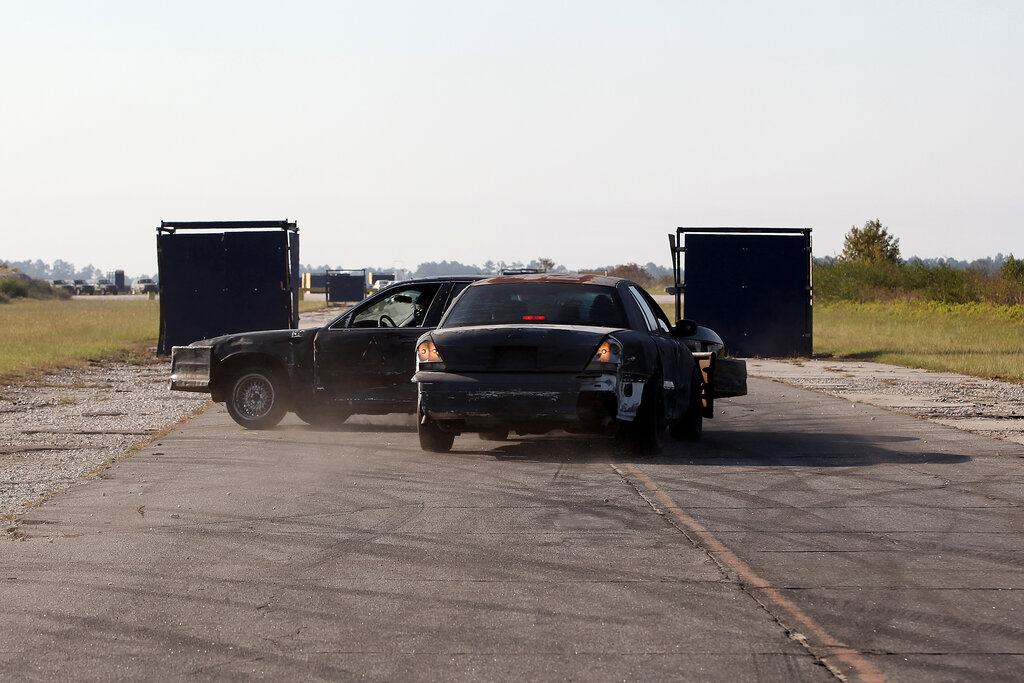
During high-speed cornering, weight transfers to the outside wheels. If you enter a corner too fast, the combination of momentum and weight transfer can overwhelm the tyres' grip, leading to understeer (where the vehicle plows straight ahead) or oversteer (where the rear swings out). Your goal is to balance these forces to follow the intended path without losing traction.
The Physics of Tactical Turns
Specialised manoeuvres like J-turns are essentially exercises in controlled instability. A J-turn, or reverse 180, allows you to rapidly reverse direction in a confined space. It works by gaining momentum in reverse, then applying a sharp, full-lock steering input. This whips the front of the vehicle around. As it passes 90 degrees, you shift to a forward gear and accelerate out, straightening the wheel as you go. The entire manoeuvre hinges on using the vehicle's momentum to pivot it quickly.
Turning mechanics differ significantly between wheeled and tracked vehicles. A wheeled vehicle needs a certain amount of space to complete a turn, dictated by its steering angle. A tracked vehicle, however, can pivot on its own axis by driving its tracks in opposite directions. This requires immense tractive force to overcome the friction between the tracks and the ground, a phenomenon known as scrub.
Multi-point turns in a tracked vehicle can be executed far more efficiently than in a wheeled one, but the stress on the drivetrain and the ground surface is significantly higher. Understanding these differences is crucial for choosing the right manoeuvre for your vehicle and environment.
The Human Factor
The physics of tactical driving don't just affect the vehicle; they have a direct impact on the crew. The rapid changes in velocity create g-forces that push and pull on the body. While not as extreme as those faced by fighter pilots, the g-forces experienced during evasive manoeuvres can be disorienting and fatiguing. Lateral Gs in a high-speed turn can make it difficult to hold your head upright or focus on instruments.
Sustained or sharp g-forces can degrade cognitive performance, slowing reaction times and impairing situational awareness at the very moment they are needed most. Smooth driving isn't just about vehicle preservation; it's about preserving your crew's ability to think and fight effectively. By managing weight transfer and executing turns with precision, you minimise the physiological strain on everyone inside.
What is the primary effect of adding heavy armour to the top of a vehicle on its stability?
During a high-speed turn, if the driver enters the corner too fast and the vehicle begins to plow straight ahead instead of turning, what is this phenomenon called?
Mastering tactical vehicle dynamics means treating your vehicle as an extension of your will. It's about understanding the forces at play and using them to your advantage, ensuring stability, control, and mission readiness under pressure.