Tactical Mastery of Five Combat Essentials
Distance Management
The Stiff-Arm for Your Legs
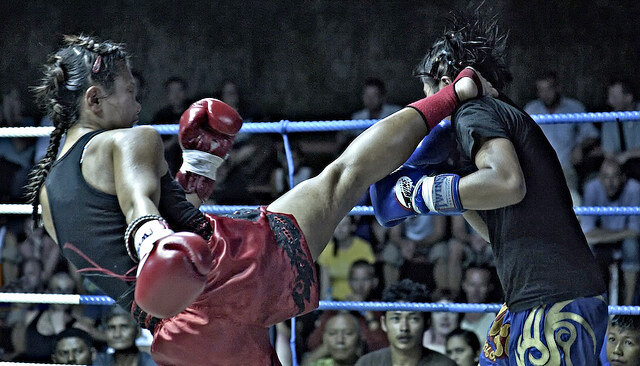
In a self-defence situation, your first priority is creating space. An attacker wants to close distance to grab, hold, or strike. Your job is to deny them that proximity. Think of the Muay Thai teep, or push kick, as a stiff-arm for your legs. It’s less about inflicting damage and more about controlling distance and disrupting an aggressor's forward momentum.
Unlike a power kick, the teep is a tactical tool. It's a straight push delivered with the ball of the foot from your lead leg. Its primary purpose is to intercept a charging opponent, stopping them in their tracks and pushing them back. This action 'resets' the encounter, giving you a precious moment to assess the situation, move laterally, or escape entirely. The goal isn't to win a fight; it's to end the confrontation on your terms, which often means getting away safely.
The Biomechanics of Control
The teep's effectiveness comes from its direct, linear path. While a roundhouse kick swings in an arc to generate power, the teep travels in a straight line from your hip to the target. This makes it faster and harder to see coming. It uses your body's structure, locking out the leg upon impact, to transfer your momentum directly into the aggressor. This is a fundamental concept in , where efficiency of movement is key.
By striking with the ball of the foot, you create a focused point of pressure. When aimed correctly, this small surface area can have a significant effect on an opponent's balance and forward drive. The kick originates from the ground up, using the pivot of your supporting foot and the thrust of your hips to generate force, all while keeping your hands up to protect your head.
Targeting for Disruption
Where you land the teep determines its effect. You're not aiming for a knockout; you're aiming to off-balance and control. The two most effective targets for this are the hip and the .
A teep to the lead hip or upper thigh of a charging person acts like a brake. It targets their centre of gravity and jams their forward movement, often forcing them to take a clumsy step back to regain their balance. A teep to the solar plexus is more disruptive. It can knock the wind out of an attacker, causing them to instinctively bend over and gasp for air. Both create space, but the solar plexus strike creates a more significant, albeit temporary, incapacitation.
| Target | Effect on Attacker | Tactical Advantage |
|---|---|---|
| Lead Hip/Thigh | Disrupts balance, halts forward momentum. | Creates immediate space, forces a reset. |
| Solar Plexus | Causes temporary breathlessness and pain. | Creates a longer window for escape or follow-up. |
| Knee | Potentially injurious, stops leg movement. | High risk, but effective at stopping a charge. |
After a successful teep, you must move. The space you've created is temporary. The most common mistake is to stand still and admire your work. Instead, use that moment to execute a —a sharp step to the side. This takes you off the attacker's centreline, forcing them to turn to re-engage, buying you even more time to escape or position yourself more advantageously.
Timing Is Everything
The teep is an intercepting tool. You don't wait for the attacker to get close; you launch it as they are moving in. Watch for the tells of an impending rush: a shift in weight, a lowering of the head, or a tensing of the shoulders. Your goal is to meet their forward momentum with the solid structure of your extended leg.
Think of it like opening a door just as someone is about to run through it. Their own momentum does most of the work.
This requires practice in judging distance and timing. In a non-consensual encounter, distance is your shield. The teep allows you to actively manage that shield, keeping danger at arm's—or rather, leg's—length. It is a simple, efficient, and powerful tool for taking control of a situation where you are being aggressively approached.
Time to check your understanding.
What is the primary purpose of a teep kick in a self-defence situation?
When is the ideal time to execute a teep against an aggressor?
By mastering the teep as a defensive tool, you add a crucial layer to your self-protection strategy. It's not about fighting; it's about controlling space and creating opportunities to stay safe.