Tactical Mastery and Biomechanics in Martial Arts
Biomechanical Power Generation
The Unseen Engine
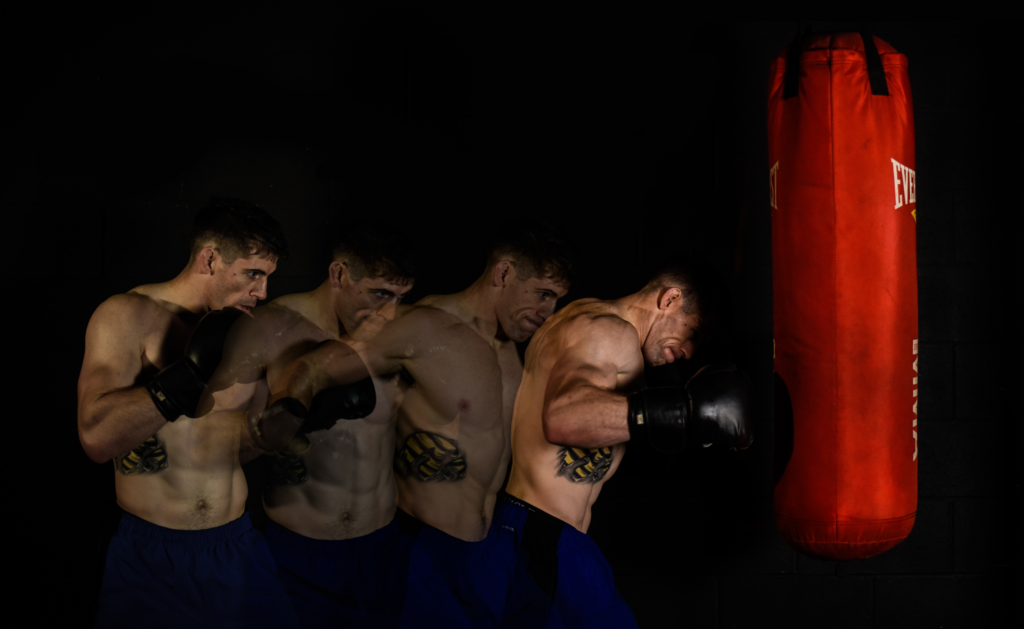
A powerful strike isn't born in the arm or the leg. It's the final link in a chain of events that starts from the ground up. You already know how to throw a punch, but the real secret to devastating power lies in understanding how to generate, multiply, and transfer energy through your entire body. This entire sequence is known as the —a series of interconnected body segments working in concert.
Think of your body not as a collection of separate muscles, but as a single, coordinated machine. The goal is to move energy from the largest, most stable part of this machine (your connection to the ground) to the smallest, fastest part (your fist or foot) with as little waste as possible.
Force From the Floor
Every powerful movement begins with your feet on the floor. When you push against the ground, the ground pushes back with an equal and opposite force. This is Newton's Third Law in action, and it’s called (GRF). It's the initial spark that ignites the entire kinetic chain.
To harness this force, you need a stable stance. Your feet act as the conduit. By driving your rear foot into the ground, you create an upward surge of energy that travels through your leg and into your hips. Without this initial push, any subsequent rotation or extension is significantly weaker.
The Hip Hinge
The energy from the ground is linear, but a strike's power comes from rotation. Your hips are the engine that converts this upward push into powerful rotational force, or s. As your rear foot pivots, your hips snap open. This rapid rotation acts as a massive force multiplier, taking the initial energy from your legs and amplifying it dramatically.
This rotational energy then needs a solid pathway to the target. This is where your core comes in. A strong, rigid core acts as a transmitter, not a generator. It ensures that the explosive force created by the hips is passed efficiently to your upper body. If your core is weak or unstable, you get force leakage. The energy dissipates like water from a leaky hose instead of being channelled forward.
A tight core is the bridge that carries power from your lower body to your upper body. Without it, the bridge collapses.
Delivering the Impact
The wave of energy, now amplified by the hips and channelled by the core, travels through the torso, into the shoulder, down the arm, and finally, into the fist. The final moments are about converting this rotational energy back into linear force, directed straight at the target. The final snap of the punch is the release of all the energy built up along the kinetic chain.
The physics of the impact itself is about momentum. The goal is to transfer the maximum amount of your body's momentum to the target in the shortest possible time. This is why technique matters more than raw strength. A well-coordinated strike that uses the entire kinetic chain will always be more powerful than a muscular arm punch that isolates one muscle group. You are striking with the force of the ground, the torque of your hips, and the mass of your entire body.
The power of a punch comes from generating force through your legs, core, and upper body, then efficiently transferring that energy to your fist.
Now, let's test your understanding of how this chain works.
What is the primary role of the hips in generating a powerful strike?
The initial force that begins the entire sequence of a powerful strike, generated by pushing off the floor, is called:
Mastering the kinetic chain turns a simple movement into a powerful expression of biomechanical efficiency.