Tactical Hand to Hand Combat
Advanced Striking Mechanics
The Anatomy of a Powerful Strike
A knockout punch isn't about arm strength. The real power comes from the ground up. Your body is a system of connected links, and generating maximum force means using this system efficiently. This is the core principle of the . When you throw a punch, the force begins with your feet pushing against the floor. That energy travels up your legs, is amplified by the rotation of your hips and torso, whips through your shoulder, and is finally delivered by your fist. Every link in the chain must do its job in the right sequence for the strike to have devastating power.
The key amplifier in this chain is torque. Think of winding up a spring and then letting it go. By rotating your hips and shoulders just before and during the strike, you are creating rotational force, or torque. This torque dramatically increases the momentum transferred into your punch or kick. A punch thrown with only the arm is a flick; a punch thrown with hip and shoulder rotation is a sledgehammer. It’s the difference between pushing someone and knocking them over.
Striking Without Warning
In a real self-defence situation, telegraphing your moves is a critical mistake. A non-telegraphed strike is one that begins with no tell-tale signs, like winding up your arm or tensing your shoulders. The movement should be explosive and efficient, flowing directly from your stance to the target. The power still comes from the kinetic chain, but the initial movements are subtle and integrated. Instead of a big wind-up, the motion begins with a small, sharp pivot of your foot and hip, making the strike much harder to see and block.
Let's apply this to a combination: the lead hook, rear cross, and liver shot. The lead hook initiates with a pivot of your lead foot and hip rotation, not a swing of the arm. As the hook lands or is blocked, your weight has shifted, perfectly setting you up for the rear cross. The power for the cross comes from rotating your rear hip and shoulder forward. The energy from the cross then flows back as you pivot again, driving a final, brutal hook into the opponent's liver. Each strike loads the spring for the next, creating a seamless and powerful sequence.
The Art of Eight Limbs
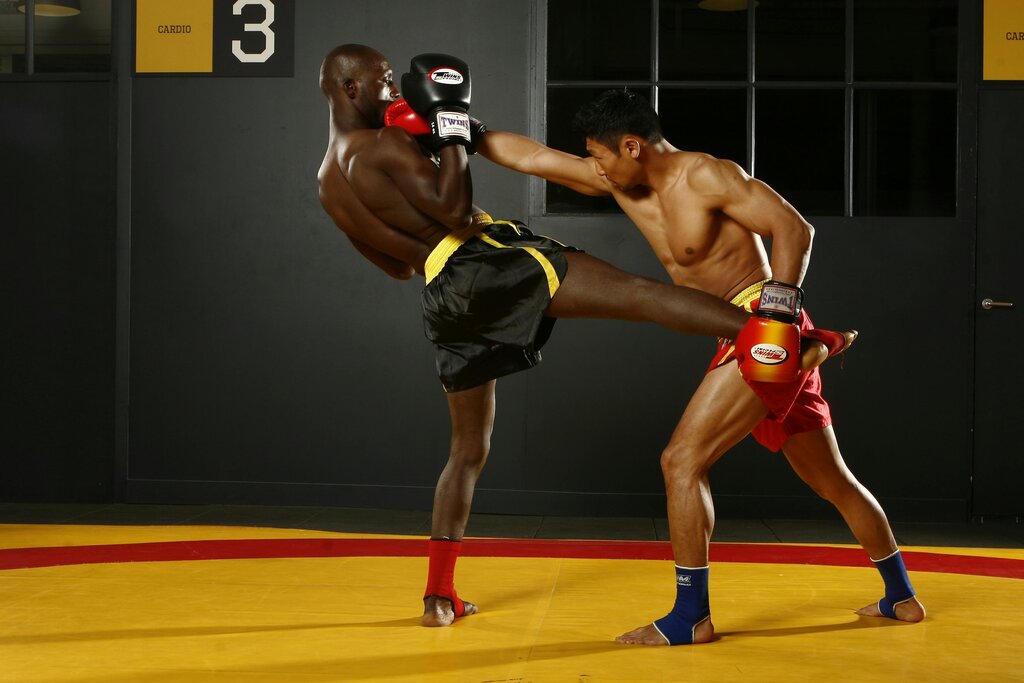
Kicks generate even more power than punches due to the larger muscle groups involved. The is a perfect example of a devastating, full-body strike. Unlike the snapping motion of a karate kick, the Muay Thai roundhouse is thrown like a baseball bat. The practitioner steps out at a 45-degree angle with their lead foot to open the hips. They then pivot on the ball of that foot while swinging the kicking leg, hip, and shoulder as a single unit. The power comes from this full-body rotation, not from simply flicking the leg. The point of impact is the hard shin bone, not the foot, transferring immense force into the target.
Remember: Your limbs are just the delivery system. The real power is generated by your core and transferred through proper biomechanics.
Time to see if you've been paying attention.
According to the principle of the kinetic chain, where does the power for a strong strike originate?
A punch thrown with only the arm is a flick; a punch thrown with hip and shoulder rotation is a sledgehammer.
Mastering these mechanics turns simple movements into powerful, effective self-defence tools. It's not about being bigger or stronger; it's about being more efficient.