Tactical Evolution of Martial Arts
Biomechanical Force Generation
The Engine of the Strike
Every powerful strike, whether it's a boxer's cross or a karateka's kick, begins from the ground up. This sequence of movement is called the —a linked system of body segments that transfer energy from your feet all the way to your fist or shin. Think of it like a whip. The power doesn't come from the tip; it originates in the handle, with energy amplifying as it moves down the line.
Your muscles generate force by pushing against the ground. This ground reaction force (GRF) is the starting point. From there, the energy travels through your ankle, knee, and hip joints, is amplified by the rotation of your torso and shoulders, and is finally delivered through your arm or leg into the target. How you manage this chain determines the nature of your strike.
Understanding how to optimize the transfer of energy from the ground through the body can enhance the power and effectiveness of strikes and kicks.
Two primary models emerge from this principle: one that prioritizes linear speed and another that focuses on rotational power.
Line vs. Circle
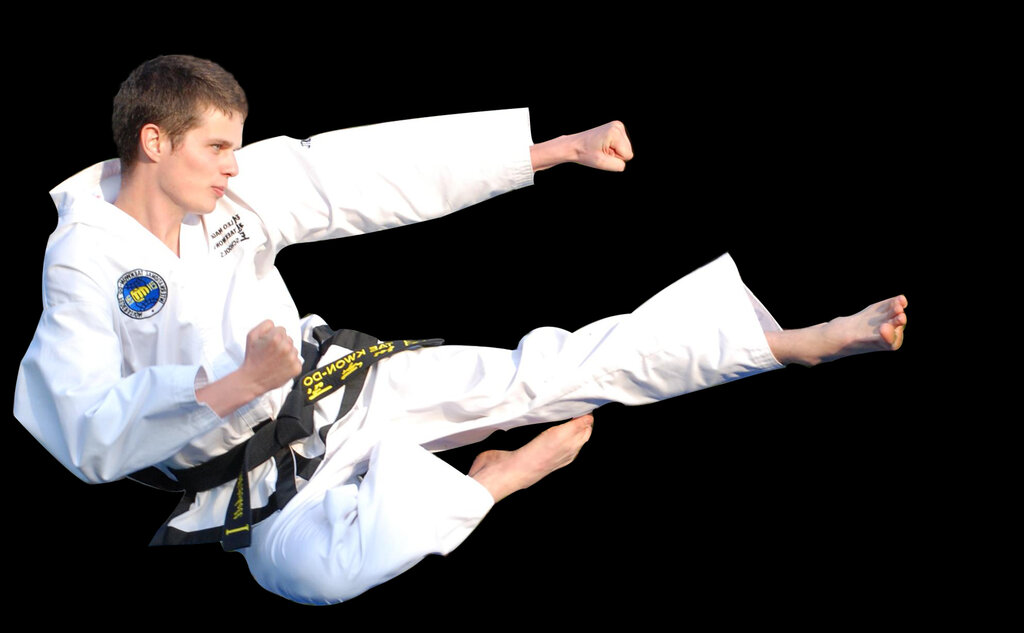
Martial arts like Karate and Taekwondo often emphasize linear, snapping strikes. The goal is to achieve maximum velocity at the point of impact. This is done through rapid extension of the joints, like the knee in a front kick or the elbow in a reverse punch. The majority of the power generation happens at the end of the kinetic chain, resulting in a quick, whip-like impact. The limb is immediately retracted to prepare for the next movement.
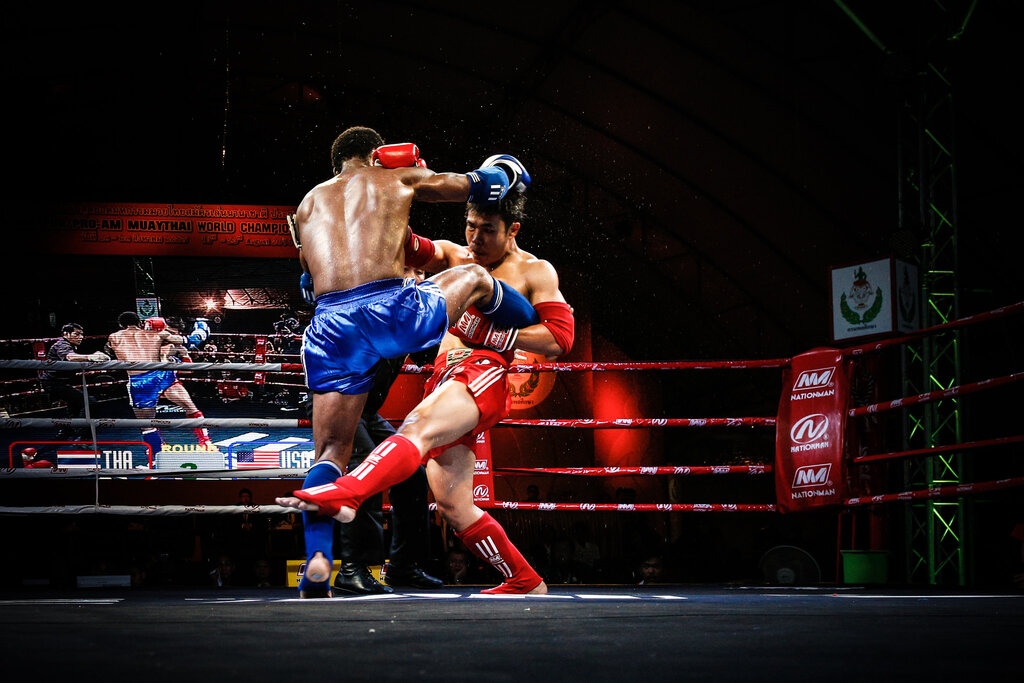
In contrast, styles like Boxing and Muay Thai rely heavily on rotational torque. Power is generated from the core and hips, rotating the entire body mass into the strike. Instead of just extending a limb, the fighter turns their whole body, treating the arm or leg like the end of a swinging bat. This method sacrifices some speed and reach for a massive increase in momentum and impact force. The strike is designed to go through the target, not just hit it.
| Characteristic | Linear Striking (Karate/Taekwondo) | Rotational Striking (Boxing/Muay Thai) |
|---|---|---|
| Primary Mover | Limb Extension (Knee/Elbow) | Hip & Torso Rotation |
| Energy Source | Quick muscle contraction | Ground Reaction Force & Momentum |
| Impact Goal | High-velocity snap | Full body mass transfer |
| Follow-through | Minimal, quick retraction | Significant, drives through target |
| Analogy | Cracking a whip | Swinging a baseball bat |
Force from the Floor
Regardless of the style, effective striking hinges on mastering the (GRF). This is a direct application of Newton's third law: for every action, there is an equal and opposite reaction. When you push off the ball of your foot into the ground, the ground pushes back with the same amount of force. This is the raw energy you channel into your strike.
Proper skeletal alignment is crucial for this energy transfer. Your bones must be "stacked" correctly to form a solid structure, preventing energy from leaking out. In a straight punch, for example, a straight line should connect your fist, wrist, elbow, and shoulder at the moment of impact. Any bend or misalignment acts like a crack in a pipe, reducing the pressure and power that reaches the target. This alignment not only maximizes force but also protects your joints by distributing the shock of impact across your entire frame.
This leads to a key trade-off in striking philosophy.
Is it better to hit with a fast, sharp 'snap' or a heavy, crushing 'push'?
A Karate-style 'snap' kick focuses on impulse—a large amount of force delivered over a very short period. The goal is to penetrate the target quickly and retract. The equation for impulse is . By making the contact time () as small as possible, the average force () becomes immense, even with a smaller amount of momentum.
A Muay Thai 'push' kick, on the other hand, is all about momentum (). By rotating the entire body mass () into the kick and following through, the fighter aims to transfer as much momentum as possible to the opponent, causing displacement and blunt force trauma. The contact time is longer, but the total energy delivered can be far greater.
Neither approach is definitively superior; they are simply different tools for different situations. A snapping front kick might be ideal for creating distance or striking a vulnerable point quickly, while a full-power roundhouse kick is designed to end a fight. Understanding the biomechanics behind both allows a martial artist to choose the right tool for the job.
What is the term for the sequence of movement that transfers energy from the ground up through the body to deliver a strike?
According to the text, a martial art like Karate that emphasizes snapping strikes primarily focuses on maximizing which physical principle?