Tactical Combat and Intermediate Striking Mechanics
Kinetic Linking and Torque
The Source of Power
A powerful strike isn't born in the arm. It starts from the ground up. Think of your body as a whip. The handle is your feet planted on the floor, and the tip is your fist. To make the whip crack, you don't just flick your wrist; you initiate a wave of energy that travels its entire length. This is the core idea behind the in striking.
Every punch and kick you throw is a transfer of energy. You push off the ground, that force travels through your legs, gets amplified by the rotation of your hips and torso, and finally accelerates through your shoulder, arm, and into your fist. Simply throwing an arm punch without engaging the rest of your body is like trying to crack a whip by only moving the tip. You'll get some speed, but you'll be missing almost all of the potential power.
Power isn't about arm strength. It's about full-body coordination and efficient energy transfer.
The Engine Room
Your hips and core are the engine of your power. This is where the linear force from the ground is converted into rotational force, or torque, which dramatically increases the impact of your strike. When you throw a cross, the movement begins with your back foot pivoting. This pivot initiates a chain reaction: your hips rotate, your core engages and twists, and only then does your shoulder rotate and your arm extend.
This sequence is crucial. If your arm moves before your hips, the chain is broken, and you lose power. The goal is to create a seamless wave of motion. Your core muscles act as the transmission, connecting the powerful rotation of your hips to your upper body. A tight, engaged core ensures that no energy is lost during this transfer.
By mastering this sequence, you ensure every strike has structural integrity. The force is backed by your entire body weight and the ground you're standing on, not just the muscles in your arm. This is the difference between a stinging punch and a knockout blow.
Stance Dictates Strategy
Your stance is the foundation from which all strikes are launched, and it involves tactical trade-offs. The two primary stances you'll encounter are the bladed boxing stance and the square Muay Thai stance.
The traditional boxing stance is narrow and angled, presenting a smaller target to your opponent. It's built for mobility, allowing for quick footwork, slips, and explosive linear strikes like the jab and cross. However, this narrow base can be less stable against lateral forces, making it vulnerable to leg kicks and sweeps.
In contrast, the Muay Thai stance is wider and more square-on, with weight often distributed more evenly or slightly biased to the rear leg. This provides a solid, stable base perfect for throwing and absorbing powerful roundhouse kicks. It allows a fighter to easily lift a leg to check an incoming kick without losing balance. The trade-off is slightly reduced in-and-out footwork speed compared to a boxer's stance.
| Stance | Advantages | Disadvantages |
|---|---|---|
| Boxing | High mobility, smaller target, quick linear punches | Less stable, vulnerable to leg kicks |
| Muay Thai | Very stable, powerful kicks, strong kick defense (checking) | Slower linear footwork, larger target |
Neither stance is inherently superior; they are simply specialized for different rule sets and strategies. An MMA fighter might adopt a hybrid stance, trying to find a balance that allows for both powerful striking and effective takedown defense.
Staying Grounded
Generating immense rotational force is useless if it throws you off balance. Every pivot and weight shift must be controlled. A key principle is keeping your head over your , which is typically located between your feet. If your head drifts too far past your lead foot when you throw a cross, you're overextended. You might land the punch, but you'll be in a poor position to defend the counter-attack or throw a follow-up strike.
Proper structural alignment also helps with impact absorption. When you block or take a hit, a solid connection to the ground allows you to dissipate the force through your entire frame. If you're off-balance, the same strike will have a much greater effect. Think of your stance as the suspension on a car. A strong, stable base allows you to handle the bumps and impacts of a fight without getting knocked off course.
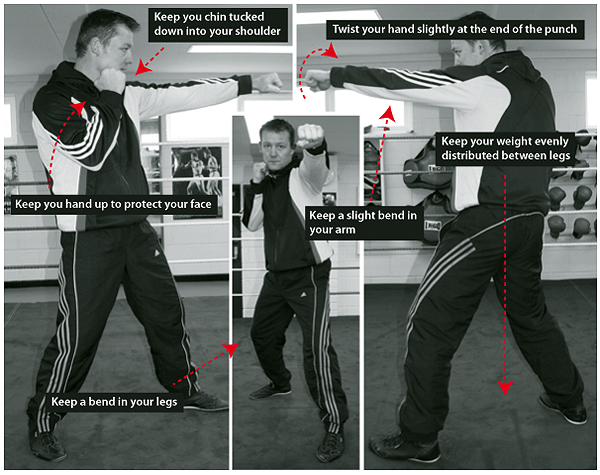
Practice your pivots slowly. Feel the weight transfer from your back foot to your front foot. Notice how your hips and shoulders rotate in unison. By building this mind-muscle connection, you can ensure that your strikes are not only powerful but also balanced and safe.
Now, let's test your understanding of these mechanics.
According to the principle of the kinetic chain, what is the initial source of power for a strong punch?
Which of the following describes the correct sequence of motion for generating maximum power in a cross?
By focusing on these principles of kinetic linking and balance, you can transform your basic punches into structurally sound, powerful weapons.