Tactical Basics of Simple Combat
Stance and Balance Optimization
Your Stance is a Spring, Not a Statue
Forget the idea of a static, perfect posture. In a dynamic situation, your stance isn't a pose you hold; it's a platform for immediate action. Think of it as a coiled spring, loaded with potential energy. This is the core of an 'active' stance: your weight is never truly settled. It's constantly prepared to shift, whether to power a strike, absorb an impact, or evade an attack. This all starts from the ground up.
Every powerful movement, from a punch to a kick, begins with a connection to the floor. Your feet don't just hold you up; they drive force through your entire body.
This transfer of energy is called , or the kinetic chain. When you push off the ground, that force travels up through your ankles, knees, and hips, rotating your torso and finally extending through your limb for a strike. A solid, active stance is the crucial first link in that chain. If your base is weak or your weight is poorly distributed, the chain breaks, and your power dissipates before it ever reaches its target.
Width, Weight, and Trade-Offs
The width of your stance directly impacts your stability and mobility. There's no single "best" width; it's a constant negotiation based on the situation. Your choice involves clear biomechanical trade-offs.
| Stance Width | Advantages | Disadvantages |
|---|---|---|
| Narrow | Greater mobility, faster footwork, longer reach. | Less stable, easier to off-balance, generates less power from the hips. |
| Wide | Excellent stability, powerful rotational force for strikes. | Slower movement, more telegraphed actions, vulnerable to leg attacks. |
Your weight distribution is just as important. A common mistake is to keep your weight perfectly centered (50/50). While this feels balanced, it's a static state. An active stance uses a slight weight bias, typically 60/40 on the back foot for defense and readiness, or shifting to 60/40 on the front foot for aggressive, forward-moving attacks.
Staying Balanced in Motion
True balance isn't about standing still; it's about controlling your while you move. Imagine a tightrope walker. They aren't rigid; they make constant, small adjustments to keep their center of gravity over their base of support (the rope). In combat, your base of support is the area between your feet. As long as your center of gravity stays within that area, you are balanced.
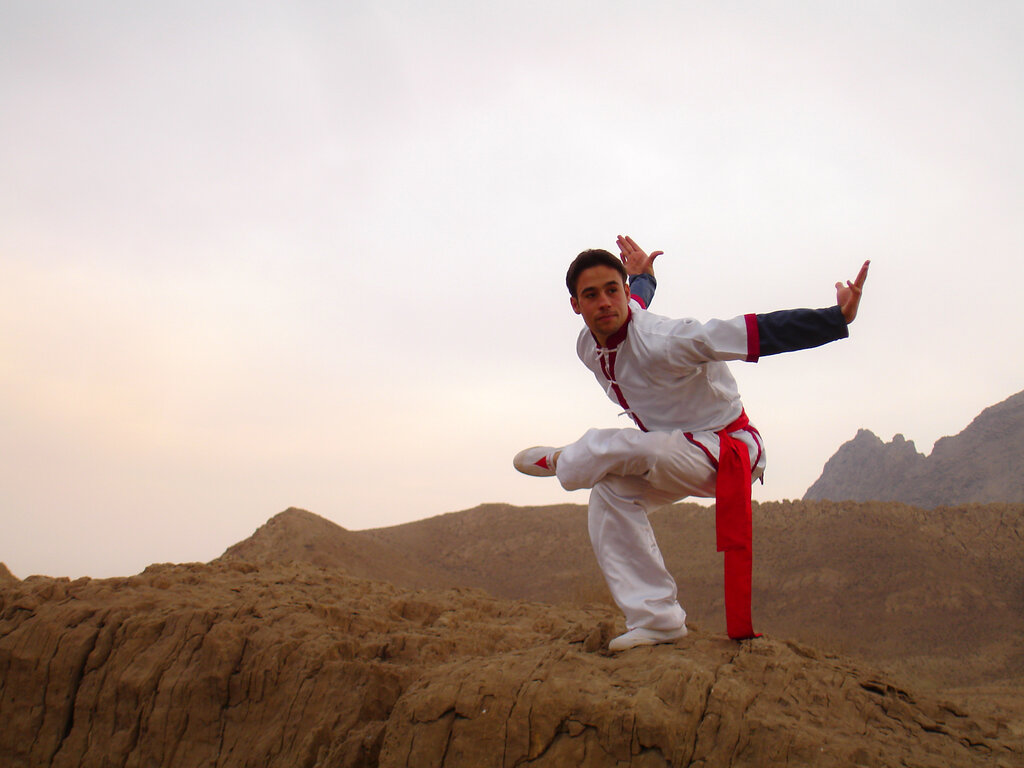
This becomes critical when you throw a strike and miss. Over-committing to a punch or kick can send your center of gravity sailing past your base of support, leaving you vulnerable. The key to recovery is not to freeze, but to move your feet. By taking a quick step or adjusting your stance, you reposition your base of support back underneath your center of gravity. Practice this: throw a powerful strike into the air and consciously catch your balance by moving your feet, not by tensing up.
The point of our stance training and the stances in our forms is to learn how to move, not merely how to stand.
Let's review some key concepts.
Ready to test your understanding of these principles?
What is the primary characteristic of an 'active' stance?
The transfer of force from the ground up through the body to power a strike is called __________.
Mastering these concepts transforms your stance from a simple posture into a dynamic engine for movement and power.