SystemVerilog FPU and Custom Protocol Design
IEEE 754 Standard
A Universal Language for Numbers
Computers are great with integers, but the real world is messy. It's filled with fractions and irrational numbers. How can a machine that only thinks in 0s and 1s represent a number like 9.75 or π? Early computers each had their own way of doing this, which led to a lot of problems. Calculations on one machine would give slightly different answers on another. It was a digital Tower of Babel.
To avoid chaos, everyone agreed on a standard: IEEE-754.
The IEEE 754 standard is a set of rules that defines how computers should handle these “floating-point” numbers. It ensures that a calculation performed on a computer in one country will produce the exact same result as on a computer halfway across the world. This consistency is the bedrock of modern scientific and financial computing.
Anatomy of a Floating-Point Number
The standard breaks every number down into three parts, similar to scientific notation. Think of the number 1,234.5. In scientific notation, we might write it as . It has a sign (positive), a set of significant digits (the mantissa), and an exponent that tells us where to put the decimal point.
Floating point is just scientific notation in base 2.
A standard 32-bit floating-point number, also known as a “single-precision” float, allocates its 32 bits very specifically across three fields:
- Sign (1 bit): This is the simplest part. A
0means the number is positive, and a1means it's negative. - Exponent (8 bits): This field determines the magnitude of the number. It works like the exponent in scientific notation, shifting the binary point to the left or right.
- Mantissa (23 bits): Also called the significand or fraction, this holds the actual digits of the number. It represents the precision.
Normalization and Special Cases
To be as efficient as possible, IEEE 754 uses a trick called normalization. In binary scientific notation, any non-zero number can be written to start with a 1. For example, the binary number 1011.1 could be written as . Since the leading 1 is always there for normalized numbers, we don't need to waste a bit storing it. It's implied, giving us an extra bit of precision for free.
But what about numbers like zero? Or concepts like infinity? The standard reserves specific exponent patterns for these special cases.
| Case | Exponent Bits | Mantissa Bits | Meaning |
|---|---|---|---|
| Zero | All 0s | All 0s | The value 0 (positive or negative based on sign bit) |
| Denormalized | All 0s | Not all 0s | Very small numbers close to zero |
| Infinity | All 1s | All 0s | Positive or negative infinity |
| NaN | All 1s | Not all 0s | "Not a Number," the result of an invalid operation like |
Denormalized numbers are a clever way to handle values that are too small to be represented with the usual leading 1. They allow for a more gradual underflow to zero instead of an abrupt drop-off.
NaN is particularly useful. It allows a program to continue running even after a mathematical error occurs, with the error propagating through the calculations in a predictable way.
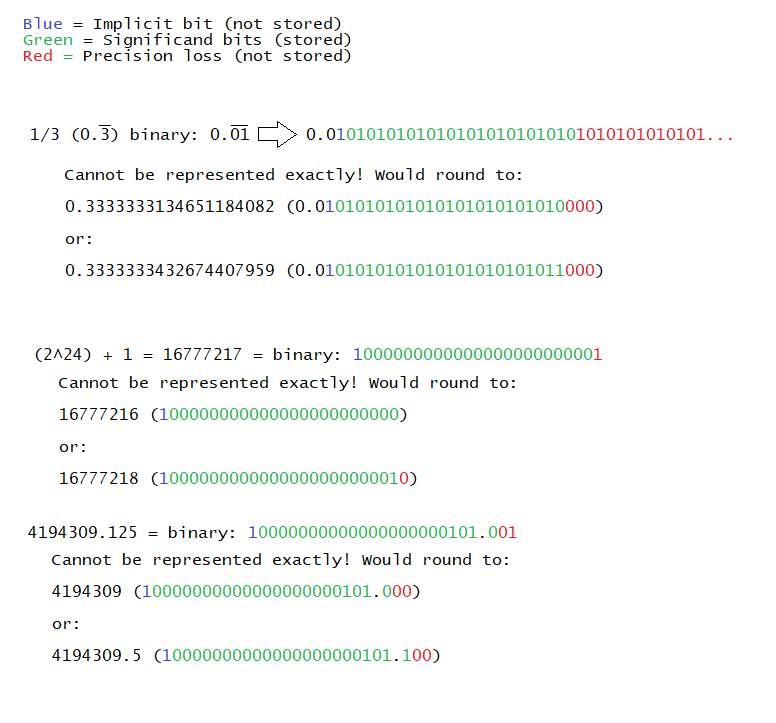
Finally, the standard defines several rounding modes. When a calculation produces a result with more precision than can be stored, it needs to be rounded. The IEEE 754 standard specifies rounding rules, such as "round to nearest, ties to even," ensuring that rounding is also performed consistently across all compliant systems.
Meeting the IEEE-754 specification for floating-point requires that final results of addition, subtraction, multiplication, division, and square root are correctly rounded based on the user-selected rounding mode.
Let's check your understanding of these concepts.
What was the primary motivation for creating the IEEE 754 standard?
A standard 32-bit (single-precision) floating-point number is divided into which three parts?
Understanding the IEEE 754 standard is fundamental to computer arithmetic. It's the reason our complex digital world can agree on the simple reality of numbers.