Systems Thinking Mastery for Leaders
Complex System Archetypes
The Stories Systems Tell
Systems often tell the same stories over and over. A product launch that starts strong but then fizzles out. A team that's constantly firefighting but never fixing the root cause. A budget crisis that seems to appear out of nowhere every year. These aren't isolated incidents; they are recurring patterns driven by the underlying structure of the system itself.
These classic stories are called s. Think of them as blueprints for common problems. They are combinations of reinforcing and balancing feedback loops that interact in predictable ways, often with surprising and counterintuitive results. By learning to recognize these archetypes, you can move from simply reacting to symptoms to diagnosing the structure that causes them in the first place.
Problem-Solving Gone Wrong
Many archetypes emerge from our best efforts to solve urgent problems. We see an issue and apply what seems like a logical fix, only to find ourselves back where we started, or worse.
Fixes that Fail: This is the story of the quick fix with a hidden cost. A problem symptom cries out for a solution. We apply a fix that makes the symptom go away quickly. However, this fix generates an unintended, often delayed, consequence that makes the original problem even worse. Over time, we become more and more reliant on the 'fix'.
For example, a company facing a cash flow problem might cut its R&D budget. This provides an immediate cash infusion (the fix), but over time, the lack of innovation (unintended consequence) causes its products to become obsolete, leading to a far worse revenue problem down the road.
Shifting the Burden: This archetype is a more insidious cousin of Fixes that Fail. Here, a problem symptom has two potential solutions: a quick symptomatic one and a more difficult, delayed fundamental one. We repeatedly choose the symptomatic solution, which not only has side effects but also erodes our ability or will to implement the fundamental solution. A dependency is created.
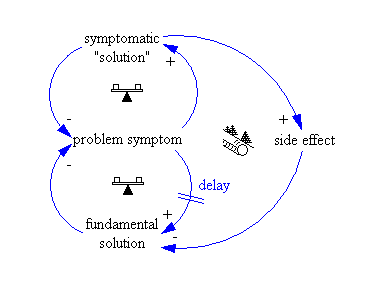
Imagine a manager who consistently steps in to solve their team's problems (symptomatic solution) instead of training them to solve problems themselves (fundamental solution). In the short term, problems get solved. But the team never develops critical skills, making them more dependent on the manager for the next crisis. The burden of problem-solving has shifted entirely to the manager.
The Perils of Growth
Growth feels good, but systems often contain the seeds of their own limitations. These archetypes describe how growth can stall or create destructive competition.
Limits to Success: This story begins with a successful reinforcing loop. An effort is generating great results, and things are growing exponentially. But as growth continues, it runs up against a limiting factor, which activates a balancing loop that slows, stops, or even reverses the growth.
A classic example is a successful startup. Initial rapid growth (reinforcing loop) from a popular product eventually strains its small customer support team. Service quality drops, customer complaints rise, and the company's reputation suffers (balancing loop), causing new sales to slow dramatically. The very success of the product created the limit.
Growth and Underinvestment: This is a specific and dangerous form of Limits to Success. An organization sees growth but fails to invest adequately in the capacity needed to support that growth. As performance declines due to the capacity strain, the perceived need to invest also declines, creating a self-fulfilling prophecy of stagnant or collapsing performance.
A factory might push its machines harder to meet rising demand instead of investing in new equipment. As the old machines break down more frequently, production capacity falls, leading management to believe the demand was just a temporary spike, justifying their decision not to invest. The growth engine starves itself.
Success to the Successful: This archetype describes how winners tend to keep winning. Two or more individuals or groups are competing for a limited resource. Whichever one starts with a slight advantage or gets an early lead gets more resources, which improves their performance, which in turn earns them even more resources. It’s a powerful reinforcing loop.
In a company, a manager might assign a promising project to their 'star' employee. The success of that project gives the employee more visibility and access to better opportunities, while another capable but less-proven employee gets overlooked and their skills stagnate. Over time, one career soars while the other languishes, based on an initial allocation of resources.
Erosion and Escalation
The final set of archetypes deals with slowly eroding standards and rapidly escalating conflicts. They are subtle but powerful.
Drifting Goals: In this pattern, a gap between a goal and the current reality creates pressure. Instead of taking action to bring reality in line with the goal, we lower the goal to relieve the pressure. This creates a reinforcing loop of gradual decline, where each lowered goal becomes the new baseline for future compromises.
Think of a company that consistently misses its quarterly sales targets. At first, there are strong efforts to improve. But after a few quarters of failure, the pressure mounts, and management decides to make the next quarter's target 'more realistic.' This reduces the immediate pressure but sets a precedent for lower performance, leading to a slow, downward spiral of expectations and results.
Tragedy of the Commons: This occurs when multiple individuals, acting independently in their own self-interest, deplete a shared, limited resource, even when it is clear that it is not in anyone's long-term interest for this to happen.
The classic example is a shared pasture where several herders graze their cattle. Each herder thinks, "What's the harm of adding just one more cow?" The benefit to the individual herder is clear, while the cost of slightly less grass is shared by everyone. But when all herders make the same 'rational' decision, the pasture is overgrazed and destroyed, and all the cattle starve. The collapses.
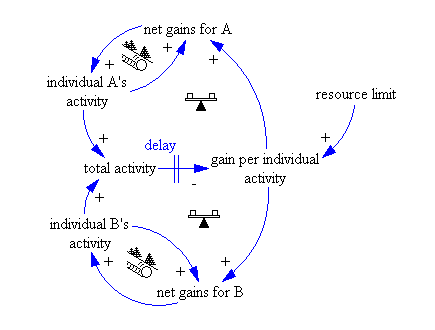
Escalation: In this archetype, two parties see their own well-being as dependent on having an advantage over the other. One party takes an action to gain an advantage, which the other party sees as a threat. They respond with a more aggressive action to regain their advantage. This provokes a counter-response, and the two reinforcing loops feed on each other, leading to a runaway cycle of competition.
This pattern is obvious in arms races between nations, but it also appears in business as price wars. One company lowers its prices to gain market share. A competitor responds by lowering theirs even more. Soon, both are locked in a battle that erodes profit margins for everyone, with neither gaining a sustainable advantage.
A software company cuts its quality assurance (QA) budget to meet quarterly profit targets. In the short term, profits increase. However, over the next year, more bugs slip into the final product, leading to customer dissatisfaction and a drop in sales that far exceeds the initial savings. Which system archetype does this scenario best illustrate?
A manager repeatedly steps in to handle complex customer complaints for their team. While this solves the immediate problem, the team never learns how to de-escalate difficult situations themselves. Over time, they become completely reliant on the manager for any non-routine issue. This is a classic example of:
Recognizing these archetypes in the wild is the first step. They provide a powerful lens to understand why problems persist and how our own actions can contribute to the very outcomes we're trying to avoid.