Systems Thinking Fundamentals
Introduction to Systems Thinking
Seeing the Bigger Picture
Most of the time, when we face a problem, our first instinct is to break it down. We look at the individual pieces, assuming that if we fix each part, we’ll fix the whole thing. This is traditional, analytical thinking. It’s useful for simple, mechanical problems, but it often fails when things get complex.
Systems thinking takes a different approach. Instead of breaking things apart, it focuses on how the pieces connect and interact. It’s a way of seeing the forest, not just the individual trees.
Systems thinking is a way of understanding the world that focuses on how things are connected, not just how they function in isolation.
This way of thinking isn't new. It has roots in various fields throughout the 20th century, from biology to engineering and social sciences. Researchers realized that you can't understand a living organism, a company, or a city by only studying its components in isolation. You have to understand the relationships that bind them into a whole.
Linear vs. Systemic Views
Traditional analysis sees cause and effect as a straight line. Event A causes Event B, which causes Event C. It's simple and direct. For example, if a plant is wilting, linear thinking might conclude it needs water. The solution is simple: water the plant.
Systems thinking sees a web of connections. A wilting plant might need water, but it also might have poor soil, too much sun, or a pest. These factors influence each other. Watering a plant in bad soil might not solve the problem. Systems thinking looks for the underlying patterns and structures that cause the visible events.
Core Principles
Three core principles form the foundation of systems thinking: holism, interconnectivity, and feedback loops.
Holism
noun
The idea that systems and their properties should be viewed as wholes, not just as a collection of parts.
Think of a bicycle. If you lay out all its parts on the ground—the frame, wheels, chain, pedals—you don't have a bicycle. You just have a pile of bike parts. It's the specific arrangement and connection of those parts that creates something new, something with the property of transport. You can't understand "bicycle-ness" by studying a single gear.
The whole is greater than the sum of its parts.
Next is interconnectivity. This is the understanding that within a system, all parts are connected, and a change in one area can have ripple effects throughout the entire system. Sometimes these effects are obvious, but often they are subtle and delayed, making them difficult to trace back to the original cause.
Imagine a pond ecosystem. Adding a new species of fish doesn't just affect the pond's fish population. It can affect the insects the fish eat, the plants that hide the insects, and the clarity of the water. Everything is linked.
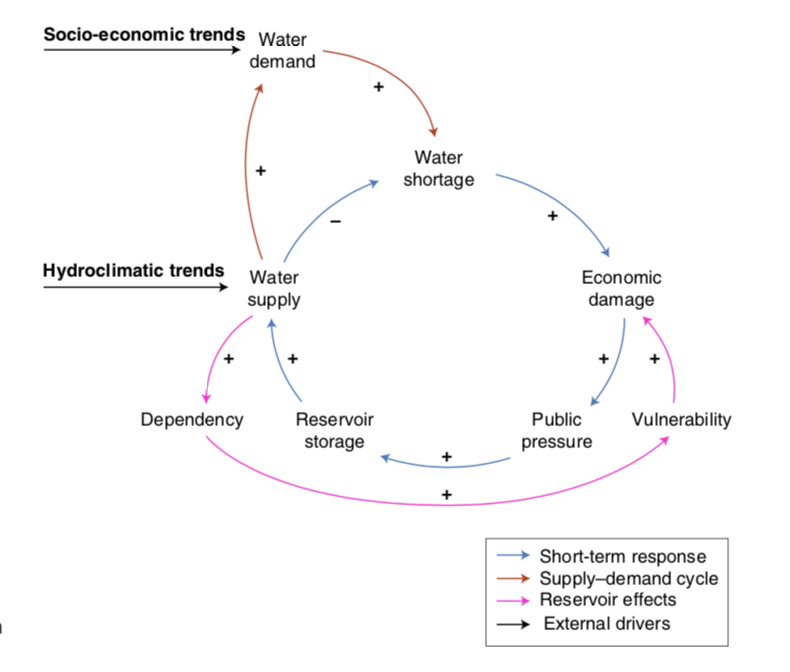
Finally, we have feedback loops. These are the engines that drive a system's behavior. A feedback loop occurs when the output of an action circles back to influence the next action. There are two main types.
Reinforcing loops amplify change. They create exponential growth or collapse. Think of a viral video. The more people who see it, the more they share it, causing even more people to see it. That's a reinforcing loop.
Balancing loops stabilize a system and resist change. They work to keep things in equilibrium. A thermostat is a perfect example. When the room gets too hot, the thermostat turns on the air conditioning to cool it down. When it gets too cool, it turns the AC off. It's constantly working to maintain a target temperature.
Understanding these principles helps us see the world differently. Instead of just seeing isolated problems, we begin to see the underlying systems that create them. This opens the door to more effective, lasting solutions.
What is the primary focus of systems thinking, as opposed to traditional analytical thinking?
The principle that a system's properties emerge from the specific arrangement and connection of its parts, and cannot be understood by looking at the parts in isolation, is known as ______.