Systems Thinking for PR Professionals
Introduction to Systems Thinking
Seeing the Whole Picture
Most of the time, we think in straight lines. If A happens, then B will happen. This is called linear thinking. It's useful for simple problems, like fixing a leaky faucet. You find the cause, fix it, and the problem is solved.
But what about complex problems, like traffic congestion, climate change, or managing a large company? In these cases, a simple cause-and-effect approach falls short. That's where systems thinking comes in. It’s a way of seeing the world as a web of interconnected relationships rather than a collection of separate parts.
Systems thinking attends to the connections between things, events and ideas.
A system is any set of interconnected parts that functions as a whole. Your body is a system. An ecosystem is a system. A family, a company, and a city are all systems. Systems thinking helps us understand how these parts interact and influence one another over time.
Linear vs. Systems Thinking
Traditional, linear thinking breaks problems down into smaller, more manageable pieces. The idea is that if you understand each piece, you understand the whole. This is a powerful approach for mechanical problems but less effective for living, dynamic systems.
Systems thinking, in contrast, focuses on the relationships that connect the pieces. It zooms out to see the larger patterns. Instead of asking "What's the one thing to fix?" it asks "How does this all work together?"
| Linear Thinking | Systems Thinking |
|---|---|
| Focuses on the parts | Focuses on the whole |
| Sees one-way cause-and-effect | Sees circular cause-and-effect |
| Tries to find one single cause | Looks for multiple causes and effects |
| Provides simple, direct answers | Reveals deeper, underlying patterns |
Core Principles
Three key principles form the foundation of systems thinking: interconnectedness, feedback loops, and emergent properties.
Everything is connected. You can't just do one thing. A change in one part of a system will inevitably ripple through and affect other parts, often in unexpected ways.
This leads to the idea of feedback loops. A feedback loop occurs when the output of an action circles back to influence the next action. It's a continuous cycle of cause and effect. There are two main types.
Reinforcing Loop
noun
A feedback loop that amplifies change, leading to exponential growth or decline. More leads to more, or less leads to less.
Balancing Loop
noun
A feedback loop that seeks stability and resists change. It tries to keep a system within a desired range, working toward a goal.
Finally, systems have emergent properties. These are characteristics of the whole system that are not present in any of its individual parts. For example, a single water molecule isn't wet. Wetness is an emergent property that arises only when you have many molecules together. Similarly, a single neuron isn't conscious, but the interactions of billions of neurons in the brain give rise to consciousness.
Understanding these properties helps us appreciate why a system is more than just the sum of its parts.
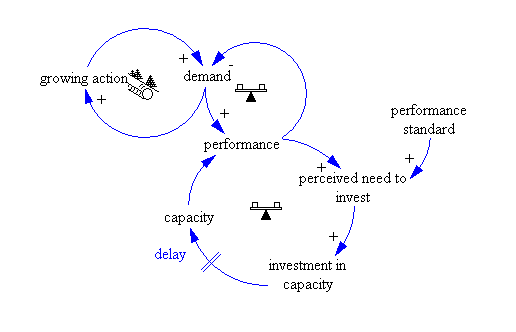
By applying these principles, we can begin to understand the complex dynamics at play in everything from business and ecology to social change. It's a shift from seeing objects to seeing relationships, from focusing on snapshots to seeing processes.
Let's test your understanding of these foundational concepts.
For which of the following scenarios is linear thinking the most effective approach?
A single bird's flight path is simple, but a flock of thousands of birds can create complex, coordinated patterns without a leader. This collective behavior is an example of what?
Thinking in systems opens up new ways to solve complex problems by revealing the hidden structures that drive behavior.