Systems Thinking for Artificial Intelligence
The Machine Learning Pipeline
The AI Factory Line
Artificial Intelligence isn't a single, magical box. It’s more like a factory assembly line. It takes in raw materials at one end, processes them through several stages, and produces a finished product at the other. This entire process is called the Machine Learning (ML) pipeline.
Understanding this pipeline is key. It shows how an idea becomes a functioning AI tool, like the one that recommends movies on your streaming service or filters spam from your inbox. Let's walk through the factory floor.
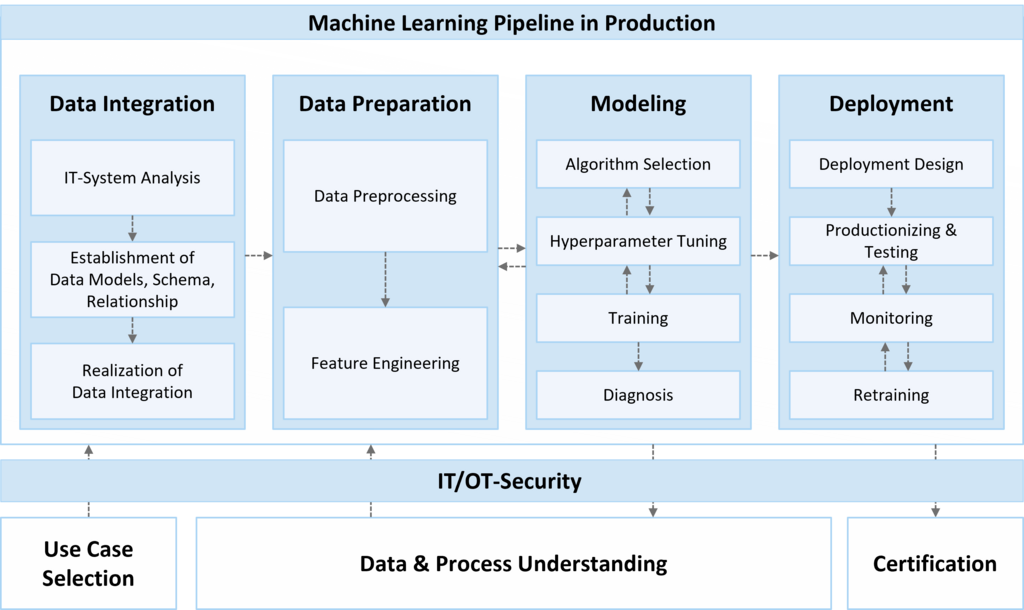
Preparing the Raw Materials
Every AI system starts with data. This could be anything: customer reviews, sales numbers, medical images, or photos of dogs. The first step, called data ingestion, is simply collecting this raw material. But raw data is almost always messy.
Imagine trying to bake a cake by throwing a carton of eggs, a bag of flour, and a sugar beet into a bowl. It wouldn't work. You need to prepare your ingredients first. That's data preprocessing. It involves cleaning the data by removing errors, filling in missing pieces, and formatting it consistently so the machine can understand it. This stage is critical — a model trained on bad data will only produce bad results.
The principle is simple: garbage in, garbage out. The quality of an AI is determined long before any 'learning' begins.
| Raw Data | Preprocessed Data |
|---|---|
| Review: "gr8 product, love it!!" | { "text": "great product love it", "sentiment": "positive" } |
| Temp: "98.6 F" | 98.6 |
| Image: A blurry, sideways photo | An upright, sharpened, consistently sized photo |
Training the Machine
Once the data is clean, the learning begins. This phase, known as training, is where the model finds patterns. It sifts through millions of examples, trying to build a mathematical map that connects inputs to correct outputs. For example, it might learn which words in a review usually signal a positive sentiment.
The model learns by adjusting its internal , which are often called weights. Think of these as thousands of tiny knobs. With each example, the model makes a guess. If it's wrong, it slightly turns these knobs and tries again. It repeats this process millions of times, fine-tuning its settings until its guesses are consistently accurate.
This knob-turning process is incredibly demanding. It requires massive computational power, which is why training often relies on (GPUs). While a standard processor (CPU) is a jack-of-all-trades, a GPU is a specialist. It can perform thousands of simple calculations simultaneously, making it perfect for the repetitive work of training a model.
Running in the Real World
After training is complete, the model's parameters are frozen. The learning phase is over. Now, it's ready to be used in a live application. This is called inference.
If training is like studying for an exam, inference is like taking the exam. It's the performance phase.
During inference, the model takes a new piece of data it has never seen before—like a brand new product review—and uses its trained parameters to make a quick prediction. Is it positive or negative? Because the heavy lifting of learning is already done, inference is much faster and less computationally expensive than training.
But the work isn't finished. The model's performance is constantly monitored. How accurate are its predictions? Are users correcting its mistakes? This new information creates a that provides more data to retrain and improve the model over time. The factory line never truly stops; it continuously refines its process to build a better product.
Now, let's test your knowledge of the AI pipeline.
What is the very first step in the Machine Learning pipeline?
Why is the 'data preprocessing' stage considered so critical for an AI model?
From raw data to a live application, the machine learning pipeline transforms information into intelligence, one step at a time.