Systems Biology and Modern Biotech Frontiers
Gene Regulatory Networks
Beyond the On/Off Switch
You already know the central dogma: DNA is transcribed into RNA, which is translated into protein. But this is like knowing that a car has an engine and wheels. The real magic is in the control systems—the accelerator, the brakes, the steering wheel—that determine when, where, and how fast the car goes.
In a cell, this control system is managed by a vast network of proteins called transcription factors (TFs). These aren't simple on/off switches. Instead, they act like dimmer knobs, finely tuning a gene's expression level. A TF's ability to influence a gene depends on its concentration in the nucleus and its binding affinity, or how 'stickily' it binds to specific DNA sequences.
A high-affinity TF can exert its effect even at low concentrations, binding tightly to its target. A low-affinity TF might need to be present in much larger numbers to have the same impact, binding more transiently. This dynamic interplay of concentration and affinity allows for incredibly precise and varied responses to cellular signals.
The cell isn't just turning genes on or off; it's constantly adjusting a complex dashboard of genetic dimmer switches.
The Regulatory Landscape
Transcription factors don't just bind anywhere. They recognise and attach to specific stretches of DNA known as cis-regulatory elements (CREs). Think of CREs as docking stations for TFs. The most familiar CRE is the promoter, located right next to the gene's starting line.
But the regulatory landscape is far more expansive. Many crucial CREs, called enhancers, can be located thousands of base pairs away from the gene they control. To exert their influence, the DNA itself performs a remarkable feat of acrobatics. It loops around, bringing the distant enhancer—and the TF bound to it—into direct physical contact with the gene's promoter. This contact helps recruit the machinery needed to start transcription.
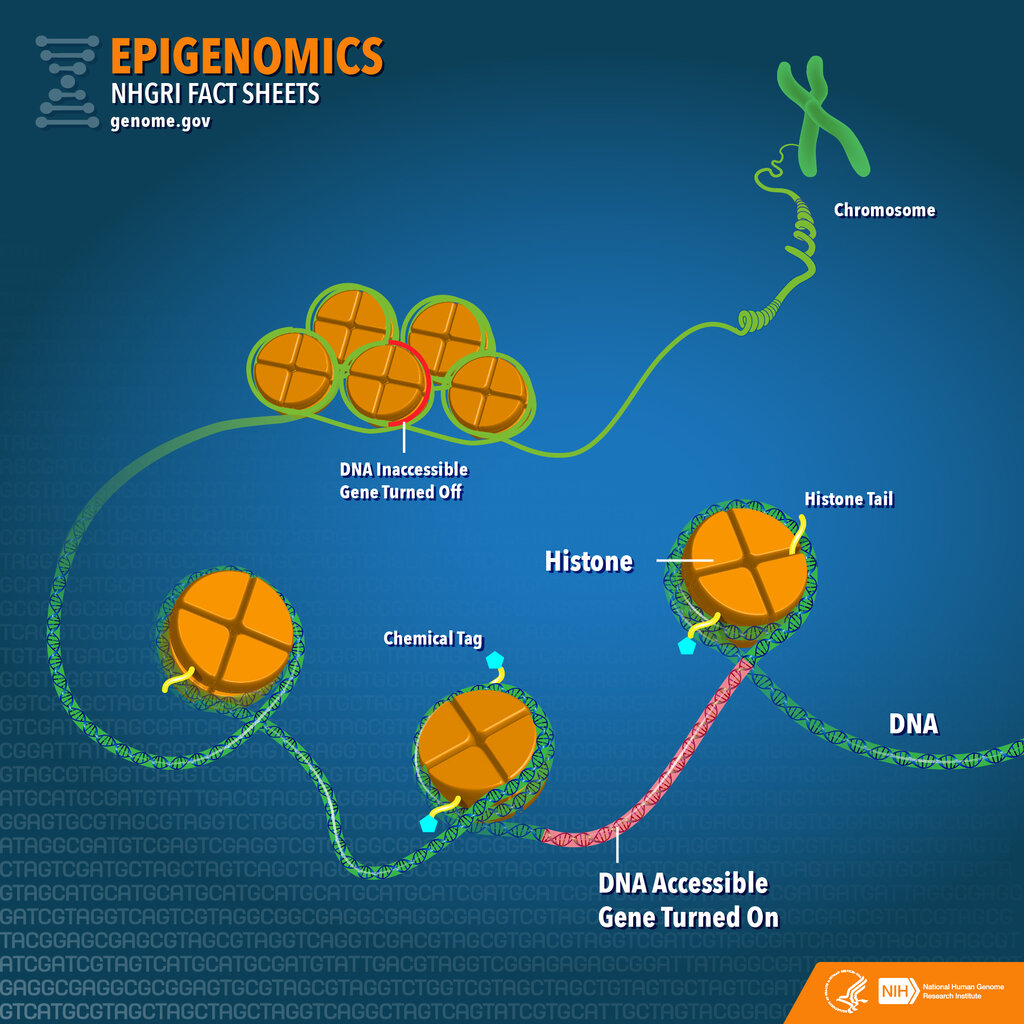
However, even the best docking station is useless if it's inaccessible. This is where epigenetic regulation comes in. The DNA in our cells is tightly wound around proteins called histones, a structure known as chromatin. When chromatin is densely packed (heterochromatin), the DNA is hidden and TFs can't access their binding sites. Chemical modifications can cause the chromatin to loosen up (euchromatin), exposing the regulatory elements and making the gene 'accessible' for transcription. This control over chromatin accessibility is a fundamental way cells determine which genes are even available to be switched on.
The Logic of Life
When we connect these components—TFs, CREs, and the genes they regulate—we reveal the wiring of the cell: the gene regulatory network. These networks are not random webs; they are built from recurring patterns of interaction called network motifs. These are the simple, reusable circuits that cells use to make complex decisions.
One common motif is the negative feedback loop, where a transcription factor activates a gene that produces a repressor protein. This repressor then turns off the very gene that made it. This is a classic mechanism for maintaining balance, like a thermostat turning off the heating once a room reaches the right temperature. It prevents the overproduction of a protein.
Another powerful motif is the feed-forward loop (FFL). In a simple FFL, a master TF (A) turns on a second TF (B). Both A and B are then required to turn on a target gene (C). This setup acts as a 'persistence detector'. A fleeting pulse of A might be enough to activate B, but if A disappears before B has accumulated, gene C won't be activated. Only a sustained signal from A can successfully turn on C. This filters out noise and ensures the cell only responds to meaningful, persistent signals.
By combining these and other motifs, cells create the complex logic that allows a single genome to produce hundreds of different cell types, each with a unique gene expression profile and function.
Mapping the Wires
Understanding these networks requires methods that can map interactions across the entire genome. Two cornerstone techniques are ChIP-seq and ATAC-seq.
ChIP-seq (Chromatin Immunoprecipitation Sequencing) answers the question: "Where is my favourite transcription factor binding?" Scientists use an antibody to grab onto a specific TF, pulling down the TF and any DNA it's currently attached to. This DNA is then sequenced. By mapping these sequences back to the genome, we can create a genome-wide map of all the binding sites for that one TF. It’s like finding all the locations a specific key can unlock.
ATAC-seq (Assay for Transposase-Accessible Chromatin with sequencing) answers a different question: "Which parts of the genome are open for business?" This technique uses an enzyme called a transposase that cuts and pastes DNA, but it can only access DNA in open, loosely packed chromatin. By sequencing the fragments the transposase inserts itself into, we can identify all the accessible regions across the genome. This gives us a map of all potential regulatory sites—promoters, enhancers, and insulators—that are active in a particular cell type at a specific moment.
| Technique | Key Question Answered | What It Maps |
|---|---|---|
| ChIP-seq | Where does a specific TF bind? | Genome-wide binding sites for one protein. |
| ATAC-seq | Which DNA regions are accessible? | Genome-wide open chromatin regions. |
By combining data from these methods, researchers can start to piece together the complex wiring diagrams of gene regulatory networks. We can see which TFs are binding to which accessible enhancers to regulate which genes, giving us an unprecedented view into the logic that drives cellular identity and function.
What is the primary role of transcription factors (TFs) in a cell?
An enhancer, a type of cis-regulatory element, must be located immediately next to a gene's promoter to function.
These networks are the foundation of systems biology. They explain how cells interpret signals, execute developmental programmes, and maintain their specific identities. It's a layer of complexity far beyond the simple sequence of A, C, G, and T.