Systems and Synthesis in Modern Biology
Gene Regulation Dynamics
The DNA Gatekeepers
Your genome contains the blueprint for every protein your body might ever need, but a cell doesn't express all its genes at once. A neuron has no use for the genes that produce stomach acid, and a skin cell doesn't need to make haemoglobin. Cells are specialists, and their specialisation depends on tightly controlling which genes are turned on or off at any given moment.
The first layer of control isn't at the gene level, but at the packaging level. A human cell contains about two metres of DNA, all of which must fit inside a nucleus just a few micrometres wide. To achieve this, DNA is wrapped around proteins called histones, forming a complex known as chromatin . This packaging isn't just for storage; it's an active gatekeeper.
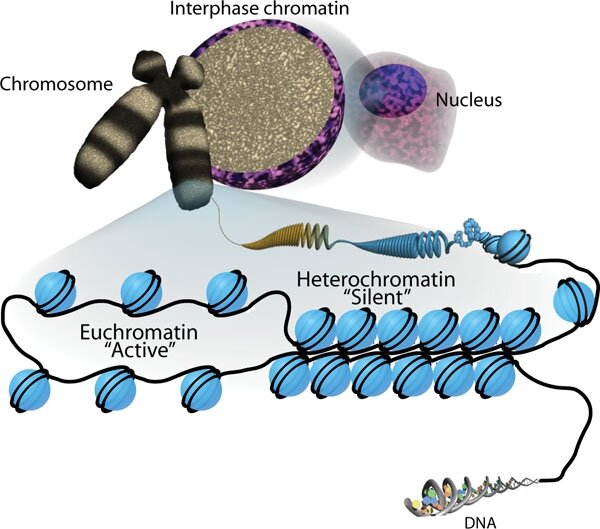
For a gene to be transcribed, the cellular machinery must be able to access it. If the chromatin is tightly wound, the gene is effectively hidden and silenced. If it's loose, the gene is accessible and can be expressed. This transition between condensed and open states is called chromatin remodelling.
Two key epigenetic mechanisms drive this process. The first is histone modification. Chemical groups can be attached to the histone proteins, altering how tightly they grip the DNA. A common modification is acetylation, the addition of an acetyl group. This neutralises the positive charge on histones, weakening their interaction with the negatively charged DNA. The result? The chromatin loosens, making genes more accessible. Deacetylation reverses this, tightening the coil and silencing genes.
Another powerful epigenetic mark is DNA methylation. This involves adding a methyl group directly to a cytosine base in the DNA sequence. High levels of methylation in a gene's promoter region are typically associated with gene silencing. It acts like a chemical lock, preventing transcription machinery from binding.
Orchestrating Transcription
Making a gene accessible is only the first step. Once the chromatin is open, the rate of transcription needs to be finely tuned. This is where specific DNA sequences called enhancers and silencers come in. Unlike promoters, which sit right next to a gene's starting point, these regulatory regions can be located thousands of base pairs away, either upstream or downstream.
Enhancers boost a gene's transcription rate, while silencers dampen it. They work by acting as landing pads for proteins called transcription factors. When an activator protein binds to an enhancer, it helps recruit the machinery needed for transcription. When a repressor protein binds to a silencer, it blocks this recruitment.
But how does a protein binding to an enhancer far away influence a gene's promoter? The DNA is flexible. It can loop around, bringing the distant enhancer (and its bound activator protein) into direct physical contact with the transcription machinery at the promoter. This intricate communication is facilitated by a large protein complex called the . It acts as a bridge, connecting the transcription factors at enhancers and silencers to the RNA polymerase at the gene's start site, integrating all the regulatory signals to either give a green light for transcription or a red light to stop.
Post-Transcriptional Fine-Tuning
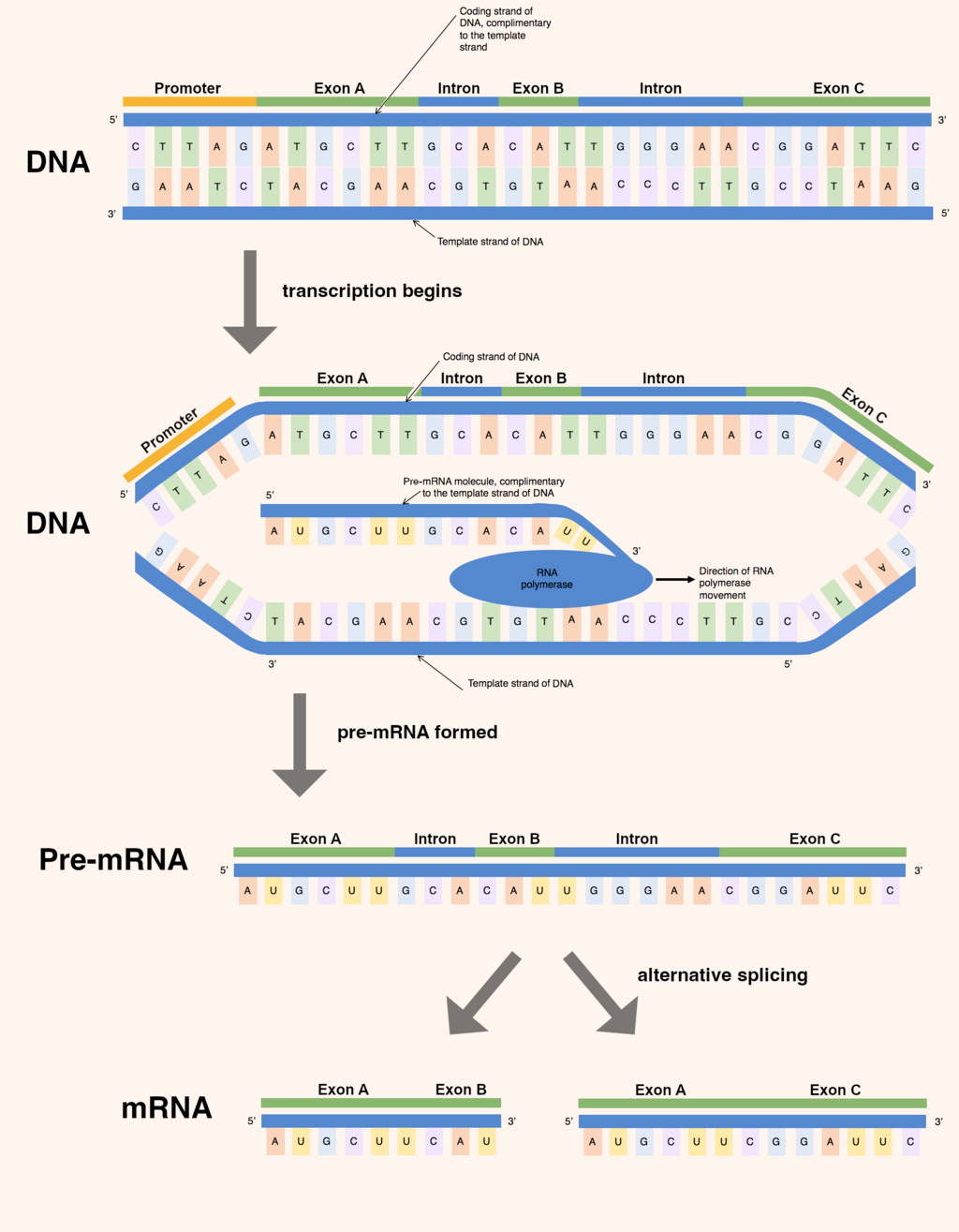
Once a gene is successfully transcribed into pre-messenger RNA (pre-mRNA), the regulation is still far from over. The cell has several powerful ways to modify the message before it's translated into a protein.
One of the most important is alternative splicing . Eukaryotic genes are composed of coding regions (exons) and non-coding regions (introns). During RNA processing, the introns are removed, and the exons are spliced together. Alternative splicing allows the cell to mix and match which exons are included in the final mature mRNA. By selectively skipping or including certain exons, a single gene can produce multiple, distinct protein variants, or isoforms. This dramatically expands the functional capacity of the genome, allowing a surprisingly small number of genes to generate a vast diversity of proteins.
Another crucial layer of post-transcriptional control involves (miRNAs). These are tiny, non-coding RNA molecules, typically just 22 nucleotides long. Unlike mRNA, they don't carry instructions for making a protein. Instead, their job is to regulate other genes.
A miRNA can bind to a complementary sequence on a target mRNA molecule. This pairing has two potential outcomes. If the match is perfect, it usually triggers enzymes to chop up and destroy the mRNA. If the match is partial, it can simply block the ribosome from translating the mRNA into a protein. In either case, the miRNA effectively silences the gene's expression after the transcript has already been made.
A Lasting Legacy
These layers of regulation create a stable cellular identity. The pattern of epigenetic marks—the specific histone modifications and DNA methylation profiles—defines a cell's type and function. When a cell divides, this epigenetic information is often passed down to its daughter cells. This is called epigenetic inheritance.
It's how a liver cell, after dividing, produces two new liver cells and not, for example, a brain cell. The epigenetic
memory
ensures that the correct sets of genes remain active or silenced, maintaining the cell's specialised role.
This system is not entirely fixed. Environmental factors, such as diet, stress, and exposure to toxins, can also influence our epigenome. These interactions provide a mechanism for the body to adapt to its surroundings by altering gene expression without changing the underlying DNA sequence itself. This dynamic interplay between our genes and our environment is a fundamental principle of modern biology, shaping both health and disease.
Ready to test your knowledge of these complex controls?
What is the primary function of chromatin remodelling in gene expression?
How does the acetylation of histones typically affect the chromatin structure and gene expression?
Understanding these regulatory networks is key to deciphering how a single genome can give rise to the complexity of a complete organism.