Systems and Cognitive Neuroscience
Synaptic Plasticity Mechanisms
When Neurons Wire Together
Learning and memory aren't abstract concepts floating in your mind; they are physical changes in your brain. Specifically, they happen at the synapse, the tiny gap where two neurons communicate. The strength of these connections can change based on how often they're used. This ability to adapt is called synaptic plasticity.
The core idea is often summarized as: "Neurons that fire together, wire together." When one neuron repeatedly helps to fire another, the connection between them gets stronger.
This strengthening process is called Long-Term Potentiation, or LTP. It's a persistent increase in synaptic strength that can last for hours, days, or even longer. It's the cellular basis for how we learn new skills or form lasting memories. Think of it like a footpath in a forest. The more it's walked on, the wider and more defined it becomes, making it easier to travel next time.
The Coincidence Detector
For a synapse to get stronger, two things need to happen at almost the same time. The presynaptic neuron must release glutamate (the primary excitatory neurotransmitter), and the postsynaptic neuron must already be excited or depolarised. This is where a special protein, the NMDA receptor, comes into play. It acts as a molecular coincidence detector.
Under normal conditions, the NMDA receptor's channel is blocked by a magnesium ion (), like a cork in a bottle. Glutamate can bind to the receptor, but nothing happens because of the block. However, if the postsynaptic neuron is already depolarised from other inputs, this positive charge inside the cell repels the magnesium ion, uncorking the channel.
With the block gone and glutamate bound, the channel opens wide, allowing a flood of calcium ions () to rush into the postsynaptic neuron. This surge of calcium is the critical trigger that initiates the cascade of events for LTP.
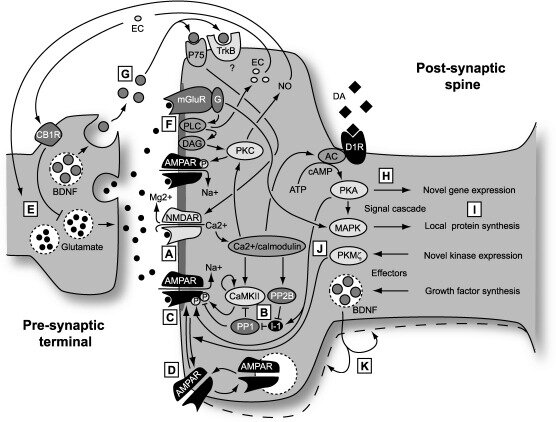
The influx of calcium activates several intracellular enzymes, most notably a kinase called CaMKII. This is the beginning of what's known as early-phase LTP, which happens quickly and lasts for a few hours. CaMKII has two main jobs. First, it phosphorylates existing AMPA receptors, which are the workhorse glutamate receptors that handle most fast excitatory signals. This phosphorylation makes them more responsive to glutamate.
Kinase
noun
An enzyme that adds phosphate groups to other molecules, a process called phosphorylation. This action often serves as an on/off switch for the target molecule's activity.
Second, and perhaps more importantly, CaMKII triggers the insertion of new AMPA receptors into the postsynaptic membrane. More receptors mean the synapse can generate a much stronger response to the same amount of glutamate. It's like opening more checkout lanes at a supermarket; you can handle more customers (signals) more efficiently.
Making Memories Stick
For a memory to last a lifetime, these short-term changes aren't enough. The connection needs to be physically remodelled. This requires late-phase LTP, a process that involves the synthesis of new proteins. With strong or repeated stimulation, the calcium signal travels all the way to the neuron's nucleus. There, it activates transcription factors, most notably .
Activated CREB switches on genes that produce proteins needed to build a more robust synapse. One of the most important of these is Brain-Derived Neurotrophic Factor, or BDNF. This protein acts as a sort of fertiliser for neurons, promoting their growth and health. In late-phase LTP, BDNF helps to stabilise the new AMPA receptors and can even trigger the growth of new dendritic spines, the small protrusions where synapses are located. This creates a larger, more permanent connection.
Weakening the Connection
Of course, brains don't just strengthen connections; they also need to weaken them to forget unimportant information and refine learned skills. This process is called Long-Term Depression, or LTD. It's not just the opposite of LTP; it has its own distinct mechanism.
LTD also involves NMDA receptors and calcium, but the pattern of stimulation is different. It's triggered by a long, slow, and low-frequency stimulation. This results in a small and slow rise in intracellular calcium, not the large, fast flood seen in LTP. This modest calcium signal activates a different set of enzymes, primarily protein phosphatases. Instead of adding phosphate groups like kinases do, phosphatases remove them. This leads to the removal of AMPA receptors from the synapse, weakening the connection and making the neuron less likely to fire in response to future signals.
LTP and LTD work together in a delicate balance. This allows our brains to be incredibly dynamic, constantly remodelling circuits based on our experiences.
Now, let's review the key terms we've covered.
Time to check your understanding.
What is the general term for the ability of synapses to strengthen or weaken over time, which is considered the basis for learning and memory?
The NMDA receptor is often called a "molecular coincidence detector" because it requires two conditions to be met simultaneously to open its ion channel. What are these two conditions?
By understanding these fundamental mechanisms, we can see how complex cognitive functions like learning and memory are built from simple molecular rules at the synapse.