Systematic Reviews and Meta-Analysis Essentials
Introduction to Systematic Reviews
What is a Systematic Review?
Imagine you have a serious question, like "Does daily exercise improve sleep quality?" You could ask one doctor, who might give you an answer based on their experience. That's helpful, but it's just one perspective.
Now, what if you could gather every single high-quality study ever conducted on that exact question? And what if you had a rigorous, transparent method for finding, evaluating, and combining their results? That's the essence of a systematic review. It's a method of research that synthesizes all the relevant evidence on a specific topic.
The main purpose is to provide a comprehensive, unbiased summary of the current evidence to answer a clearly defined research question. This helps people make informed decisions, whether they're doctors, policymakers, or just curious individuals.
Not Just Any Literature Review
You might have written a literature review for a school paper. Often, that involves finding a handful of relevant articles to provide background on a topic. It’s useful, but it’s not systematic. A traditional review can be subjective; the author might (unintentionally) select sources that confirm their existing beliefs.
A systematic review is different. It’s built on a foundation of objectivity and reproducibility. Think of it as a scientific experiment in itself. The researchers must create and publish a detailed plan, called a protocol, before they even begin. This plan lays out the exact steps they will take, from their search strategy to how they'll select and analyze studies. This transparency means that another team of researchers could follow the same protocol and arrive at the same conclusions.
| Characteristic | Traditional Review | Systematic Review |
|---|---|---|
| Question | Often broad and general | A specific, focused question |
| Search | Can be selective; not always exhaustive | Comprehensive and systematic to find all relevant studies |
| Selection Criteria | Not always specified | Clear, pre-defined inclusion and exclusion criteria |
| Quality Assessment | Often absent | Rigorous appraisal of the quality of each study |
| Reproducibility | Difficult to reproduce | Transparent process that can be replicated |
The key takeaway is the commitment to minimizing bias. By using a pre-planned, systematic approach, researchers ensure their review reflects the complete state of the evidence, not just a convenient or partial snapshot.
The Process in a Nutshell
Conducting a systematic review is a methodical process. While the details can be complex, the overall journey follows a clear path from a question to an evidence-based answer. Each step is designed to be deliberate and documented, ensuring the final result is trustworthy.
A common way to visualize the screening and selection part of this process (Step 4) is with a PRISMA flow diagram. It shows the flow of information through the different phases of a review, mapping out the number of records identified, included, and excluded.
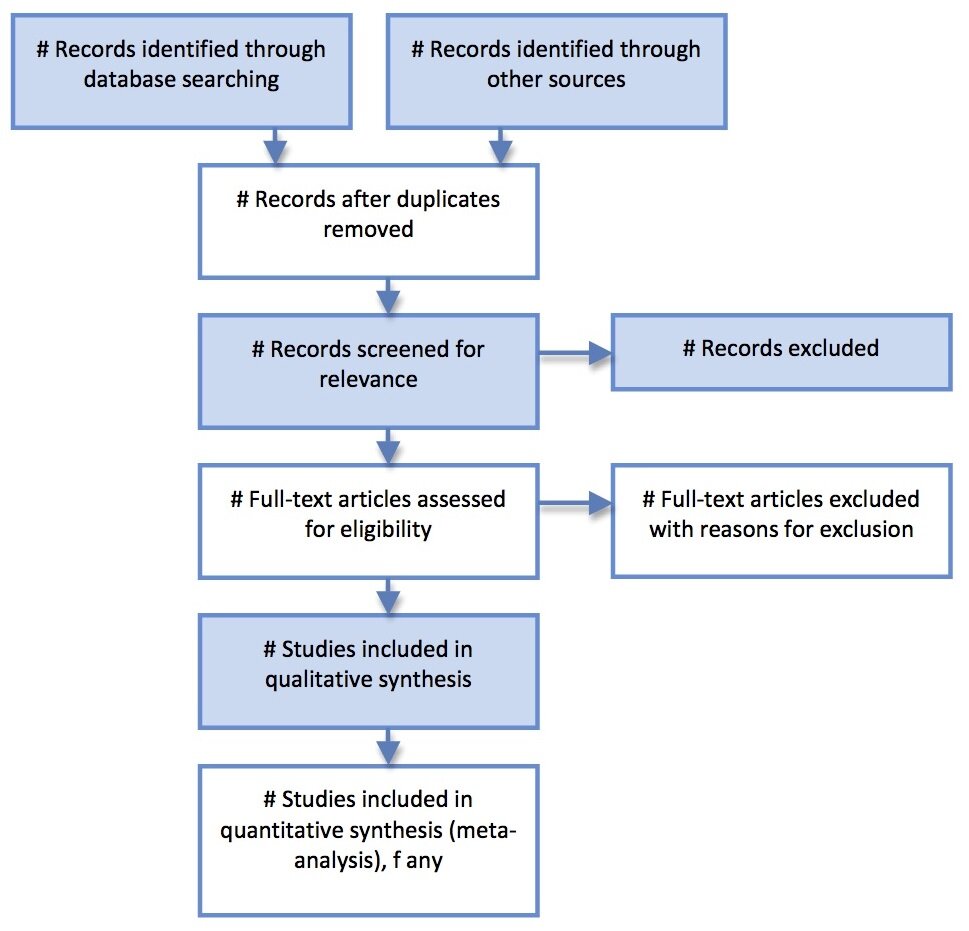
This structured approach is what makes systematic reviews a cornerstone of evidence-based practice in many fields, especially medicine and public policy. They provide the reliable, comprehensive answers needed to make important decisions.