System Thinking Fundamentals
Introduction to Systems Thinking
Seeing the Whole Picture
We often try to understand the world by taking it apart. To understand a car, we study the engine, the wheels, and the transmission. To solve a company's sales problem, we might focus only on the sales team. This approach is useful, but it can miss the bigger picture.
Systems thinking is a way of seeing the whole, not just the parts. It focuses on the connections and interactions that bind a system together. A system isn't just a collection of things; it's a set of interconnected elements that produces its own pattern of behavior over time. Your family is a system. A city is a system. A forest ecosystem is a system. The behavior of a system arises from the relationships among its parts.
In systems thinking, the whole is greater than the sum of its parts. You can't understand a system by looking at its components in isolation.
From Straight Lines to Webs
Most of us are trained in linear thinking. We see problems as a simple chain of cause and effect: A leads to B, which leads to C. If you press the gas pedal (A), the car goes faster (B). This is straightforward and often correct for simple, mechanical problems.
But the world is rarely that simple. Complex problems in business, society, and nature are more like webs than straight lines. In a web, everything is connected. An action in one area can have surprising effects somewhere else. Systems thinking helps us see and understand these webs of relationships.
Linear thinking is like watching a single domino fall. Systems thinking is like tapping a spiderweb and watching the vibrations spread throughout the entire structure. By focusing on the connections, we can anticipate ripple effects and find more effective solutions.
Systems thinking is a way of understanding the world that focuses on how things are connected, not just how they function in isolation.
Solving the Right Problem
A linear approach often leads to treating symptoms instead of the root cause. Imagine a town with a traffic problem. A linear solution might be to widen the roads. This may help for a short time, but wider roads might encourage more people to drive, eventually making the traffic just as bad, or even worse. The problem wasn't just the width of the roads; it was part of a larger system including public transport, housing locations, and work culture.
A systems thinker would look at the entire transportation system. How do all the pieces interact? Perhaps improving the bus network or creating bike lanes would be a more lasting solution. By understanding the whole system, we can avoid creating new problems while trying to solve the old one.
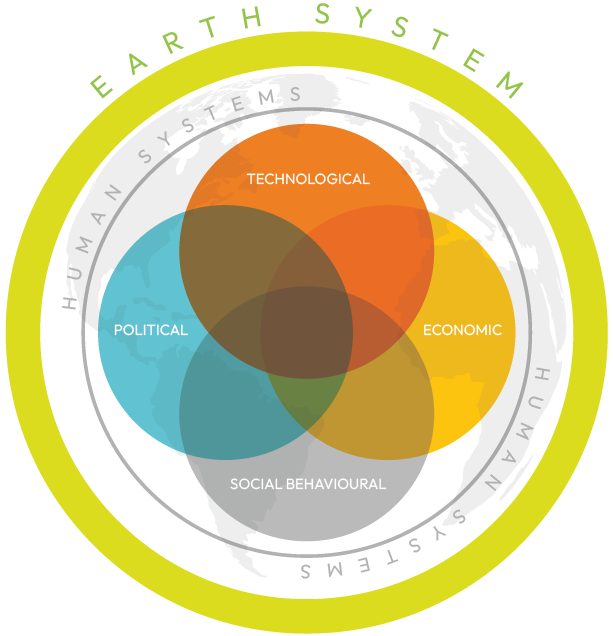
This holistic approach is valuable in many fields. In medicine, it means seeing a patient as a whole person whose health is affected by diet, stress, and environment, not just as a collection of symptoms. In business, it means understanding how departments like marketing, production, and customer service all influence each other. In environmental science, it's essential for understanding the complex web of life in an ecosystem.
By stepping back to see the full picture, we can identify leverage points—small changes that can lead to big improvements throughout the system.
Let's check your understanding of these foundational ideas.
What is the primary focus of systems thinking?
Linear thinking is best suited for understanding complex, interconnected problems like climate change or social inequality.
Systems thinking provides a powerful lens for understanding and navigating the complexity of the world around us.