Symmetric Encryption Explained
Introduction to Symmetric Encryption
One Key to Rule Them All
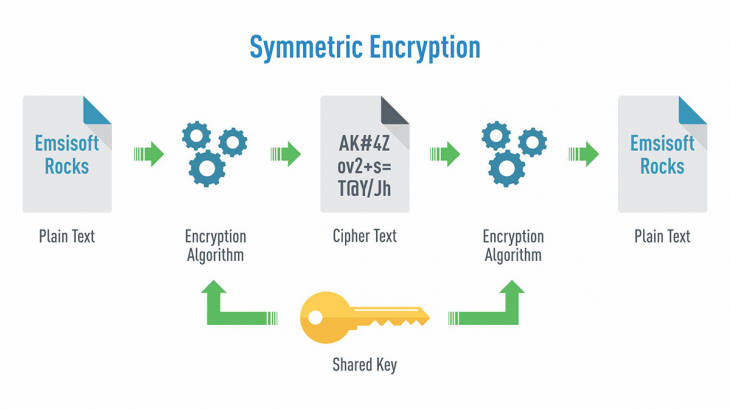
Symmetric encryption is the oldest and most straightforward type of cryptography. Think of it like a physical lock and key. If you want to send a secret message in a locked box, you need to send the key to your friend so they can open it. In this system, the same key locks and unlocks the box.
In the digital world, the “box” is your data, and the “key” is a secret piece of information, like a string of characters or numbers. You use this single, shared key to scramble your message into an unreadable format (encryption). The recipient uses the exact same key to unscramble it back into its original form (decryption). If anyone intercepts the message without the key, all they see is gibberish.
This idea has been around for centuries. One of the earliest known examples is the Caesar cipher, famously used by Julius Caesar to protect military communications. The “key” was simply a number representing how many letters to shift each character in the alphabet. For example, with a key of 3, the letter A becomes D, B becomes E, and so on. To decrypt the message, the recipient just shifts the letters back by 3.
# A simple Caesar cipher example

plaintext = "HELLO"
key = 3

# Encryption
ciphertext = ""
for char in plaintext:
  # Shift character by the key value
  encrypted_char = chr(ord(char) + key)
  ciphertext += encrypted_char

print(f"Ciphertext: {ciphertext}") # Output: KHOOR

# Decryption
decrypted_text = ""
for char in ciphertext:
  # Shift character back by the key value
  decrypted_char = chr(ord(char) - key)
  decrypted_text += decrypted_char

print(f"Decrypted: {decrypted_text}") # Output: HELLO
Of course, a simple shift cipher is easy to crack today. Modern symmetric algorithms like AES (Advanced Encryption Standard) are infinitely more complex, but they operate on the same fundamental principle of a single, shared key.
Speed vs. Secrecy
The biggest advantage of symmetric encryption is speed. The algorithms are relatively simple from a computational standpoint, which means they don't require a lot of processing power. This makes them ideal for encrypting large amounts of data quickly, such as entire hard drives or high-volume network traffic.
However, symmetric encryption has one major weakness: key distribution. How do you get the shared key to the recipient securely in the first place? If you send it over an unsecured channel, an attacker could intercept it. Once the key is compromised, all messages encrypted with it are exposed. This is often called the “key exchange problem.”
| Advantages | Limitations |
|---|---|
| Fast | Key Distribution |
| Computationally efficient | Sharing the key securely is a major challenge. |
| Good for bulk data | If the key is compromised, security is lost. |
Where You'll Find It
Despite its key-sharing challenge, symmetric encryption is everywhere in our digital lives because of its speed. It’s commonly used to protect data “at rest,” which is data stored on a device. For example, when you use BitLocker on Windows or FileVault on a Mac to encrypt your hard drive, you're using symmetric encryption.
It’s also used to protect data “in transit.” When you connect to a secure website using HTTPS, your browser and the server establish a temporary, shared symmetric key to encrypt the data flowing between them. This protects your credit card numbers, passwords, and other sensitive information during that session.
Symmetric encryption shines when you need to encrypt a lot of data quickly, and you already have a secure way to share the key.
Now that you've got the basics down, let's test your knowledge.
What is the defining characteristic of symmetric encryption?
What is considered the primary advantage of symmetric encryption?
Symmetric encryption forms a critical building block of modern cybersecurity. Its speed and efficiency make it the workhorse for protecting massive amounts of data, even if it needs a little help sharing its key.