SWOT Analysis for New Business Ideas
Introduction to SWOT Analysis
A Framework for Big Decisions
Before launching a new business or starting a big project, it helps to see the full picture. A SWOT analysis is a simple tool for doing just that. It's a way to organize your thoughts about what could help or hurt your venture.
SWOT stands for Strengths, Weaknesses, Opportunities, and Threats. It’s a strategic planning technique that helps you assess these four aspects of your business.
Think of it like a scout's report before a big game. You wouldn't just focus on your own team's star players; you'd also look at your team's injuries, the opponent's strategy, and even the weather forecast. A SWOT analysis gives you this complete view, helping you make smarter, more informed decisions instead of guessing.
Internal vs. External Factors
The four parts of a SWOT analysis are divided into two groups. Strengths and Weaknesses are internal factors—things you can control directly. Opportunities and Threats are external factors—things happening in the outside world that you can’t control but must respond to.
The goal is to match your internal strengths with external opportunities while also working to improve your weaknesses and defend against threats.
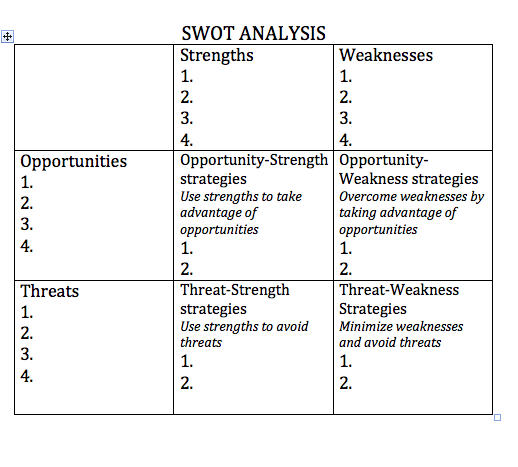
Let's break down each part.
Strengths
Strengths are the positive attributes inside your organization. What does your business do especially well? What unique resources can you draw on?
These could be tangible things like a patent on a new technology, a skilled team, or a prime physical location. They can also be intangible, like a strong brand reputation or a loyal customer base. Identifying your strengths helps you understand what you should lean into.
Example: A small bakery's strength is its secret family recipe for sourdough bread, which no competitor can replicate.
Weaknesses
Weaknesses are negative factors that are also within your control. It's crucial to be honest here. Where is your business lacking? What do your competitors do better?
This might include a limited budget, a lack of market presence, an inexperienced team, or outdated technology. Acknowledging weaknesses is the first step toward fixing them or finding ways to work around them.
Example: The same bakery has a weakness in its poor online presence; it has no website or social media, making it hard for new customers to find.
Opportunities
Opportunities are external factors that could give your business an advantage. These are trends or situations you can capitalize on. You don't create opportunities, but you can be ready to seize them.
Examples include a growing market for your product, new technology that could streamline your operations, or a competitor going out of business. Keeping an eye out for opportunities allows you to be proactive instead of reactive.
Example: A new office complex is being built down the street from the bakery, presenting an opportunity to attract a large lunch crowd.
Threats
Threats are external factors that could harm your business. Like opportunities, these are outside your control, but you can and should prepare for them.
Threats might include a new competitor entering the market, changing customer tastes, new regulations, or a negative economic downturn. Identifying threats allows you to build a defense and create contingency plans.
Example: A large coffee chain announces it's opening a location next door, posing a threat to the small bakery's coffee sales.
By mapping out these four areas, a business can develop a clear strategy. The bakery can use its strength (unique recipe) to capitalize on an opportunity (new customers) while working on its weakness (online presence) to mitigate a threat (new competition).
In a SWOT analysis, which two elements are considered external factors, happening outside the organization's direct control?
A company has a highly skilled and experienced team. In a SWOT analysis, this would be classified as a(n)...