SWOT Analysis for New Business Ideas
Introduction to SWOT Analysis
A Snapshot of Your Business
Before launching a new venture or making a big strategic move, you need a clear picture of where you stand. A SWOT analysis is a simple but powerful tool that gives you exactly that. It's a framework for organizing your thoughts and assessing a situation from four different angles.
The strengths, weaknesses, opportunities and threats (SWOT) analysis is a decision-making tool that helps companies define what they do well, what they do poorly and areas for improvement, while also determining what could stand in the way of being competitive in their market.
The acronym stands for Strengths, Weaknesses, Opportunities, and Threats. By looking at these four areas, you can get a balanced view of your business idea, helping you spot potential advantages and hidden dangers before you commit time and money. It’s a foundational step in strategic planning that helps turn raw ideas into a viable plan.
The Four Components
A SWOT analysis is organized into a four-quadrant grid. Two of the components focus on internal factors—things you can control. The other two focus on external factors—things happening in the world around you.
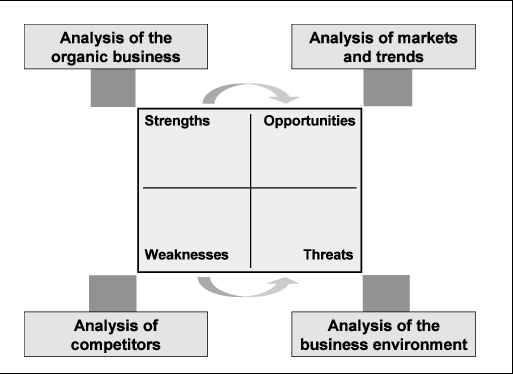
Let's break down each part:
-
Strengths (Internal): These are the positive attributes of your business. What do you do better than anyone else? This could be a unique skill, a strong brand reputation, proprietary technology, or a talented team. These are the advantages you have working for you from the inside.
-
Weaknesses (Internal): These are the areas where you're at a disadvantage. It’s important to be honest here. Do you lack capital? Is your team missing a key skill? Are your processes inefficient? Acknowledging weaknesses is the first step toward improving them.
Strengths and Weaknesses are about your company. They are the things you can build on or must improve.
-
Opportunities (External): These are factors in your environment that you could exploit to your advantage. Is there a growing market for your product? Have new regulations created a gap you can fill? Are there new technologies you can use? Opportunities are favorable winds you can catch to sail forward.
-
Threats (External): These are outside forces that could harm your business. What obstacles do you face? You might have new competitors, changing customer tastes, or negative economic trends. Identifying threats early helps you prepare for them.
How the Pieces Connect
A SWOT analysis isn't just about making four lists. The real power comes from seeing how the components interact. The goal is to develop strategies that match your strengths with opportunities, while also finding ways to convert weaknesses or guard against threats.
For example, you might ask:
- How can we use our team's expertise (a strength) to enter a new, underserved market (an opportunity)?
- How can we improve our marketing (a weakness) to defend against a new competitor (a threat)?
By asking these kinds of questions, a SWOT analysis moves from a simple description to a dynamic tool for making smart decisions. It provides the insight needed to build on what you do well, address what you lack, and carve out a successful path in the market.