SWOT Analysis for Business Ideas
Introduction to SWOT Analysis
A Framework for a Clear View
Before launching a new product, opening a coffee shop, or even making a big career move, it’s wise to look before you leap. Strategic planning is the process of setting goals and charting a course to reach them. One of the most popular tools for this is the SWOT analysis.
SWOT Analysis
noun
A strategic planning technique used to help a person or organization identify strengths, weaknesses, opportunities, and threats related to business competition or project planning.
Think of it as a structured brainstorming session that gives you a 360-degree view of your situation. It organizes your thinking into a simple four-quadrant grid, helping you see both the internal landscape of your venture and the external world it operates in.
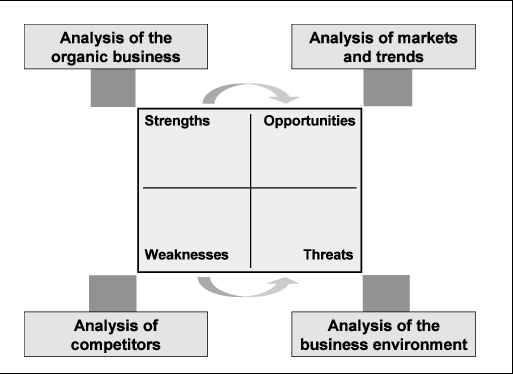
The four letters in SWOT stand for Strengths, Weaknesses, Opportunities, and Threats. The first two, Strengths and Weaknesses, are internal factors. These are things you have some control over, like your team's skills, your company's reputation, or the technology you own. The last two, Opportunities and Threats, are external. These are factors outside your business, such as market trends, new government regulations, or a competitor's latest move.
It's important to remember that the first two elements of a SWOT analysis, the S and W which represents strengths and weaknesses, refer to internal factors within your immediate control; while the O and T, which are your opportunities and threats, refer to factors outside of your control—external factors.
Here’s a simple way to break it down:
| Category | Factor | Description |
|---|---|---|
| Strengths | Internal, Helpful | What does your business do well? What unique resources do you have? |
| Weaknesses | Internal, Harmful | Where could you improve? What are you lacking? |
| Opportunities | External, Helpful | What market trends could you take advantage of? |
| Threats | External, Harmful | What obstacles do you face? What are your competitors doing? |
Why Bother with SWOT?
The main benefit of a SWOT analysis is clarity. It cuts through the noise and helps you see the most important factors affecting your business. By laying everything out, you can spot connections you might have otherwise missed. Maybe a strength can help you neutralize a threat, or an opportunity could help you overcome a weakness.
This framework isn't just for big corporations. A freelancer can use it to assess their career, a nonprofit can use it to plan a fundraiser, and a student can use it to tackle a big project. It provides a solid foundation for making smart decisions.
In the broader context of strategic planning, a SWOT analysis is often one of the first steps. The insights gained from it feed directly into creating goals and action plans. It ensures that your strategy is grounded in reality, not just wishful thinking.
From Analysis to Action
A SWOT analysis isn't just an academic exercise. Its purpose is to drive action. Once you’ve filled out the four quadrants, the next step is to think about how they interact.
This leads to developing strategies. For instance:
- Strength-Opportunity Strategies: How can you use your strengths to capitalize on opportunities?
- Weakness-Opportunity Strategies: How can you leverage opportunities to overcome your weaknesses?
- Strength-Threat Strategies: How can you use your strengths to minimize or avoid threats?
- Weakness-Threat Strategies: How can you address your weaknesses to make you less vulnerable to threats?
By matching internal factors with external ones, a simple grid becomes a powerful tool for crafting a path forward.
Ultimately, a SWOT analysis is a starting point. It provides the situational awareness needed to build a resilient and effective strategy for any venture.
Ready to test your understanding?
In a SWOT analysis, what do the letters S and W represent?
A new government regulation that could negatively impact your business's supply chain would be classified under which quadrant of a SWOT analysis?
By understanding these core components, you're equipped to start looking at any business or project with a more strategic eye.