Swell Dynamics and Coastal Engineering
Wave Fundamentals
How Waves Are Born
Most waves you see on the ocean are created by a simple transfer of energy. Wind blows across the surface of the water, and friction between the air and the water creates small ripples. If the wind keeps blowing, these ripples catch more wind and grow larger, organizing into the familiar patterns we call waves.
The size of the waves depends on three things: how fast the wind is blowing, how long it blows, and the distance over which it blows (known as the fetch). A strong, sustained wind over a large expanse of open ocean can generate enormous waves.
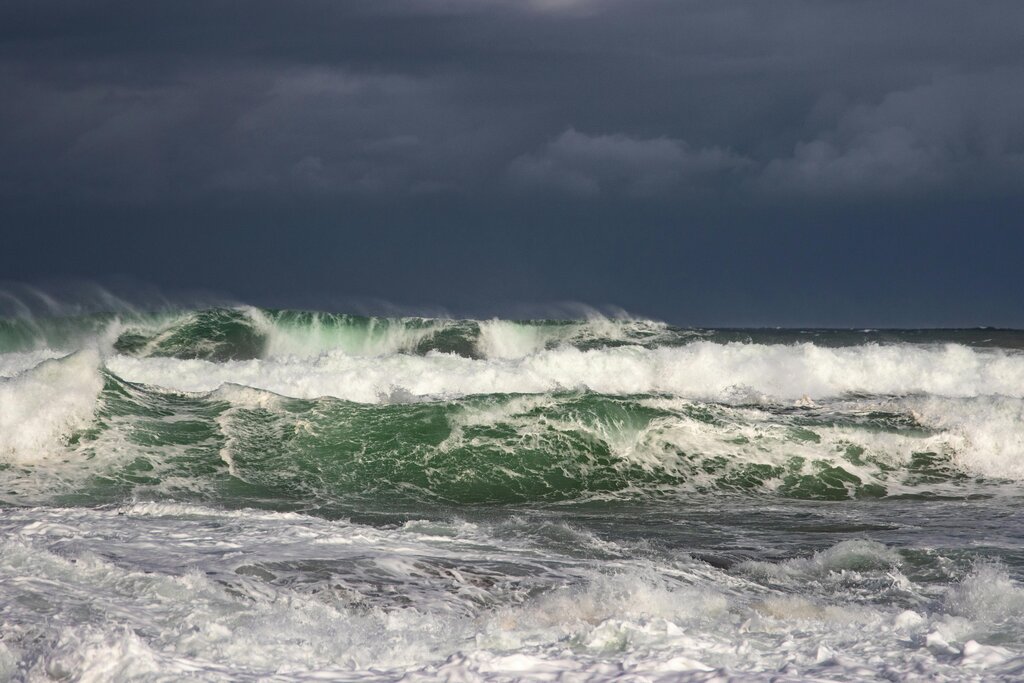
Once a wave is created, it can travel thousands of miles across the ocean. This movement is called wave propagation. It’s important to understand that the wave itself is energy moving through the water, not the water moving across the ocean. A water molecule in a wave mostly just moves up and down in a circular orbit. Think of a stadium wave: the people stand up and sit down, but they don't run around the stadium. The wave of motion travels, but the people stay in their seats. Ocean waves work in much the same way.
The Anatomy of a Wave
To talk about waves, we need a common language. Scientists use a few key measurements to describe any wave, from a tiny ripple to a massive swell.
Let's break these terms down:
Wave Height (): The vertical distance from the trough (the lowest part of the wave) to the crest (the highest part). This is what we often think of as the wave's "size."
Wavelength (): The horizontal distance between two consecutive crests or two consecutive troughs. This tells you how spread out the waves are.
Wave Period (): The time it takes for two successive crests to pass a fixed point. If you were in a boat, it's the time you'd wait between one wave lifting you up and the next one doing the same. It's measured in seconds.
Speed and Relationship
Wave speed, or celerity (), is how fast the wave energy is moving across the water. It's not the same as the speed of the water particles themselves. Wave speed is directly related to wavelength and period.
The relationship is simple: wave speed is the wavelength divided by the wave period.
This equation makes intuitive sense. If waves are very long (large ) or have a very short period (small ), they are moving quickly. A long, rolling swell from a distant storm has a large wavelength and period, and it travels across the ocean at high speed. As waves approach the shore, their characteristics change, but these fundamental parameters are what define them in the open ocean.
What is the primary cause of most waves seen on the ocean's surface?
Which of the following is NOT a primary factor in determining the size of waves generated in the open ocean?