Sutayta al Mahamli and the Mathematics of Wealth
Algebra in Baghdad
Baghdad's Intellectual Crucible
In the 10th century, Baghdad was the world’s center of gravity for science, philosophy, and mathematics. Scholars from across the known world gathered in its libraries and courts. In this bustling intellectual environment, Sutayta al-Mahamli emerged not just as a participant, but as a formidable innovator. She was a jurist and a mathematician, seeing the deep connections between the two fields.
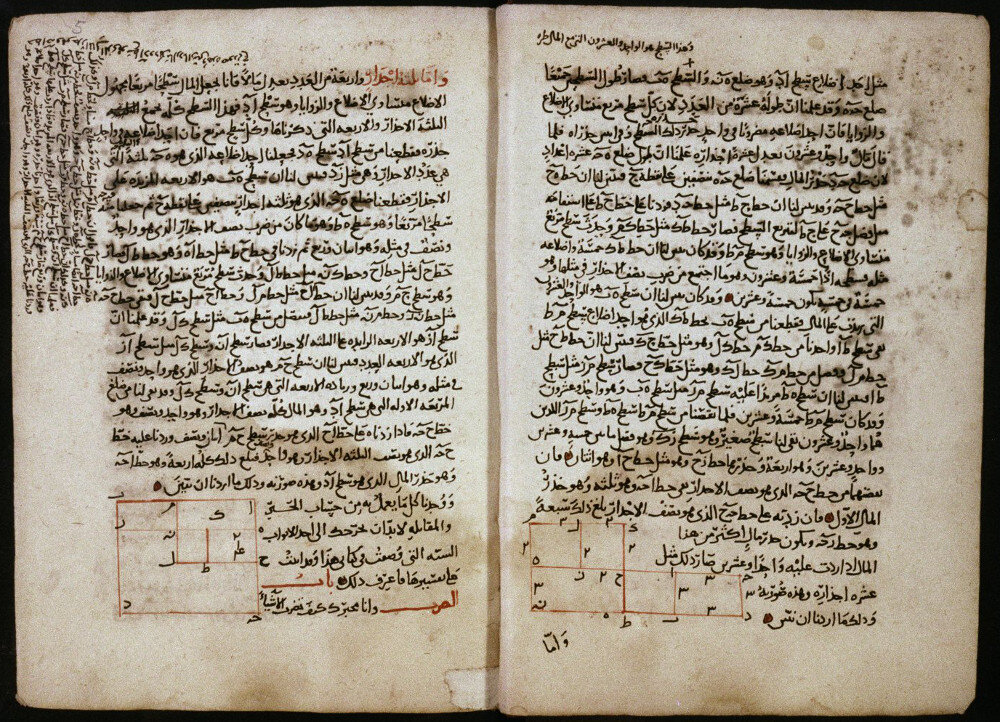
Sutayta's work didn't arise from a vacuum. She built upon the foundations laid by 9th-century polymath Muhammad ibn Musa , whose text Hisab al-Jabr w’al-Muqabala gave us the word "algebra." But where al-Khwarizmi focused on methods for solving specific types of equations, Sutayta saw a broader application. She recognized that the complex rules of Islamic inheritance law, known as fara'id, could be modeled as a complete system of equations.
She shifted the perspective from solving individual inheritance problems to creating a generalized algebraic framework for any inheritance scenario.
The Mufti-Mathematician
Sutayta was a , an Islamic legal scholar who issues authoritative legal opinions, or fatwas. This role required a deep understanding of jurisprudence. Her distinction was that her legal rulings on inheritance were not just based on legal precedent; they were mathematically irrefutable. She approached the 'science of quotas' (Ilm al-Fara’id) as a mathematician would, ensuring that the distribution of an estate was both just according to law and precisely calculated.
This represented a logical extension of al-Khwarizmi's work. By framing inheritance as a system of linear equations, she moved beyond rote calculation and into abstract algebraic modeling. Each heir's share was a variable, and the total estate was the constant. Her solutions were not just numbers, but formulas that could be adapted to different family structures.
| Approach | Al-Khwarizmi | Sutayta al-Mahamli |
|---|---|---|
| Focus | Solving specific equation types | Modeling systemic relationships |
| Application | Case-by-case problem solving | General formulas for estate law |
| Innovation | Foundational algebraic methods | Abstracting legal rules into equations |
The Science of Quotas
Islamic inheritance law specifies fixed shares for relatives. For example, a wife might receive 1/8th of the estate if there are children, while daughters collectively receive 2/3rds. When multiple heirs are involved, the calculations can become complex, especially if the shares sum to more or less than the total estate.
Sutayta treated these shares as variables in a system. By setting up the relationships algebraically, she could systematically solve for each person's portion of the estate, no matter how complicated the family structure.
Sutayta's contributions highlight a crucial moment in the history of mathematics. She demonstrated that algebra was more than a tool for solving abstract puzzles; it was a powerful language for modeling and resolving complex, real-world social and legal systems.
What two fields did Sutayta al-Mahamli notably combine in her work?
How did Sutayta al-Mahamli's work represent a logical extension of al-Khwarizmi's contributions to algebra?