Supply Chain Strategy and Optimization
SCOR Model Integration
A Framework for Your Supply Chain
Managing a supply chain without a common language is like trying to build a house with multiple sets of conflicting blueprints. Different departments—procurement, manufacturing, logistics—often speak their own dialects, leading to friction and inefficiency. The Supply Chain Operations Reference (SCOR) model provides a standardized framework to get everyone on the same page. It’s a tool for describing, measuring, and improving supply chain performance.
Instead of reinventing the wheel, SCOR provides a set of standard processes and metrics. This allows you to visualize your entire supply chain as a series of interconnected activities, benchmark its performance against industry standards, and identify exactly where to focus your improvement efforts. It's not a rigid set of rules but a flexible guide that helps you map out your existing processes and design more effective future ones.
The Six Core Processes
The SCOR model is built around six primary management processes. These aren't just siloed functions; they are interlocking gears that drive the entire supply chain engine.
1. Plan: This process is about aligning supply chain strategy with the overall business plan. It involves forecasting demand, assessing supply resources, and making high-level decisions about everything from inventory levels to distribution networks. Think of it as the brain of the operation, determining how to balance demand and supply to meet financial goals.
2. Source: Here, you manage the procurement of goods and services needed to create your product. This includes selecting suppliers, scheduling deliveries, receiving and inspecting materials, and authorizing supplier payments. Effective sourcing ensures you have the right materials, on time, and at the right cost.
3. Make: This covers all activities that transform raw materials into a finished product. It encompasses everything from assembling and manufacturing to testing and packaging. The goal is to produce according to demand in the most efficient way possible.
4. Deliver: This process manages all aspects of order fulfillment. That includes taking customer orders, managing warehousing, picking and packing products, and coordinating transportation to the final destination. It's the face of your supply chain to the customer.
5. Return: Not everything goes according to plan. The return process handles the reverse flow of goods. This could be due to warranty claims, product defects, or incorrect shipments. It includes customer support, receiving returned goods, and determining their disposition—whether that’s repair, recycling, or disposal.
6. Enable: This is the support structure that holds the other five processes together. It involves managing business rules, performance, data and information, assets, and compliance. Without robust Enable processes, the rest of the supply chain would struggle to function cohesively.
From Processes to Performance
Describing your processes is only half the battle. To improve, you need to measure. The SCOR framework defines five core performance attributes, each tied to specific high-level metrics. These attributes help translate operational actions into strategic outcomes, allowing you to benchmark your performance against competitors or internal goals.
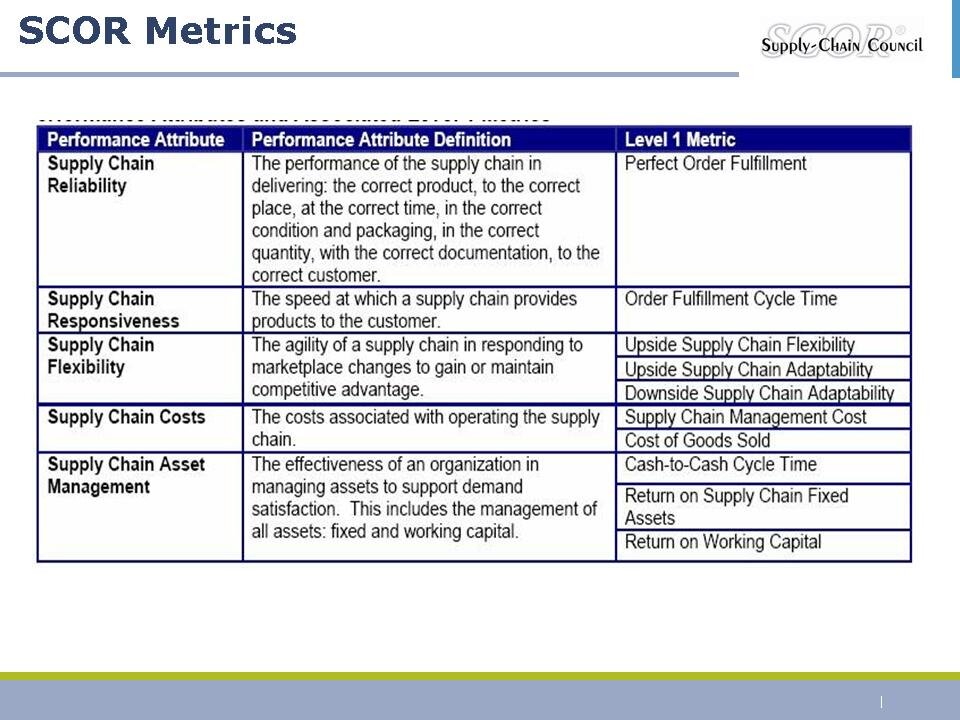
These five attributes give you a balanced view of your supply chain's health.
- Reliability: How consistently do you fulfill customer orders perfectly?
- Responsiveness: How quickly can you deliver an order to a customer?
- Agility: How well can you handle unexpected changes in demand or supply?
- Cost: What is the total cost associated with running your supply chain?
- Asset Management Efficiency: How effectively are you using your assets (like inventory and facilities) to support the supply chain?
Aligning Functions and Finding Gaps
The true power of the SCOR model is its ability to create cross-functional alignment. A low score in Reliability isn't just a logistics problem. It could stem from poor forecasting in the Plan phase, unreliable suppliers in the Source phase, or production delays in the Make phase. By using a common set of metrics, different departments can see how their actions impact the entire chain.
This shared perspective is crucial for strategic gap analysis. You start by mapping your current-state processes and measuring their performance using SCOR metrics. Then, you compare those numbers against industry benchmarks or your own strategic targets. The difference is your performance gap.
For example, if your Order Fulfillment Cycle Time (a Responsiveness metric) is ten days while your top competitor's is five, you have a clear gap. Using the model's hierarchy, you can drill down. Is the delay in order processing? Warehousing? Or transportation?
The lets you trace that high-level gap back to a specific, fixable root cause. This transforms the conversation from finger-pointing between departments to collaborative problem-solving, guided by a shared roadmap for improvement.
By applying this framework, you move from simply executing tasks to strategically managing your entire supply chain as a single, cohesive system.